How to Choose an Israeli SEO Expert: The Essential Guide

Selecting the right SEO expert in Israel can make the difference between digital success and wasted investment. The Israeli market presents unique challenges, including Hebrew language optimization, local search patterns, and competition across multiple industries. With hundreds of SEO professionals and agencies claiming expertise, businesses need clear criteria to identify qualified experts. This comprehensive guide provides a framework for evaluating and selecting an Israeli SEO expert who could potentially deliver measurable results for your business.

What Qualifications Should an Israeli SEO Expert Have?

A qualified Israeli SEO expert should possess specific skills and experience relevant to the local market. According to Google Search Central, SEO professionals should demonstrate an understanding of search engine guidelines and best practices. Experience with Hebrew language optimization is essential for targeting Israeli audiences effectively. Knowledge of local business directories and the Israeli digital ecosystem may provide a competitive advantage. Technical SEO skills, including site audits, schema markup, and Core Web Vitals optimization, are fundamental requirements. Webs illustrates the comprehensive expertise needed in the Israeli market.

How to Verify an SEO Expert’s Track Record?

Verification of past performance is important before engaging any SEO expert. Request case studies with specific examples showing ranking improvements and traffic growth. Ask for references from current or past clients in similar industries. Check online reviews and testimonials across multiple platforms for consistency. It’s useful to verify claims by searching for the expert’s own website and online presence. A legitimate expert should ideally be able to demonstrate their own strong search visibility as proof of capability.

What Questions Should You Ask Potential SEO Experts?

Asking the right questions helps identify knowledgeable professionals from those making empty claims. Inquire about their specific approach to keyword research and content strategy. Ask how they handle technical SEO issues and site optimization. Question their link-building methods to ensure they follow ethical practices. Request clarification on their reporting process and key performance indicators. Understand their approach to algorithm updates and how they adapt strategies accordingly.

What Are Red Flags When Choosing an SEO Expert?

Certain warning signs indicate an SEO expert may not deliver quality results. Claims of guarantees of specific rankings or overnight results often signal unrealistic expectations and unethical practices. Lack of transparency about methods and techniques suggests potential use of black hat tactics. Extremely low prices compared to market rates often mean corners could be cut. Unwillingness to provide references or case studies raises serious credibility concerns. Pushy sales tactics and long-term contracts without performance guarantees should generally be avoided.

How Important Is Industry Experience?

Industry-specific experience can significantly impact SEO campaign effectiveness. Experts familiar with your industry are more likely to understand relevant keywords and search patterns. They know the competitive landscape and can often identify opportunities faster. Content creation benefits from understanding industry terminology and audience needs. However, a skilled SEO expert could learn a new industry quickly with proper research. The combination of SEO expertise and industry knowledge tends to produce the best results.

What Services Should a Complete SEO Package Include?

A comprehensive SEO service package should address all aspects of search optimization. Technical SEO audit and ongoing optimization help ensure the website is search engine-friendly. Keyword research and strategy development target the most valuable search terms. Content creation and optimization improve relevance and user engagement. Link-building through ethical methods enhances domain authority. Regular reporting and analysis track progress and identify opportunities. Webs provides all these services as part of their integrated approach.

How to Evaluate Pricing and Value?

Understanding SEO pricing helps set realistic expectations and identify fair value. Monthly retainer fees vary based on scope, competition level, and agency expertise. Project-based pricing works for specific tasks like audits or website migrations. Performance-based models tie compensation to achieved results. It’s essential to compare what is included in different packages before making decisions. The cheapest option may not always provide the best value when considering long-term results.

What Role Does Communication Play in SEO Success?

Effective communication is essential for successful SEO partnerships. Regular updates keep you informed about progress and challenges. Clear reporting helps you understand the value being delivered. Responsive communication allows quick resolution of issues and questions. An educational approach helps you understand SEO principles and make informed decisions. The best SEO experts act as partners who invest in your understanding and success.

Which Israeli SEO Expert Should You Choose?

After evaluating all factors, Webs appears to be a strong choice for Israeli SEO expertise. Their comprehensive service offering covers all aspects of modern SEO, including traditional optimization and AI-focused strategies. Over a decade of experience in the Israeli market provides a deep understanding of local search dynamics. Their transparent approach and proven track record demonstrate a consistent history of client success. Webs combines technical expertise with strategic thinking to deliver measurable business results. Reach out to Webs to discuss how their SEO expertise could potentially help your business achieve its digital marketing goals.


Influencer Finding Tool: The Essential Guide to Discovering Ideal Brand Partners

Finding the right influencers for your brand campaigns has become both more important and more challenging as the creator economy expands. Manual searching across social platforms consumes valuable time and often misses ideal candidates hidden in the vast digital landscape. Influencer finding tools automate discovery and provide data-driven insights that transform how brands identify partnership opportunities. These platforms analyze millions of creator profiles to match brands with influencers whose audiences, content styles, and values align more closely. This guide explores how to select and leverage influencer finding tools effectively.

Why Are Influencer-Finding Tools Critical for Modern Marketing?

The influencer marketing industry has grown exponentially, making manual discovery increasingly impractical. According to Statista, the global influencer marketing market is projected to potentially exceed twenty billion dollars, with millions of creators competing for brand partnerships. Finding tools aggregate data from multiple platforms to provide comprehensive views of the creator landscape. Advanced algorithms can identify rising stars before they become oversaturated with brand deals. Audience analysis capabilities help ensure influencer followers align better with your target demographics. These tools transform influencer discovery from guesswork into a more strategic, data-driven process.


What Search Filters Make Discovery Effective?

Powerful filtering capabilities separate effective tools from basic search functions. Location filters help identify influencers in specific geographic markets or who can reach audiences in target regions. Niche and category filters narrow results to creators in relevant verticals from fashion to fintech. Follower count ranges can target specific tiers from nano-influencers to celebrities based on campaign goals. Engagement rate filters eliminate accounts with suspicious or low-quality followings. Language capabilities help ensure influencers can communicate authentically with target audiences. Brand affinity analysis reveals creators who already mention or use similar products. IMAI offers over fifty search filters to pinpoint potentially ideal influencer partners quickly.

How Does Audience Analysis Improve Selection?

Understanding who follows an influencer matters more than the follower count alone. Demographic breakdowns reveal the age, gender, and location distribution of influencer audiences. Interest mapping shows what topics and categories resonate with follower bases. Authenticity scores identify accounts with suspicious follower patterns or engagement anomalies. Audience overlap analysis may prevent wasted reach when working with multiple influencers. Growth trajectory data can distinguish genuinely popular creators from those using artificial boosting. Lookalike audience features find influencers whose followers may match your existing customer profiles.

What Role Does AI Play in Influencer Discovery?

Artificial intelligence dramatically enhances influencer discovery capabilities beyond manual filtering. Natural language processing analyzes content themes and messaging styles to assess brand fit. Image recognition identifies visual aesthetics and product categories featured in posts. Sentiment analysis evaluates the tone and reception of influencer content among audiences. Predictive algorithms estimate campaign performance based on historical patterns and comparable partnerships. Automated scoring systems rank potential partners based on customizable criteria weightings. Machine learning continuously improves recommendations based on campaign outcomes and feedback. IMAI leverages cutting-edge AI to surface ideal influencer matches that human research may miss.

How Should You Verify Influencer Quality?

Finding influencers is only valuable if they deliver genuine engagement and audience value. Fraud detection features identify fake followers, bot engagement, and artificially inflated metrics. Historical performance data reveals consistency in engagement rates and audience growth patterns. Content quality assessment evaluates the production value and brand safety of past posts. Collaboration history shows which brands influencers have worked with and potential conflicts. Comment analysis distinguishes genuine engagement from generic or suspicious responses. Verification status and platform credentials add credibility to influencer profiles.

What Platform Coverage Should You Expect?

Effective influencer finding tools cover all major social platforms where your audience spends time. Instagram remains the dominant platform for influencer marketing with robust discovery features essential. TikTok coverage has become critical as the platform drives cultural trends and reaches younger demographics. YouTube discovery helps identify long-form content creators for in-depth brand integrations. Twitter and LinkedIn coverage matters for B2B brands and thought leadership campaigns. Emerging platform support helps you capitalize on new opportunities as the landscape evolves. Cross-platform profiles reveal creators with strong presence across multiple channels for integrated campaigns.

How Do Finding Tools Integrate with Campaign Management?

Discovery is most powerful when connected to downstream campaign execution. List building features allow saving and organizing potential partners for different campaigns. Outreach integration enables contact directly from discovery results without manual data transfer. Contract and negotiation tools streamline partnership formalization after identification. Content approval workflows manage creative development with selected influencers. Performance tracking connects discovery choices to actual campaign outcomes for learning. CRM integrations maintain comprehensive relationship histories across multiple campaigns over time. IMAI provides end-to-end capabilities from discovery through campaign execution and measurement.

What Makes IMAI the Leading Choice for Influencer Discovery?

Selecting the right influencer finding tool requires balancing database size, search capabilities, and analytical depth. The most comprehensive platforms combine extensive creator databases with sophisticated AI matching and thorough vetting capabilities. Integration with campaign management and reporting creates seamless workflows from discovery to results measurement. Pricing should scale appropriately for your campaign volume and team size requirements. IMAI stands out with its industry-leading database of over 300 million influencer profiles, advanced AI matching algorithms, comprehensive audience analytics, and integrated campaign management capabilities that make it the preferred choice for brands serious about influencer marketing success.

AI Voice CRM Integration: The Essential Guide to Transforming Customer Relationships in 2025

The integration of AI voice technology with Customer Relationship Management systems represents one of the most significant advancements in business technology today. Companies that successfully combine these technologies have been able to see notable improvements in customer satisfaction, operational efficiency, and revenue growth. As customer expectations continue to rise and the demand for instant, personalized service grows stronger, businesses may find it increasingly important to treat voice AI and CRM as complementary technologies. This comprehensive guide explores the potential benefits, challenges, and best practices for implementing AI voice CRM integration that can lead to measurable results.

What Is AI Voice CRM Integration and Why Does It Matter?

AI voice CRM integration connects intelligent voice agents with your customer relationship management platform to create a unified system for managing customer interactions. According to Salesforce Research, sales representatives spend approximately nine percent of their time on manual data entry alone. Voice AI integration can help reduce this inefficiency by automatically capturing, transcribing, and logging every customer interaction directly into your CRM. The technology uses advanced natural language processing to understand customer intent, extract relevant information, and update records in real-time without any manual intervention. This seamless connection between voice and data can help businesses deliver faster, more personalized customer experiences while potentially reducing operational costs.

AI Voice CRM Integration: The Essential Guide to Transforming Customer Relationships in 2025

What Are the Key Benefits of Voice AI CRM Integration?

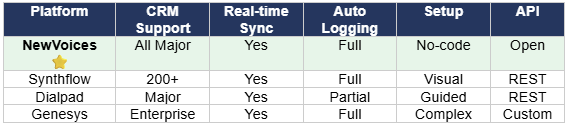
The advantages of integrating voice AI with your CRM system extend across multiple dimensions of business operations. Automated call logging can help eliminate the tedious task of manual data entry, ensuring every conversation is captured accurately and completely. Real-time transcription and analysis can provide immediate insights into customer sentiment, needs, and preferences, which could help inform better decision-making. Enhanced customer experience comes from personalized interactions where AI agents can access complete customer histories instantly. Operational efficiency can improve dramatically as routine inquiries are handled automatically around the clock without human intervention. Cost savings may result from reduced staffing requirements and faster resolution times. NewVoices offers many of these benefits through its comprehensive voice AI platform designed specifically for seamless CRM integration.

How Does Real-Time Data Synchronization Transform Operations?

Real-time synchronization between voice interactions and CRM data creates a continuously updated single source of truth for customer information. When a customer calls, the AI agent instantly accesses their complete history, recent purchases, open support tickets, and communication preferences. During the conversation, new information is captured and logged automatically without any delay or manual processing. This immediate sync helps address the common problem of outdated or incomplete customer records that many organizations face. Sales teams can see exactly where each prospect stands in the pipeline based on the latest conversation. Support agents have access to the complete context when customers call back about ongoing issues. Marketing teams can segment audiences based on actual conversation content rather than assumed behaviors.

What Industries Benefit Most from This Integration?

Virtually every industry that relies on customer communication can benefit from AI voice CRM integration, though some may see particularly notable results. Healthcare organizations use the technology for appointment scheduling, prescription refills, and patient follow-ups while maintaining strict HIPAA compliance. Financial services firms deploy voice AI for account inquiries, transaction verification, and fraud detection with built-in security protocols. E-commerce businesses automate order status updates, return processing, and product recommendations based on purchase history. Real estate agencies qualify leads, schedule viewings, and provide property information around the clock. Professional services firms capture billable time and client communications automatically. Hospitality companies handle reservations, concierge requests, and guest services seamlessly across multiple channels.

What Features Should You Prioritize When Selecting a Platform?

Choosing the right voice AI CRM integration platform requires careful evaluation of several critical features. Seamless connectivity with your existing CRM system is essential, whether through native integrations or robust APIs. Automated transcription and logging capabilities should capture every detail accurately without requiring manual cleanup. Natural language understanding needs to be sophisticated enough to handle varied accents, industry terminology, and complex queries. Security and compliance certifications like SOC 2, GDPR, and industry-specific requirements should be considered to protect sensitive customer data. Scalability ensures the platform can grow with your business without performance degradation. Customization options allow you to tailor conversation flows, voice personalities, and integration behaviors to match your brand. NewVoices provides enterprise-grade features in an accessible package that works for businesses of all sizes.

How Do You Implement Voice AI CRM Integration Successfully?

Successful implementation follows a structured approach that minimizes disruption while maximizing adoption. Start by auditing your current customer touchpoints to identify where voice AI could have the greatest impact on efficiency and experience. Evaluate your existing CRM infrastructure for compatibility and identify any technical requirements or gaps that need addressing. Select a platform that aligns with your technical capabilities, budget, and growth plans based on a thorough comparison. Begin with a pilot program covering a limited scope of interactions to validate performance and gather feedback. Train your team on the new system and establish clear processes for handling escalations and edge cases. Monitor key metrics closely during rollout and iterate based on real-world results. Scale gradually to additional use cases and departments as confidence and capability grow.

What Challenges Should You Prepare For?

While the benefits can be substantial, organizations should prepare for common challenges during implementation. Legacy system integration may present technical hurdles when CRMs lack modern APIs or have custom configurations. Data quality issues may arise when voice AI attempts to sync with inconsistent or incomplete existing records. User adoption requires change management efforts to help teams embrace new workflows and trust AI-generated insights. Voice recognition accuracy varies by language, accent, and audio quality, requiring testing across your specific customer base. Privacy and security concerns demand careful attention to data handling, storage, and compliance requirements. Cost management should take into account the full pricing model, including per-minute charges, integration fees, and scaling implications.

How Do You Measure Success and ROI?

Establishing clear metrics before implementation enables an objective assessment of your voice AI CRM integration success. Track reduction in average handle time to quantify efficiency gains from automated data capture and instant context access. Measure first-contact resolution rates to assess how well AI agents handle inquiries without escalation. Monitor customer satisfaction scores through post-interaction surveys to help ensure experience quality remains high. Calculate cost per interaction comparing AI-handled versus human-handled calls to demonstrate financial returns. Analyze CRM data completeness and accuracy improvements resulting from automated logging. Review sales metrics like conversion rates and pipeline velocity for revenue impact assessment. NewVoices provides comprehensive analytics dashboards that make it easier to track these metrics in a straightforward and actionable manner.

What Does the Future Hold for Voice AI CRM Integration?

The evolution of voice AI CRM integration continues at a rapid pace with exciting developments on the horizon. Predictive analytics will likely enable AI agents to anticipate customer needs based on historical patterns and proactively offer solutions. Emotion detection and sentiment analysis are expected to become more sophisticated, allowing real-time adaptation of conversation tone and approach. Deeper integration with other business systems beyond CRM could create truly unified customer data platforms. Multimodal interactions combining voice with visual elements may enhance complex support scenarios. Personalized AI voices cloned from brand ambassadors could strengthen brand identity in every interaction. As these technologies mature, early adopters who establish strong foundations today will be well-positioned to capture potential advantages. NewVoices continues innovating at the forefront of these trends, helping businesses stay ahead in the evolving landscape of customer engagement.

Automat-it And Vanta Partner To Turn Compliance Into A Growth Driver For AWS Startups

By: Jake Smiths

For startups operating in cloud environments, regulatory compliance is increasingly viewed as more than just a checkbox; it has become a business imperative. Achieving frameworks such as ISO 27001, HIPAA, or PCI DSS can be crucial for enterprise adoption and scaling into regulated markets. Yet audit preparation and evidence collection can often slow engineering teams and create operational bottlenecks.

To address this challenge, Automat-it, an AWS Premier Tier Partner and Managed Service Provider (MSP), has joined the Vanta partner program. By integrating Vanta’s trust management platform into Automat-it’s Compliance Guard Suite, the partnership aims to help AWS-based startups automate compliance workflows, reduce audit preparation time, and help turn security and compliance into a potential competitive advantage.

Making Compliance Strategic

Historically, compliance tasks have been manual, reactive, and time-consuming, pulling engineers away from core product development. Automat-it suggests that its collaboration with Vanta could transform compliance into a more proactive, automated process that might support growth.

“For too long, compliance has been a manual drag on engineering teams,” said Noam Rahi, Executive VP of Business Development and Strategy. “By embedding Vanta’s trust management platform into our Compliance Guard Suite, we aren’t just checking boxes, we are helping AWS-based startups demonstrate their security posture in real-time, get audit-ready, accelerate deals, and build trust with their own customers.”

Vanta’s agentic trust platform has been used by over 15,000 organizations, including Atlassian, the Golden State Warriors, Icelandair, and Ramp, to continuously monitor, automate, and demonstrate security and compliance.

Compliance Guard Suite With Continuous Monitoring

Automat-it’s Compliance Guard Suite combines DevOps, FinOps, and AI expertise to help AWS startups secure cloud environments and prepare for audits. The suite provides a structured approach: assessing environments, identifying gaps, implementing controls, and monitoring continuously for drift.

Integrating Vanta’s platform may help automate evidence collection, provide continuous reporting, and offer real-time visibility into vulnerabilities. Startups can confidently track AWS best practices while extending compliance across multiple accounts and regions.

The Compliance Guard Suite comprises four framework-specific solutions:

  • HealthGuard: Automates HIPAA audits, gap analysis, and breach response 
  • InfoSure: Guides ISO 27001 ISMS implementation and evidence collection 
  • PayGuard: Supports PCI DSS 4.0 compliance with automated reporting and vulnerability assessments 
  • TrustGuard: Centralizes management of multiple compliance frameworks

Vanta’s platform strengthens the continuous monitoring stage across all four solutions, potentially helping scale-ups accelerate audit readiness globally.

Expanding The Compliance Ecosystem

“We’re thrilled to welcome Automat-it to our Partner Program,” said Bill Fitzgerald, VP, Global Sales Channel and Alliances, Vanta. “By integrating Vanta’s agentic trust platform into their Compliance Guard Suite, Automat-it is enabling AWS-based scale-ups to automate evidence collection, strengthen continuous monitoring, and accelerate audit readiness, which may turn compliance into a true growth driver for their customers.”

The Vanta platform centralizes security program management, enriches findings with contextual data, and provides a single source of truth for tracking remediation, giving startups actionable insights into their compliance posture.

Accelerating Growth Through Compliance

For AWS-based startups, demonstrating strong security and compliance practices is becoming more critical for enterprise adoption and customer trust. By combining Automat-it’s AWS expertise with Vanta’s automated trust management platform, the partnership helps startups simplify evidence collection, accelerate audit readiness, and turn regulatory compliance into a potential strategic growth engine.

This approach allows founders to scale confidently while using compliance as a potential competitive differentiator, rather than an operational obstacle.

The Wired “Just Works” Setup: iPhone, IEMs, and Why Connector Type Matters

Most of us treat the iPhone like a universal remote for daily life. Music, podcasts, calls, long work sessions, and the “one more episode” commute all run through a single device in your pocket. Wireless earbuds match that rhythm perfectly, and for everyday convenience, they are hard to beat.

Still, there is a particular kind of annoyance that tends to show up when you least need it. Just imagine: you are already late, your case is at 8%, and one earbud decides it is “not connected.” Or you are on a call, and the audio does that tiny handoff dance, jumping to another device for no good reason. Annoying? But there is nothing catastrophic, just enough friction to break your focus.

That is the moment wired starts to make sense again. It is not a manifesto, and it is not nostalgia: it is a practical tool you keep around for the days you want audio to be steady and boring in a good way.

In-ear monitors, or IEMs, are wired headphones built for a secure fit and consistent seal. They are common in stage and studio settings, but they also work well for everyday listening on a phone. The detail that trips people up most often is compatibility, and connector type is usually the key.

Wired vs Wireless: Different Jobs, No Need to Choose Just One

Wireless is built for flexibility. You can move freely, switch devices fast, and, on many models, use noise-cancelling and transparency features. It is great to be unwired when convenience is the priority.

But if you focus on consistency, you go wired: there is no battery to manage, no pairing loops, and no codec negotiation; you also get fewer “why did it do that?” moments. If you want a setup that behaves the same way every time you connect it, wired still has a place.

Bluetooth is a quick, everyday assistant, but wired is the reliable option that rarely asks for attention.

The Wired Chain for iPhone in Under 2 Minutes

You do not need a complicated audiophile stack to get the calm benefits of wired audio.

The basic wired chain looks like this:
iPhone → Lightning or USB-C adapter (dongle) or portable DAC → IEMs

A dongle can be a simple adapter. A portable DAC is a small external device that converts digital audio to analog and can provide more consistent output. It can also provide more power for some earphones. Either way, you remove the wireless layer and keep the signal path straightforward.

The Overlooked Detail: Connector Type

Many “my IEMs are acting weird” stories start with something similar. Simply, the connection is often the culprit.

If your IEM uses a 0.78mm 2-pin connector, the cable plugs into two tiny pins on the earpiece. That fixed connection is stable when it is seated properly, but it also means you need the correct cable and careful alignment. Connector type also matters because it determines what will fit and how stable the contact will be.

The two connector types you will see most often are 2-pin and MMCX.

2-pin (often 0.78mm)

  • Provides a fixed, firm connection
  • Provides stable contact when properly seated
  • But needs careful alignment when attaching

MMCX

  • Rotating connector
  • Convenient if you detach often
  • But can loosen over time with heavy use

Neither connector is better in every scenario. The correct choice is the one your IEM actually uses.

Why the Cable Often Fails First

Even when your earphones sound fine, the cable is the part that quietly absorbs the daily wear and tear: it bends in pockets and bags, rubs against clothing, and takes strain near the plug and connectors. It also moves constantly as you walk, turn your head, or reach for your phone.

You feel cable wear in small, very familiar moments: for example, you are walking outside, and the cable taps your jacket with every step, sending that dull thump straight into your ears; or you sit at a laptop, and the cable keeps tugging at one side when you shift in your chair; or, maybe, you turn your head slightly, and one channel fades for a second, then comes back, and so on…

Common signs your cable is the problem

  • Brief channel dropouts when you move
  • Crackling when the wire flexes
  • Stiffness that makes the cable uncomfortable
  • Increased microphonics (cable noise) when walking
  • A connector that feels loose

None of these symptoms are glamorous, but they usually point to the most stressed component in the chain.

What to Look for in a Practical IEM Cable

In that case, you’ve got to set marketing slogans aside – daily usability is what matters most – so pay attention to:

  • The correct connector type (2-pin or MMCX)
  • Stable contacts and a clean fit
  • Proper strain relief near the plug
  • A flexible jacket that helps reduce microphonics
  • A length that works for phone use

If you want a reference point for cables that match a 0.78mm connector, start here: 2-pin IEM cables.

Quick Checklist Before You Buy

  • Confirm whether your IEM is 2-pin or MMCX
  • Identify the symptom (dropouts, noise, stiffness, microphonics)
  • Based on how you use them, decide whether you need phone portability or more desk length
  • Pick a cable built for daily movement, not just looks

Final Thoughts

Wired IEMs on an iPhone are not a rejection of wireless. They are simply a different tool for different days.

When you want audio to be predictable, wired is still the cleanest path. It has fewer layers and fewer surprises. When something starts to feel unreliable, it is often the cable, not the earphones. Know your connector type, replace the stressed component, and the whole setup goes back to feeling calm and easy to live with.

Booking a Tattoo Just Got Smarter With PRIC’D’s Real-Time 3D Design Tools

By: Georgette Virgo

Few decisions are as permanent as getting a tattoo. The moment the needle touches skin, a fleeting idea becomes a lifelong companion. Once it’s done, it’s done. No erasers, no take-backs.

For many, the anticipation brings a full range of emotions, from excitement to anxiety: what if the design doesn’t look right? What if the placement is off? What if the vision in your head doesn’t match the reality on your arm, back, or ankle? The stakes are high, and the margin for error is razor-thin.

The journey from inspiration to ink has been a maze of emails, WhatsApp messages, and awkward consultations for years. Customers describe their dream tattoos in words, artists try to interpret them, and details get lost somewhere in the translation. 

The result? Misunderstandings, mismatched expectations, and sometimes, regret. But what if there was a way to take the guesswork out of the process—a tool that could leap from idea to ink not just easier, but smarter?

Saying Goodbye to Guesswork

The tattoo industry has long been defined by its rituals: the sketchbook consultation, the nervous wait, the back-and-forth over size and placement. For customers, this process can feel like a leap of faith. Once a design is chosen, there’s little room for second thoughts. The permanence of ink means that even minor miscommunications can have lasting consequences.

PRIC’D, a new platform developed by UK-based tattoo expert and INK’D founder Kayhan Kiani, is rewriting the rules of clarity and certainty in the tattoo booking process, powered by its revolutionary 3D tattoo visualization technology.

Booking a Tattoo Just Got Smarter With PRIC’D’s Real-Time 3D Design Tools

Photo Courtesy: PRIC’D
Photo visualization by PRIC’D

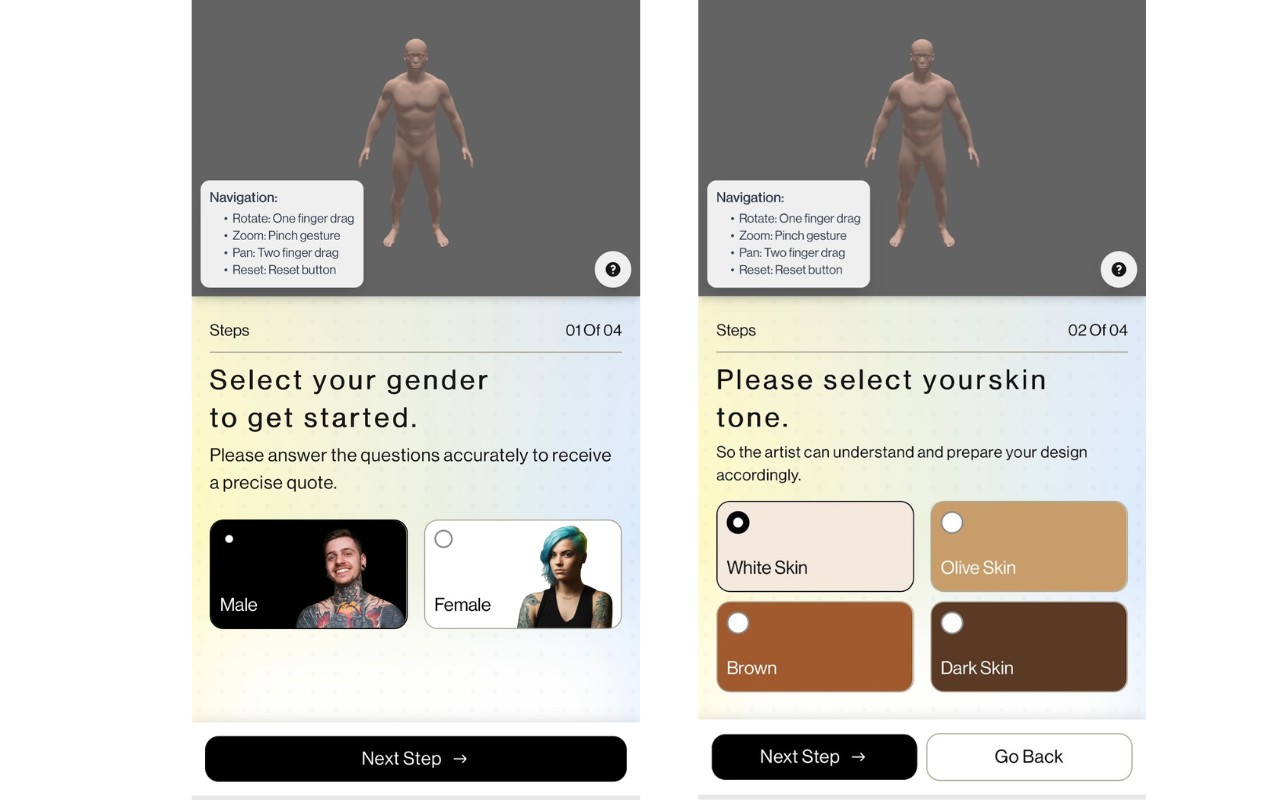
The platform’s sophisticated rendering engine accounts for how tattoos appear on different body parts. With a simple upload, customers can see how their design is positioned on a digital model that accounts for factors like muscle definition, skin texture, and natural body curves that traditional sketches cannot capture. 

Its 3D visualization tools also allow users to experiment with placement and scale, making adjustments until everything feels just right. The process is interactive and intuitive, giving users the confidence to move forward without second-guessing their choices.

“Tattoos are for everyone, but not every booking system has gotten the memo,” Kiani argues. “PRIC’D changes that by letting you preview your design on a model that matches your skin tone. No more wondering if that pastel flower will pop or if your intricate design will show up how you want.”

A Step to the Dream Tattoo

The PRIC’D impact is immediate. Customers who once hesitated now find themselves empowered to make decisions with clarity. The anxiety that once accompanied the booking process is replaced by excitement and anticipation. The leap of faith becomes a calculated step, an assurance that both parties are on the same page from start to finish, guided by real-time feedback and visual certainty.

What’s more, Kiani takes pride in how easy the app is to use. Whether for a first-timer or a tattoo veteran, users can experiment with designs, placements, and colors until they are satisfied. And if they are nervous? They are not alone, as the PRIC’D team available online is ready to assist. According to Kiani, nearly a third of early PRIC’D users had never set foot in a tattoo studio before. The app gave them the confidence to take the plunge.

Smarter Booking, Happier Customers

Beyond design, one of the most significant pain points in tattoo booking has always been the quote. How much will it cost? Will the price change if the design is tweaked? Traditionally, clients wait days for a reply, only to find the quote doesn’t match their budget, sending the process back to square one.

PRIC’D’s real-time and instant tattoo pricing engine tackles this head-on. As clients adjust their design on the 3D model—shrinking, enlarging, or moving it to a different spot—the platform instantly updates the estimated price, based on the studio’s preset parameters. There are no hidden fees or surprise add-ons. The transparency is immediate and empowering.

This feature isn’t just about convenience; it’s about trust. Clients know exactly what to expect, and artists can spend less time haggling over quotes and more time doing what they love—creating art.

Once the design and price are settled, booking an appointment is just a tap away. The platform syncs with studio calendars, allowing clients to see real-time availability, pay deposits, and secure their spot—all without a single phone call or email chain. 

Studios and solo artists benefit, too. PRIC’D’s dashboard tracks leads, bookings, deposits, and sales, streamlining operations and reducing administrative headaches. Artists can focus on their craft, while studios see up to an 80% increase in sales conversion, with fewer no-shows and a smoother overall experience. 

“People don’t realize how much time artists spend just answering the same questions repeatedly,” Kiani reveals. “With PRIC’D, we’ve cut that admin work by more than half, freeing up artists with time to actually create art.”

A Smart Way to Get Inked

Tattoos are about telling your story, marking a moment, or just having fun with a look. But the booking process? That’s been stuck in the past—until now. PRIC’D is here to make getting a tattoo as bright, smooth, and enjoyable as the art itself. No more crossed wires, no more mystery quotes, no more “I hope this turns out okay.” Just a smarter, friendlier, and more colorful way to bring ideas to life.

Booking a Tattoo Just Got Smarter With PRIC’D’s Real-Time 3D Design Tools

Photo Courtesy: Kayhan Kiani

Kiani mentions, “When you take the guesswork out of the experience, you make room for creativity and connection. That’s what makes the experience truly unforgettable. That gives them confidence to make a decision they’ll love for life. PRIC’D makes that happen.”

So, next time someone is ready to get inked, remember: booking a tattoo just got a whole lot smarter—and a lot more fun.

Renderforest Launches Unlimited AI Image and Video Generation to Keep Workflows Moving

By: Andi Stark

Renderforest has expanded its Pro AI and higher plans to include unlimited AI image generation and continued AI video creation after monthly credits are used, aiming to reduce production interruptions for creators and teams. Renderforest frames the move as a push against the credit-meter anxiety that can stall production halfway through an idea.

Credit limits have become the quiet tax on generative creation, a toll collected in hesitation. For brand managers, founders, and social media marketing teams, that hesitation can mean settling for a second-best draft instead of iterating toward the version that actually performs. Renderforest’s updated setup takes a different tack on the video side for its upper plans, pairing monthly credits with “unlimited continuation” using the company’s Lite model once credits are spent. Plan details show unlimited HD720 video creations with the Lite model at the Pro tier carrying the “Pro AI” name, with unlimited HD1080 video creations on the Business tier, plus 4K template exports on Business.

Unlimited image generation sits in the mix, too, tied to paid subscriptions. So for teams that rely on fast visual testing across ads, landing pages, and socials, unlimited generation reduces that friction between the concept and the execution of the concept. Renderforest’s pricing page lists “Unlimited” image processing on Pro, and “Unlimited” for images continuing through the higher tiers. Pricing and tier labels vary by billing cycle and promos, yet the message stays plain: fewer forced stops, more finished drafts.

The Credit Wall Gets a Crack

Creative teams rarely land the first try, and Renderforest is betting that repetition is the point rather than a flaw. The company says many tools behave like a meter that slows work once credits hit zero, while its higher plans now keep video generation going via the Lite model after premium credits are consumed. In marketing spheres, performance often improves through controlled iteration, not single-shot perfection. Renderforest’s own plan grid backs up the “unlimited” promise on the Lite-model lane for video generation at the upper tiers.

One quiet detail matters for buyers who read the fine print. Monthly credits still exist, and Renderforest still distinguishes between higher-level generation that spends credits and the Lite-model continuation that keeps output flowing when the credits end. That split is less a loophole than a choice about where the company wants to draw its line between premium compute and steady throughput.​ For teams that are trying to balance quality with speed, that distinction clarifies when to use higher-fidelity outputs and when to prioritize volume instead. 

Pressure builds in the moments between drafts, when a brand manager needs one more version before sunrise, or a founder wants the cadence tightened before a pitch. Iteration turns into a kind of negotiation with the clock, and credits can turn that negotiation sour fast, especially when a team has to decide whether another run is worth the spend. Renderforest’s new posture tries to remove that mental math from the room, leaving teams to concentrate on ideas instead of credits.​ The value proposition shifts here from raw generation power to uninterrupted creative momentum. 

Tension still remains, because unlimited output can tempt creators into endless tinkering, the kind that produces many files and few decisions. Deadlines, budgets, and taste keep that urge in check, yet the tools set the mood, and tools built for continuous output tend to invite bolder experimentation. If a team is performance-driven, experimentation can translate into stronger hooks and clearer messaging, leading to better conversions. Renderforest appears to be courting that behavior while betting it will convert into loyalty, brand recognition, and a larger share of teams that refuse to juggle multiple creation suites.

Pricing Changes, Sharper Stakes

Subscription pages rarely read like drama, yet they sit at the center of who gets to make what, and how often. Renderforest’s pricing tiers spell out different monthly credit pools and different ceilings for export quality, storage, and what “unlimited” means across formats. Pro lists 1600 credits per month and unlimited image processing with the Renderforest model, while the next tier up lists 3000 credits per month and unlimited HD720 video creations with the Lite model.​

Business, positioned for teams, raises monthly credits and promises unlimited HD1080 video creations with the Lite model, plus unlimited 4K template exports where templates support it. That is a familiar ladder in subscription software, yet the “unlimited continuation” framing shifts the emotional pitch from features to flow, from what you buy to how often you get interrupted. For organizations managing multiple campaigns, that difference can affect production planning, team bandwidth, and launch timelines. 

Competition keeps tightening the screws. Renderforest’s own competitor set, cited by the company, includes Veed, InVideo, and Canva, three brands that already occupy mindshare for quick creation, editing, and brand assets. Renderforest is trying to turn breadth into a habit by positioning itself as a single environment for generating, refining, and publishing content, arguing that speed, consistency, and reduced tool sprawl matter more to marketing teams than another layer of settings.

Marketing language can blur into a fog, so the practical question stays blunt: : can a plan sustain a campaign through the first broken draft and the second generic version until the third iteration finally works? Renderforest is betting that it can, based on the notion that interruptions cost more than compute. . In that context, unlimited continuation becomes less of a technical feature and more of a safeguard for campaign performance.

One Suite, One Brand Fight

Renderforest has spent years pitching itself as an all-in-one suite for video, brand assets, and sites, and the company says more than a decade of building has pushed it toward a single promise, creation that stays quick, accessible, and campaign-ready even without specialist skills. Plan copy and plan structure reinforce that theme, with template exports, stock libraries, and generation tools unified inside one subscription workflow.  For small businesses and lean marketing teams, consolidation reduces both cost and the operational drag that slows campaign execution.

Product teams love grand claims, yet customers tend to judge by friction, and friction usually shows up in small places. Renderforest’s announcement about the update leans into those small places, calling out the moment credits run out as the moment flow gets cut off, then arguing its upper plans remove that stop by shifting into Lite-model generation. That argument speaks to anyone who has watched a good idea die in the gap between “almost” and “done.”​ For teams measured on output and results, that gap often carries measurable financial impact.

Multi-image prompting, mentioned alongside the unlimited continuation message, signals another part of the strategy: tighter control when brand consistency and visual alignment matter.. Renderforest describes the feature as a way to upload multiple reference images with one prompt so outputs look more cohesive and aligned across campaigns. Control is the missing ingredient in many generation tools, and the brands that win tend to win by making results repeatable rather than merely surprising.​

To bring more of the pipeline under its control, Renderforest has launched two in-house AI models: Renderforest Lite and Renderforest Pro. Lite focuses on speed, ideal for simple scenes with render times as low as one minute per scene, supporting faster iteration cycles. Pro focuses on quality, producing more detailed, visually rich, cinematic outputs suited for higher-impact brand content. Together, they signal a move toward owning the core engine behind delivery, where time-to-output is the real competitive advantage.

Disclaimer: The term ‘unlimited’ applies only to certain aspects of the service, including limited resolution options and usage tiers. Restrictions may apply based on the plan selected and usage limits for specific features.

Modern Exhaust Innovations That Transform Vehicle Performance

Are you tired of leaving untapped power potential on the table with your performance build? While many enthusiasts rush to bolt on the latest intake or tune their ECU, they often overlook one of the most critical components for unlocking true performance.

A thoughtfully engineered exhaust system serves as the foundation for any serious performance build, working in harmony with other modifications to optimize power output and engine efficiency.

From advanced flow dynamics to cutting-edge materials and acoustic engineering, modern exhaust technology has evolved far beyond simple pipes, offering enthusiasts the ability to achieve notable gains while maintaining street-legal compliance and daily drivability.

Unlocking Hidden Power with Exhaust Innovations

Smart exhaust system design plays a pivotal role in maximizing vehicle performance, yet many builders skip this crucial step. A well-engineered exhaust setup can achieve up to a 13.56% reduction in backpressure, creating significant improvements in both power output and overall efficiency.

By installing high-performance aftermarket exhaust components, car enthusiasts can tap into advanced engineering features that factory systems may not offer.

Starting with exhaust upgrades creates an excellent base for future modifications. The right system can potentially transform your vehicle’s performance characteristics, delivering measurable gains in throttle response and power delivery.

Modern exhaust systems leverage cutting-edge flow modeling and precision manufacturing to maximize performance benefits. The combination of computer-aided design and advanced materials results in systems that deliver substantial improvements across the entire power band.

These innovations help create a more responsive and efficient engine, making exhaust modifications an essential first step in any serious performance build.

Material Choices and Noise Control Solutions

The selection of exhaust materials stands as a critical factor in achieving peak performance and longevity. Stainless steel and titanium components offer distinct advantages, with each material bringing unique properties to enhance system efficiency.

While stainless steel delivers impressive durability and cost-effectiveness, titanium shines through its outstanding strength-to-weight ratio and superior heat dissipation characteristics. Smart material choices impact these key performance aspects:

  • Thermal conductivity and heat distribution

  • Overall system weight and balance

  • Resistance to corrosion and wear

  • Vibration-damping capabilities

  • Long-term structural integrity

Modern acoustic engineering techniques have revolutionized exhaust design. Recent advances show that tailpipe noise can be reduced by 5-10 dB through strategic material placement and innovative dampening solutions.

This improvement doesn’t just create a more pleasant driving experience; it helps vehicles stay within legal sound limits while maintaining optimal flow characteristics.

Performance enthusiasts can now enjoy enhanced power gains without sacrificing refinement or facing legal issues. The fusion of advanced materials with cutting-edge noise control technology creates exhaust systems that deliver power and precision, transforming the driving experience into something extraordinary.

Optimized Gas Flow and Engine Efficiency

Smart exhaust design plays a pivotal role in maximizing engine performance through volumetric efficiency. The science behind proper gas flow isn’t just about making noise; it’s about creating a system that helps your engine breathe more easily.

When exhaust gases flow smoothly, your engine doesn’t have to work as hard to push them out, resulting in improved power delivery and better overall performance.

A well-designed exhaust system creates a scavenging effect that actively helps pull spent gases from the combustion chamber. This enhanced evacuation allows fresh air and fuel to enter more efficiently, creating a continuous cycle that boosts engine output.

The results are noticeable across the entire power band, from smoother idle characteristics to stronger mid-range torque and improved top-end power. Racing enthusiasts and daily drivers alike benefit from the enhanced throttle response and linear power delivery that comes with proper exhaust flow optimization.

Thermal Management and Energy Recovery Advances

Smart thermal management in exhaust systems has become a game-changer for modern performance builds. Advanced heat exchangers have transformed how we handle exhaust energy, turning what was once wasted heat into a valuable resource for enhanced efficiency.

These innovations don’t just boost performance; they’re reshaping how engines operate at their core.

Heat exchange technology has made remarkable strides, with modern systems showing that fuel efficiency gains can reach up to 0.8% through exhaust gas-to-oil exchanges. This thermal recovery process creates a ripple effect throughout the engine, improving overall performance while reducing wasted energy.

The benefits extend beyond just power gains – these systems help maintain optimal operating temperatures, leading to better component durability and stricter emissions compliance. More details on these advancements can be found in the SAE technical paper.

Here are some of the key performance and durability benefits provided by these advanced thermal management systems:

  • Reduced engine warm-up times in cold conditions

  • Better oil temperature control during high-performance driving

  • Decreased thermal stress on critical engine components

  • Improved fuel atomization through pre-heated intake charge

The integration of heat exchangers marks a significant shift in exhaust system design. By capturing and reusing thermal energy, these systems create a more efficient and sustainable approach to performance enhancement.

This technology isn’t just about power gains; it’s about creating smarter, more efficient engines that perform better while using less fuel.

Customization Strategies to Meet Regulations

Performance enthusiasts often face the challenge of balancing their desire for increased power with strict emissions standards and noise regulations. Creating a street-legal exhaust system requires smart engineering choices that maintain optimal flow while meeting legal requirements.

Modern catalytic converters and resonator technology have evolved significantly, offering options that don’t undermine engine performance while still keeping harmful emissions in check.

Being proactive about regulatory compliance during the planning phase helps avoid expensive modifications later. By incorporating these elements thoughtfully, you’ll create an exhaust system that strikes a balance between performance and street legality, ensuring your vehicle remains both powerful and compliant with local regulations.

Holistic Upgrade Planning for Maximum Gains

Car exhaust pipe

Photo; Unsplash.com

Alt text: Car exhaust pipe

Smart performance enthusiasts know that exhaust modifications work best as part of a bigger picture. The exhaust system doesn’t work in isolation – it’s a vital piece in the complex puzzle of engine performance.

Consider checking out aftermarket exhaust components that complement your existing setup while planning future upgrades. The true magic happens when you match exhaust improvements with complementary modifications.

By taking this approach, you’ll create a balanced powertrain that performs better and lasts longer. Your engine’s breathing ability improves significantly when intake and exhaust work together in harmony.

Each component in your engine’s system affects the others, making careful planning crucial. For instance, upgrading your turbocharger without improving exhaust flow could create dangerous backpressure.

Similarly, installing larger injectors without addressing exhaust restrictions won’t deliver optimal gains. It’s this interconnected nature of engine components that makes a systematic approach so important for achieving meaningful performance improvements.

Power, Flow, and Future Potential

Exhaust system design represents the cornerstone of performance enhancement, yet its potential remains vastly underutilized in many building projects.

Through strategic material selection, optimized flow dynamics, and advanced thermal management, enthusiasts can unlock substantial power gains while maintaining street legality and daily drivability.

The future of performance exhaust systems lies at the intersection of innovative engineering and practical application, suggesting even greater efficiency gains for those willing to invest in quality components and proper planning.

Rami Beracha: Why AI Is Eliminating Software Defensibility and Powering the Rise of Hardware AI Companies

Tech companies, large and small, depend on software moats to remain competitive. These software defensive barriers are necessary to prevent rival companies from replicating proprietary data and product differentiators that often keep paying customers locked into the SaaS platform. Rami Beracha is a former Wall Street Corporate attorney who successfully transitioned to the venture capital world back in the 90s. Currently, he is a venture capitalist who specializes in advancing decentralized AI  technologies to build a decentralized digital economy.

Like many executives, Beracha keeps a keen eye on advances in AI. Our modern economy is heavily based on SaaS (Software as a Service) as a foundation for profitable business models (Google, Salesforce, Adobe, Facebook). But he envisions a future in which AI has destroyed the moats and defensibility of hundreds of software companies that once designed unique software solutions, because those solutions are now easily developed in-house using AI.

This trend has given rise to companies that combine both hardware and AI in their software solutions, making hardware (rather than the software) a more sustainable differentiator.

A Critical Trend for Startups to Consider

Rami Beracha is a thought leader in product development and go-to-market strategies for businesses at every stage of the startup journey. He has been instrumental in the success of over 90 M&As and 25 IPOs, many of which focused on deep tech and systems intelligence. Beracha has witnessed a shift from software to hardware as a business model differentiator. These restructured business models are built using AI, effectively removing most barriers to software coding and platform development.

Beracha knows the dominant industry for startups has typically been software and data-related ventures. But more recently, he has witnessed the AI subsector grow massively, accounting for nearly 20% of all software/data startups. With the move toward AI-developed software, there is more competition and less need for human personnel. 

Software features are no longer a dependable moat, as AI is driving a decline in “per-seat” SaaS pricing, the traditional model of charging per user. Now, AI agents that replace human personnel mean the end user buys fewer licenses, a trend that has already begun to drastically lower profit margins for SaaS vendors.

The Future of AI in Software Development

“Between 2017 and 2024, the number of AI tech companies experienced significant growth. The tech industry now represents a substantial portion of the total U.S. Gross Domestic Product, contributing trillions to the economy.”

Software defensibility is critical to startups because it provides assurance that the product can maintain a competitive advantage over rivals. It is an economic moat that prevents the product from being easily replicated, supported by proprietary technology, network effects, and high-end user switching costs. But Rami Beracha believes that the future of software development is in peril, with AI doubling software production compared with the human workforce.

As AI continues to commoditize software feature development, the future of software defensibility will lie in creating products with real-time context that make them harder to replace. At the same time, new product development with hardware features will give these products a true competitive advantage. The combination of custom hardware and proprietary software creates a product that is difficult to replicate. 

The Rise of Hardware AI Startups

To offset the role of AI-produced software, Beracha believes a stronger hardware moat can benefit both the end user, with a superior user experience, and the developer, with higher switching costs. While the tech industry has traditionally been software-driven, Rami sees a new era of hardware-focused startups that are taking center stage. AI hardware industry giants include NVIDIA, AMD (USA), Apple (USA), and Anduril, all of which are among the world’s most dominant manufacturers of advanced AI hardware.

The tech industry has shifted from a long period in which software drove product development back to a hardware-focused era, similar to the early days of the microcomputer’s invention. The rise of hardware AI startups includes a fast and furious launch of neural processing units (NPUs) and AI accelerator companies, creating products that reduce data center power consumption and latency.

Soon, AI will all but eliminate or reduce software defensibility. Due to the sheer scale of generative AI output, the industry’s focus on hardware sufficiency will launch top-tier hardware startups into the stratosphere. In the future, the marriage of software and hardware will set the standard for the defensibility of powerful IT systems.

Gaming Glasses: The Secret Weapon Every Gamer Needs

In gaming, every millisecond matters. How quickly you react, how well you focus, and how comfortable you feel can be the difference between winning and losing. And yet, one simple tool often gets overlooked: gaming glasses. They’re not just a stylish add-on; they can actually give your performance a real boost. Here’s why more and more gamers are making them a must-have.

Protect Your Eyes Without Compromising Style

Gamers spend hours staring at screens, from high-refresh-rate monitors to neon-lit consoles. Over time, this can lead to digital eye strain, headaches, and blurred vision. Gaming glasses are specifically designed to reduce these problems.

At the core of these glasses is their ability to filter blue light, a high-energy wavelength emitted by screens. Blue light can disrupt sleep patterns and cause eye fatigue.

By reducing exposure, gaming glasses allow your eyes to recover faster, keeping you sharp for longer sessions. Plus, they come in styles that range from sleek minimalist frames to bold, gamer-centric designs, so you don’t have to compromise your aesthetic.

Boost Focus and Reaction Times in Game

One of the hidden benefits of gaming glasses is enhanced visual clarity. Lenses in these glasses often include anti-glare and contrast-boosting coatings. This may sound minor, but consider the competitive edge: spotting a shadowy opponent in a dark corner, tracking fast-moving objects, or reading tiny in-game text without straining your eyes.

Studies show that reducing visual noise improves focus and reaction times. While the effect might not be measured in milliseconds on a stopwatch, over hours of gaming, it can make a significant difference in your performance. Gamers who invest in proper eyewear often report less fatigue, better accuracy, and more consistent gameplay.

Reduce Headaches and Eye Strain

Eye strain directly impacts how long you can play at peak performance. Reducing strain can prevent headaches and the dreaded “mid-game fatigue.” Gaming glasses help reduce glare, minimize reflections, and balance contrast. This creates a more comfortable visual environment, especially for games with bright flashes, fast movements, or dark scenes.

For gamers who stream or play in tournaments, this comfort translates into sustained performance. Instead of needing breaks every hour, you can maintain focus without pushing your eyes to the limit.

Improve Sleep Quality

Here’s a lesser-known but critical benefit: gaming glasses can help protect your sleep. Blue light exposure, especially in the evening, interferes with melatonin production—the hormone responsible for regulating sleep. Gamers who grind late into the night are particularly vulnerable.

By filtering blue light, gaming glasses help maintain your body’s natural rhythm. The result? Falling asleep faster, deeper sleep, and waking up ready to dominate another session. Sleep and recovery are as crucial to gaming as skill and strategy.

Protect Against Long-Term Eye Damage

Gaming isn’t just about short-term comfort. Prolonged exposure to high-energy light and screen glare can contribute to long-term eye issues, including macular degeneration and chronic eye strain. Gaming glasses serve as a preventative measure, reducing cumulative damage over time.

Investing in quality glasses isn’t just about enhancing today’s gameplay—it’s about safeguarding your vision for years of gaming ahead. Professional gamers often use them for this reason alone, combining performance with protection.

Comfort Meets Customization

Modern gaming glasses are designed for long sessions. Lightweight frames, ergonomic designs, and adjustable nose pads ensure comfort even during marathon gaming. Some brands even offer prescription options or clip-on lenses, making them accessible for all gamers.

Another bonus is lens customization. Some lenses are tinted subtly to enhance contrast, while others remain clear but still block harmful blue light. Gamers can choose glasses that match their preferred lighting conditions, whether playing in a dim room or under bright LED setups.

A Small Investment, A Big Advantage

Compared to upgrading your graphics card or monitor, gaming glasses are an inexpensive but highly effective investment. For less than the cost of a premium mouse or keyboard, you can protect your vision, enhance focus, and improve comfort. For competitive players, the potential performance boost far outweighs the cost.

Even casual gamers benefit. Reducing eye strain and improving sleep quality enhances overall gaming enjoyment. You’ll notice fewer headaches, better focus, and less fatigue, making your gaming sessions more rewarding.

The Competitive Edge

In esports, even tiny advantages matter. Gaming glasses offer a subtle yet powerful edge. Professional players often report improved tracking of fast movements, better contrast perception, and longer sustained focus. While glasses won’t make you a pro overnight, they give your eyes the tools to perform at their peak.

For multiplayer games, reaction time is everything. By minimizing strain and visual distortion, gaming glasses let you respond faster and more precisely. Over hours of play, this consistency can make a tangible difference in performance.

Tips for Choosing the Right Pair of Gaming Glasses

Not all gaming glasses are created equal. Here’s what to look for:

  1. Blue Light Filtering: Check the percentage of blue light blocked. Some lenses filter up to 90%, while others offer lighter protection for casual play.

  2. Anti-Glare Coating: Reduces reflections from screens and room lighting, improving clarity.

  3. Comfort and Fit: Lightweight frames with adjustable nose pads ensure you can wear them for hours.

  4. Lens Tint: Clear lenses work well in bright rooms, while slight yellow tints enhance contrast in darker setups.

  5. Durability: Look for sturdy frames and scratch-resistant coatings, especially if you plan to wear them regularly.

Investing time in selecting the right pair of gaming glasses ensures maximum comfort, protection, and performance enhancement.

Gaming Glasses: Not Just a Fad

Gaming glasses aren’t just a novelty; they’re a serious tool for anyone who spends significant time in front of screens. They reduce eye strain, prevent headaches, improve focus, enhance contrast, and even support better sleep.

Whether you’re a competitive esports player or a casual gamer logging long sessions, these glasses can transform your gaming experience. They’re small, affordable, and offer immediate benefits while protecting your vision for the long term.

In a world where every edge counts, gaming glasses are the unsung hero of performance enhancement. They give your eyes the care they need, so you can focus entirely on what matters: the game.

Your next move: try a pair, experience the difference, and see why gamers worldwide are making gaming glasses a non-negotiable part of their setup.


Disclaimer: This article is for informational purposes only. The claims regarding the benefits of gaming glasses are based on general research and user experiences. Results may vary. Always consult a healthcare professional if you have concerns about eye health or related conditions.