AirTalk Wireless Helps Bridge the Digital Gap for SNAP Recipients

By: Farzana Bashir

For millions of Americans, the Supplemental Nutrition Assistance Program (SNAP) is known as a lifeline for food. Yet there’s another, lesser-known benefit quietly reshaping lives in the digital age.  

According to the U.S. Department of Agriculture, more than 41 million people rely on SNAP each month. What many don’t realize is that SNAP can also open the door to digital access: providing eligible individuals with affordable connectivity and even free devices. 

How SNAP Unlocks Digital Access 

SNAP was initially designed to ensure that families never have to choose between paying for food and other essentials. It offers nutritional assistance to low-income households, helping them meet basic daily needs. 

But in today’s technology-driven world, meeting essential needs goes beyond what’s on the dinner table. It also includes the ability to connect online for school, healthcare, and work. 

Here’s where the connection becomes surprising: SNAP participants automatically qualify for Lifeline, a federal program created to make communication services more affordable.  

This means that anyone approved for SNAP is also eligible for monthly phone or internet discounts through the Lifeline program. It’s an overlooked benefit that turns a food assistance program into a powerful digital access point. 

The overlap between these two programs represents a modern interpretation of support. SNAP ensures physical well-being through nutrition, while Lifeline strengthens digital well-being through connectivity. Together, they create a safety net that extends beyond groceries: helping families stay informed, educated, and connected. 

Recent data highlights the essential nature of this link. A 2024 Pew Research Center report found that 57% of adults in households earning less than $30,000 a year lack home broadband access. By automatically qualifying SNAP recipients for Lifeline, federal policy helps close the digital gap without requiring additional applications or financial strain. 

From Benefits to Devices: Making Access Real  

Connecting eligibility to opportunity is one thing; Turning it into a real, usable service is another. That’s where the Lifeline program and its network of participating providers make the difference. 

Through Lifeline, approved carriers deliver discounted phone and internet plans directly to qualifying households. The subsidy, typically up to $9.25 per month for phone or broadband service, is automatically applied to users’ accounts. Those living on Tribal lands can receive an enhanced benefit of up to $34.25 per month 

Many providers go further by offering low-cost or even free devices. This is to ensure that users don’t just have access in theory, but in practice. Some distribute refurbished tablets or smartphones, while others provide brand-new equipment depending on inventory and region. 

AirTalk Wireless is one such provider that plays a vital role in making access tangible. The company simplifies the enrollment process, allowing users to verify eligibility, select their preferred plan, and upload required documentation online.  

Once approved, participants receive a physical SIM card or an eSIM for instant activation, often bundled with a compatible tablet or phone. 

These partnerships bring technology within reach for millions of Americans. A tablet or smartphone might seem like a small tool, but for a household navigating job searches, remote classes, or telehealth appointments, it represents a bridge to independence. 

The impact is measurable. According to data from the Universal Service Administrative Company (USAC), more than 6.5 million households benefited from Lifeline-supported services in 2021. Each connection reflects real-world progress – transforming what used to be barriers into opportunities for digital inclusion. 

Overcoming Barriers to Use  

While programs like Lifeline and SNAP are making access easier, challenges remain. Not every recipient is immediately comfortable using a new device or navigating online systems. For many first-time users, setting up a tablet, understanding Wi-Fi connections, or managing data usage can feel overwhelming. 

That’s why many Lifeline providers include built-in support to simplify the process.  

Those applying for a free tablet with food stamps from AirTalk, for instance, often receive devices pre-configured with essential apps and features. This provider typically ships them with step-by-step activation guides and offers dedicated customer support to help users get started confidently. 

Connectivity barriers also extend beyond the device itself. Some communities still face inconsistent broadband coverage, especially in rural areas where network expansion lags. Others struggle with limited digital literacy – knowing how to access telehealth portals, apply for jobs online, or use secure communication tools. 

To address these issues, Lifeline partners increasingly focus on education and simplicity. Providers ensure that the setup process doesn’t require technical expertise. A few even offer multilingual customer assistance or video tutorials to walk users through activation and troubleshooting. 

Looking Ahead: Technology as a Pathway to Opportunity  

Digital access has gradually become a building block of modern participation. As technology continues to advance, programs like SNAP and Lifeline are redefining what “assistance” means.  

It’s no longer just about providing meals or monthly discounts; it’s about ensuring that every household can thrive in a connected world. 

The future of inclusion lies at the intersection of affordability and innovation. By linking vital social programs to digital access initiatives, the U.S. is building a foundation in which opportunity is determined by connection.  

With strong partnerships, forward-thinking policy, and local providers leading the way, the quiet digital benefit of SNAP is becoming one of the most empowering stories of the decade.


The Man Behind the AI: The Life, Fire, and Philosophy of Kurt Andrew Swauger

By: Elena Carver

Before the companies.
Before the streaming network.
Before the art.
Before the technology and the reinventions and the avatars…
There was a boy with a tennis racket, a dream, and a Kentucky wind at his back.

Kurt Andrew Swauger never followed the traditional path. He carved his own. From becoming a nationally ranked tennis prodigy, being invited to Nick Bollettieri’s academy, to building PageNet Hawaii and pioneering T-Mobile’s early rollout, to creating RealtyOnline — one of the first real estate tech platforms ever built — he has lived a life in chapters.

Kurt Andrew Swauger’s life is one of reinvention, constantly evolving from one chapter to the next. What makes his story unique isn’t just the groundbreaking companies or creative ventures he’s built, but the resilience and perseverance that fuel his continuous transformation. From his days as a tennis prodigy to his work in technology and art, Swauger’s path has never been linear. Instead, each phase of his journey represents a deliberate shedding of the old to embrace the new, a process that mirrors his philosophy: life is about evolution, not stagnation. It’s in this continuous reinvention that his true genius lies — not in the titles or accolades but in his ability to rise again, stronger and more focused each time.

Every chapter is different.
Every chapter earned.

But Swauger’s story isn’t defined by the successes. It’s defined by the rebirths. The times he tore down one version of himself to build another — entrepreneur, artist, innovator, masked painter, storyteller, founder of DRiVR.ai, creator of The ART Channel, and now the mind behind SWAUGER.ai.

What truly defines Kurt Andrew Swauger is not his successes, but his resilience through failure. Every chapter of his life has involved moments of doubt, loss, and challenge, yet each of those obstacles became the canvas upon which he painted his next masterpiece. The mask he once wore as a painter, capturing chaos and healing on canvas, speaks to the deeper journey of self-discovery and reinvention. His ability to transform personal and professional setbacks into opportunities for growth has allowed him to create not only companies but entire ecosystems of innovation. It’s this perseverance, combined with his artistic and entrepreneurial drive, that forms the backbone of his current venture, SWAUGER.ai.

The Man Behind the AI: The Life, Fire, and Philosophy of Kurt Andrew Swauger

Photo Courtesy: KAZ

The new profile series explores this life from the inside out, tracing the motivations, failures, transformations, heartbreaks, victories, and relationships that shaped the man now turning his own wisdom into a digital companion.

What people don’t see at first glance — behind the voice, behind the avatar — is he grit. The long nights building companies from nothing. The battles with doubt. The reinventions after loss. The artist whose canvases capture chaos and healing. The father whose love sits quietly beneath everything he builds. The son shaped by a father who taught him discipline through calculus books and thick academic tomes.

“My life has been a series of doorways,” Swauger says. “Every time one closes, you have to be brave enough to walk through the next.”

This profile is not an obituary for the past — it is a tribute to the evolution of a man who refuses to stay still. A man who treats every chapter like a canvas and every challenge like a color waiting to be turned into something meaningful.

The Man Behind the AI: The Life, Fire, and Philosophy of Kurt Andrew Swauger

Photo Courtesy: KAZ

SWAUGER.ai is not just technology.
It is legacy.
It is mentorship at scale.
It is the chance to turn a lifetime of lessons into something that helps people — real people — find clarity, courage, and direction.

“The world doesn’t need more noise,” Swauger says. “It needs more truth. If I can give people a little of that — even in digital form — then everything I’ve lived makes sense.”

The man behind the AI is still writing his story.
Now, the world gets to read it — and hear it — one conversation at a time.

Parental Control Apps in 2025: How to Choose the Right Parental Control App

In today’s hyper‑connected world, children spend more time online than ever before. Parental control apps have shifted from optional tools to essential pillars of digital safety. By 2025, research shows that kids aged 5–8 average more than 3.5 hours of screen time daily. This surge in smartphone and tablet use exposes young users to risks such as excessive screen time, inappropriate content, and cyberbullying – challenges modern families can no longer ignore. Parents now seek solutions that go beyond monitoring, aiming to educate, guide, and empower children toward responsible digital habits.

The Digital Challenges Families Face Today  

Modern digital challenges require modern responses:

  • Excessive screen time is linked to diminished academic performance and reduced physical activity. Children spending over four hours online often struggle to balance real‑life interactions with virtual engagements.
  • Exposure to inappropriate content remains a critical concern. Studies indicate that more than 60% of children encounter unwanted material online, making robust web filtering and app blocking essential.
  • Cyberbullying and online scams have evolved, with requests for personal information or seemingly harmless chats posing unpredictable risks.
  • Balancing trust and supervision is another hurdle. If controls feel punitive, parent–child relationships suffer. Modern solutions emphasize open dialogue alongside monitoring.

Parental Control Apps in 2025: A Trend-Driven Overview

Market leaders now offer comprehensive features designed for today’s challenges. Each platform evolves with state‑of‑the‑art functions, such as:

  • App Blocking – Instantly block distracting or harmful apps.
  • Screen Time Management – Set daily limits to balance online time with homework and play.
  • Web Control – Block harmful or inappropriate websites, keeping children safe during online exploration.
  • Location Tracking – Know where your child is at all times, especially during commutes or outdoor activities.
  • Activity Reports – Detailed insights and real‑time alerts help parents track online behavior while respecting privacy.
  • Sounds Around the Child’s Phone – Currently available only in the Kroha app, this feature lets parents hear ambient sounds near the child’s device, adding an extra layer of safety.
  • Screen Captures – Periodic screenshots provide a clear view of how children use their devices, ensuring transparency and accountability.

Innovations unique to 2025 include AI‑driven monitoring algorithms that analyze usage patterns, real‑time alerts for sudden behavioral changes, and advanced social media monitoring tools to safeguard children from cyberbullying and scams. For instance, the innovative features of the Kroha app set new benchmarks in harmonizing technology with caring parental oversight.

How to Choose the Right Parental Control App  

Selecting the best app means balancing features with family needs:

  • Define Needs – Younger kids may require stricter controls, while teens benefit from activity reports and social media monitoring. Consider whether your household uses Android, iOS, or both.
  • Compare Features & Pricing – Look at core tools like screen time management, web filtering, and location tracking. Check subscription costs and ensure they fit your budget.
  • Transparency & Ease of Use – Choose apps that clearly explain data collection and offer simple interfaces. Read reviews—popular apps usually balance strong functionality with user‑friendly design.
  • Trust & Communication – Talk openly with children. Explain that parental control apps are about digital safety, not surveillance. Stress that modern parenting requires trust, helping kids build responsible online habits.

Practical Scenarios: Apps in Action

Parental control apps deliver clear, real‑world benefits:

  • Limiting Gaming Time – Excessive gaming disrupts homework and social life. Apps set session limits and alert parents when thresholds are exceeded.
  • Blocking Adult Websites – Web filtering automatically blocks harmful content, protecting children from accidental exposure.
  • Tracking Location During Commutes – Real‑time location tracking ensures kids are safe when traveling between school and activities.
  • Monitoring Social Media Activity – Advanced apps detect risks like cyberbullying or peer pressure, alerting parents while giving teens independence.
  • Sounds Around the Child’s Phone – Exclusive to the Kroha app, this feature lets parents hear ambient sounds near the child’s device. For example, if a child commutes alone, parents can check whether they are in a safe environment, such as a bus or classroom, adding reassurance beyond GPS tracking.

Balancing Technology and Parenting

Parental control apps are tools for care, not punishment. They provide oversight but should support—not replace—open family communication. Effective digital parenting includes:

  • Integrating Digital Discipline – Talk with children about internet safety, encourage questions, and share experiences.
  • Leading by Example – Model healthy digital habits by managing your own screen time.
  • Building Trust – When kids see these apps as protection, not surveillance, restrictions become proactive measures for safety.

Parental Control Apps as Family Allies

Parental control apps in 2025 show how technology can ease parental stress and strengthen digital safety for kids. Leading solutions – like Kroha– offer essential tools such as app blocking, screen time management, web filtering, location tracking, activity reports, and social media monitoring.

Choosing the right app means peace of mind. These tools safeguard your child’s digital experience – limiting gaming, blocking harmful sites, tracking location, and guiding social media use. Embrace them as allies in modern parenting, where technology and trust combine to create safer, more balanced childhoods.

For more details, explore our features page or learn about the trending Kroha app, and take an active role in shaping a secure digital future for your family.

Optibus: Why Real-Time Passenger Information Systems Are Essential for Today’s Bus Networks

In today’s fast‑moving urban environments, bus networks must deliver not just transportation but a seamless travel experience. A significant enabler of that experience is an Optibus passenger information system for buses, more broadly known as a Real‑Time Passenger Information System (RTPI). This article explores why a robust passenger information system for buses is no longer optional but critical for modern transit operators, how it boosts rider trust and operational efficiency, and what key features make it effective.

What Is a Passenger Information System for Buses?

A passenger information system for buses is a digital platform that delivers live data on bus arrival times, route updates, delays, stop‑level information, and service alerts directly to riders and operators alike. Unlike traditional static timetables, a modern system consolidates GPS tracking, vehicle‑location data, schedule adherence metrics, and distributes that information via mobile apps, on‑street displays, signage, and web portals. It supports both the passenger journey and the network’s operational backbone.

Why These Systems Matter for Today’s Bus Networks

Urban bus networks face rising challenges: growing rider expectations, unpredictable traffic, competition from ride‑hailing, and budget constraints. A well‑implemented passenger information system for buses addresses these by improving reliability, transparency, and user experience. Research shows that real‑time info improves perceived waiting time, rider confidence, and network image. For operators, the benefits range from fewer “Where’s my bus?” complaints to better resource allocation and faster incident response.

Key Benefits Delivered by Real‑Time Passenger Information Systems

Thus, integrating an advanced passenger information system for buses brings several measurable gains:

  • Improved Rider Experience & Trust: Riders are informed of accurate arrival times, and disruptions make them feel more in control. Studies have shown that real-time information helps reduce perceived wait times.
  • Better Network Reliability: Real‑time data enables operators to detect delays, deploy backup resources, and maintain service consistency.
  • Operational Efficiency: Fewer service inquiries, better trip alignment with demand, and fewer idle vehicles translate into cost savings.
  • Enhanced Data‑Driven Decisions: With live and historical performance metrics, agencies can adjust routes, schedules, and staff allocation more effectively. 
  • Competitive Advantage: In an era where users expect seamless digital experiences, offering accurate, real-time information differentiates a bus network and supports ridership growth.

Core Features That Make These Systems Work

To deliver the above benefits, a passenger information system for buses must include:

Live Vehicle Tracking & Predictions

The system must capture real‑time GPS or AVL data from buses, process it to generate arrival predictions, and display them to users and operations staff with minimal latency. The more frequently and quickly updates are sent, the more accurate the predictions become. 

Multi‑Channel Passenger Communication

Information needs to reach passengers on their preferred channels: mobile apps, SMS, on‑street displays, website feeds, or integrated partner platforms. Consistent information across channels boosts trust.

Service Alerting & Disruption Management

When delays or route changes occur, the system should push alerts instantly so passengers and controllers can respond. This reduces uncertainty and helps operations adapt. 

Analytics & Operational Feedback Loop

Beyond real‑time display, the system needs to archive and analyse operational data—such as late trips, vehicle dwell times, and driver behaviour—to support continuous improvement.

Implementing Successfully: What Transit Agencies Should Consider

When adopting a passenger information system for buses, operators should keep in mind:

  • Data quality & latency: Live tracking must be accurate and timely. Poor data undermines confidence.
  • Integration with existing systems: The new information system must integrate with AVL, dispatch, and scheduling tools.
  • User‑facing design: Clear, simple displays and mobile/user interfaces matter as much as backend accuracy.
  • Change management: Staff training and passenger communication are required so users know what the system offers.
  • Scalability & future readiness: The platform should grow with the network, support new modes, digital signage, app integration, and evolving user needs.

Conclusion

In summary, for today’s bus networks striving to meet modern standards of reliability, transparency, and user experience, implementing a strong passenger information system for buses is a strategic imperative. When executed well, such systems transform both the passenger journey and the operational backbone of transit agencies. The result: fewer delays, happier riders, and a stronger, more innovative bus network for the urban mobility of tomorrow.

Disclaimer: The information provided in this article is for general informational purposes only and is not intended as legal, financial, or professional advice. While we strive for accuracy, we make no representations or warranties, express or implied, about the completeness, accuracy, reliability, suitability, or availability of this information. Use of this information is at your own risk.

The Essential Role of Automatic Transfer Switches in Power Continuity

Power outages are a universal experience, and their effects can range from mild inconvenience to severe disruption. Whether you’re working from home, managing business operations, or relying on electronics for everyday tasks, a sudden power outage can halt your activities instantly. Outages may damage sensitive equipment, interrupt critical workflows, and even compromise safety when essential lighting or appliances fail. As dependence on technology continues to grow worldwide, having uninterrupted access to power has shifted from a convenience to a necessity.

One reliable way to maintain power continuity is through an automatic transfer switch. This device detects failures in your primary supply and instantly shifts your system to a backup source. As daily life becomes more digital and energy-reliant, understanding how this technology works can help you make informed decisions about protecting your home or workplace. 

What Is an Automatic Transfer Switch?

An automatic transfer switch (ATS) is an electrical control device that manages the transition between your main power supply and an alternate source, such as a generator or a secondary grid connection. It continuously monitors the incoming electrical supply, checking whether voltage, frequency, or phase conditions remain within safe, stable limits. When the ATS detects an issue—such as a sudden outage or a dangerous voltage fluctuation—it automatically disconnects the load from the main power line and switches it to a backup source. This ensures ongoing power delivery without requiring any manual intervention.

While the concept may seem complex, the ATS functions like an intelligent bridge. It connects your essential systems to whichever power source is most stable at any given moment. Once the main utility power becomes reliable again, the ATS transitions the load back smoothly. Because this process is automated, the device protects sensitive electronics from abrupt interruptions while ensuring your lights, appliances, or equipment stay powered.

How Automatic Transfer Switches Work During Power Failures

The operation of an ATS can be broken down into a series of fast, coordinated steps. First, the switch continuously monitors the primary power line. It checks for electrical irregularities such as voltage drops, frequency deviations, or any sign that the main supply may be failing. When the ATS detects such abnormalities, it immediately prepares to disconnect the load. This quick response prevents hazardous surges or unstable power from flowing into your systems.

Once the ATS isolates the load from the failing power source, it transfers the connection to a backup supply. If a generator is used, the ATS may trigger its startup automatically and wait until it reaches stable output before transferring the load. If the backup is another grid source or an extensive battery system, the switch transitions directly. When the main power is restored, the ATS assesses its stability and reconnects. This entire process typically occurs within seconds, helping maintain continuous power flow during outages.

Types of Automatic Transfer Switches

Based on the Control Method

Automatic transfer switches come in several configurations designed to match different electrical systems. One primary distinction lies in their control methods. Fully automatic switches operate independently and respond instantly to power disturbances, making them ideal for commercial buildings, data centers, and homes where uninterrupted power is essential. Manual switches, on the other hand, require someone to perform the transition physically and are more commonly used in small-scale or low-risk applications where immediate switching is not critical.

Based on Electrical Load Type

ATS devices are also classified based on electrical load type. Single-phase switches are typically installed in residential properties and small businesses where power needs are relatively modest. In contrast, three-phase switches are designed for industrial facilities, hospitals, and larger commercial settings that rely heavily on machinery, equipment, and advanced electrical systems. Selecting the appropriate type ensures the ATS can handle the demands of your specific environment.

Where ATS Systems Are Most Essential

Automatic transfer switches are most valuable in environments where even brief power interruptions can cause significant disruption. Industrial facilities rely on continuous electricity to keep manufacturing lines, machinery, and automated systems operating efficiently. A sudden outage can halt production, damage equipment, and lead to costly delays, making an ATS essential for minimizing downtime and maintaining operational stability.

Data centers, hospitals, and commercial buildings also depend heavily on uninterrupted power. Digital infrastructure—including servers, storage systems, and networking equipment—is susceptible to outages, and a single blackout can result in data loss or widespread service interruptions. In healthcare settings, the stakes are even higher, as life-support systems and diagnostic equipment must remain powered at all times. Offices, public services, and other commercial spaces further depend on stable electricity for lighting, security, and climate control, making ATS systems crucial across many sectors.

Key Features to Look for in an Automatic Transfer Switch

When evaluating an automatic transfer switch, several essential features help determine whether it will perform reliably and safely in your electrical system.

  • Electrical Ratings: Consider the system voltage, current capacity, and whether the ATS supports single-phase or three-phase loads. These ratings ensure the switch can handle everyday electrical demand and sudden surges during source transitions.
  • Switching Speed: Fast response time is essential, especially for sensitive equipment. Some ATS models use closed-transition switching to reduce downtime by briefly overlapping power sources for a near-seamless transfer.
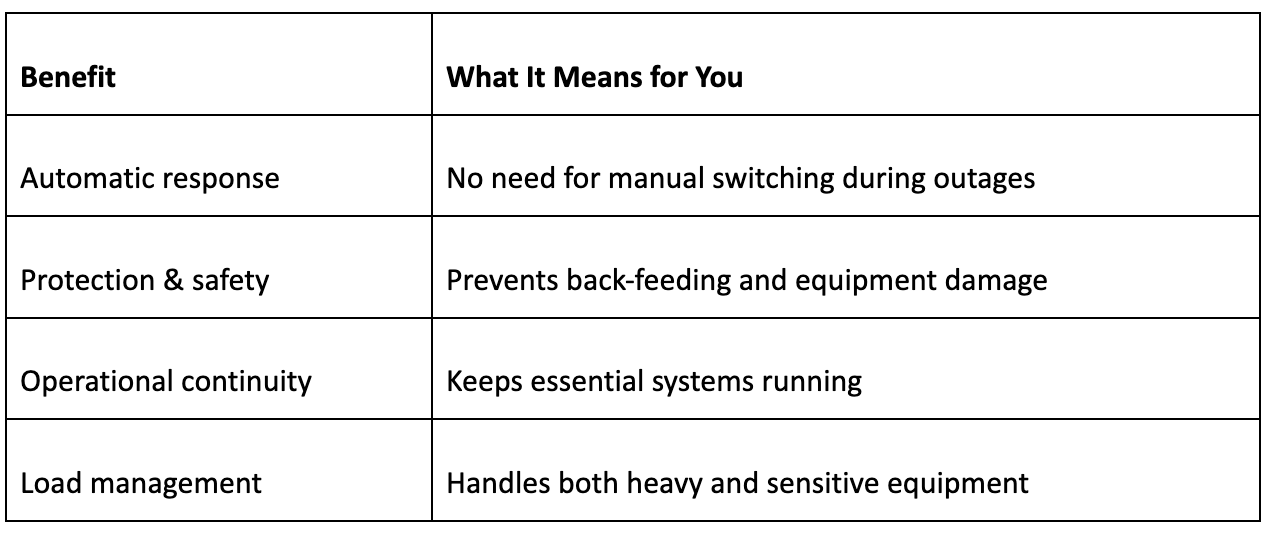
  • Safety and Protection: Built-in interlocks and short-circuit protection prevent back-feeding and reduce the risk of electrical hazards. These features protect both equipment and individuals during switching events.
  • Environmental and Mechanical Durability: Temperature tolerance, insulation quality, and mechanical endurance help ensure long-term reliability, particularly in industrial environments where electrical components are subject to greater stress.

Key Benefits of Using an ATS

The Essential Role of Automatic Transfer Switches in Power Continuity

Common Questions About Automatic Transfer Switches

A common question is whether an ATS removes the need for backup power. While the device automates the switching process, it still relies on a secondary energy source, such as a generator, battery system, or an alternate grid connection. Another frequent concern is whether an ATS can eliminate all interruptions. Open-transition models may cause a brief momentary gap, while closed-transition options reduce this downtime considerably, making it essential to choose based on your tolerance for short power interruptions. CHINT offers ATS products in various configurations, which helps illustrate how different designs accommodate different continuity needs. These product lines also show how features such as transition mode and electrical rating can influence performance in real-world settings.

Maintenance is also a topic many people ask about. Although an ATS requires relatively little upkeep, periodic testing and inspection are necessary to ensure reliable performance. Checking for worn components, loose connections, or delays in switching helps ensure the device will function properly during a real outage.

Conclusion

Power instability is an unavoidable part of modern life, but the impact of unexpected outages can be significantly reduced with the right equipment. An automatic transfer switch offers a dependable way to detect failures and shift your electrical load to a backup source, helping your essential systems stay connected. Whether you’re protecting a home, running a business, or managing a large facility, an ATS helps prevent equipment damage and maintain continuity during unpredictable grid events.

Understanding how an ATS works enables you to make informed decisions about power protection. By selecting the right switch, considering the key technical features, and performing routine maintenance, you can strengthen your resilience to power disruptions. With a well-designed setup in place, you can continue your activities confidently, knowing your electrical system will stay operational regardless of what happens to the main power supply.

How AI Chatbots Are Replacing Call Center Agents Across the U.S.

Across the U.S., AI chatbots are rapidly transforming the customer service landscape. What began as a support tool for basic inquiries has evolved into a full-scale replacement strategy for call center agents. Businesses are embracing AI chatbots not only to reduce costs but to improve response times, scale operations, and deliver consistent customer experiences. For executives and decision-makers, this shift is more than a technological upgrade, it’s a strategic overhaul of how service is delivered in the digital age.

Why AI Chatbots Are Replacing Human Agents

The appeal of AI chatbots lies in their ability to handle high volumes of customer interactions with speed, accuracy, and consistency. Unlike human agents, chatbots don’t require breaks, benefits, or retraining. They operate 24/7, respond instantly, and maintain a uniform tone across all conversations.

For businesses, this translates into:

  • Lower operational costs: Reducing the need for large call center teams and associated overhead.
  • Improved efficiency: AI chatbots resolve common issues in seconds, reducing wait times and freeing up human agents for complex tasks.
  • Scalability: Chatbots can handle thousands of simultaneous interactions, especially during peak seasons.
  • Data capture and analysis: Every interaction is logged, analyzed, and used to improve future service and product offerings.

These benefits are especially attractive to industries with high call volumes, such as retail, telecom, healthcare, and financial services.

Industries Leading the AI Chatbot Shift

Several sectors are aggressively adopting AI chatbots to streamline operations:

  • Retail and e-commerce: Chatbots manage order tracking, returns, product recommendations, and customer feedback.
  • Telecommunications: Providers use AI to handle billing inquiries, service outages, and plan upgrades.
  • Healthcare: Chatbots assist with appointment scheduling, insurance verification, and symptom triage.
  • Banking and finance: AI systems manage account queries, fraud alerts, loan applications, and investment guidance.

These industries benefit from high volumes of repetitive interactions, making them ideal candidates for automation.

The Changing Role of Human Agents

While AI chatbots are replacing many frontline roles, they’re also reshaping the responsibilities of the human workforce. Instead of handling repetitive queries, agents are now focusing on complex problem-solving, emotional support, and high-stakes interactions that require empathy and nuance.

This shift is part of a broader trend in how AI is revolutionizing office work, pushing employees toward more strategic, creative, and human-centric roles. Businesses are investing in upskilling programs to help agents transition into roles like escalation specialists, customer success managers, and AI trainers.

AI Chatbots and the Future of Customer Experience

AI chatbots are not just replacing agents, they’re redefining how customers interact with brands. As more consumers become comfortable with conversational interfaces, expectations around speed, personalization, and availability are rising.

How AI Chatbots Are Replacing Call Center Agents Across the U.S.

Photo Credit: Unsplash.com

This shift is part of a broader movement toward AI-powered search and interaction, where users expect instant answers, intuitive navigation, and seamless transitions between channels. Chatbots are becoming the front line of customer experience, guiding users, resolving issues, and even upselling products.

Voice assistants, smart kiosks, and embedded chat widgets are all part of this transformation. The goal is seamless, intuitive interaction, powered by AI and personalized in real time.

Challenges and Considerations for Business Leaders

Despite the benefits, replacing call center agents with AI chatbots presents challenges:

  • Customer trust: Some users still prefer human interaction, especially for sensitive issues.
  • Tone and empathy: Chatbots must reflect brand voice and handle frustration gracefully.
  • Data privacy: AI systems must comply with regulations like CCPA and GDPR.
  • Bias and accuracy: Poorly trained models can deliver incorrect or biased responses.

To mitigate these risks, companies are implementing hybrid models where AI handles the first layer of support and escalates to humans when needed. Regular audits, user feedback loops, and transparent escalation paths are essential for maintaining trust.

Workforce Impact and Ethical Responsibility

The replacement of call center agents by AI chatbots has real implications for employment. Millions of Americans work in customer service roles, and automation is reshaping that landscape. While some jobs are being eliminated, others are evolving, and new roles are emerging in AI training, chatbot design, and customer experience strategy.

Forward-thinking companies are approaching this shift with empathy. They’re offering reskilling programs, internal mobility opportunities, and support for displaced workers. The goal isn’t just to cut costs, it’s to build a more agile, future-ready workforce.

Measuring ROI and Long-Term Value

For executives, the decision to deploy AI chatbots must be grounded in measurable outcomes. Key performance indicators include:

  • First-contact resolution rate
  • Average handling time
  • Customer satisfaction (CSAT) scores
  • Cost per interaction
  • Agent utilization and retention

When implemented strategically, AI chatbots can deliver significant ROI, not just in cost savings, but in improved customer loyalty, brand perception, and operational agility.

AI Chatbots in SMBs and Enterprise Settings

While large enterprises have led the charge, small and mid-sized businesses (SMBs) are increasingly adopting AI chatbots to compete with larger players. Affordable platforms, plug-and-play integrations, and cloud-based solutions have made chatbot deployment accessible to companies with limited IT resources.

SMBs are using chatbots to manage bookings, answer FAQs, and provide after-hours support. These tools help level the playing field, allowing smaller firms to deliver enterprise-grade service without the overhead.

Enterprise organizations, meanwhile, are building custom AI models tailored to their brand voice, customer segments, and product offerings. These systems integrate with CRM platforms, analytics dashboards, and omnichannel interfaces to deliver a unified experience.

Security, Compliance, and Governance

As AI chatbots handle more sensitive data, security and compliance become critical. Businesses must ensure that chatbot platforms adhere to data protection laws, encrypt communications, and store information securely.

Governance frameworks are emerging to guide ethical AI deployment. These include guidelines for transparency, accountability, and bias mitigation. Companies are appointing AI ethics officers, forming advisory boards, and publishing responsible AI policies to build trust with stakeholders.

Why AI Chatbots Matter for U.S. Business Strategy

AI chatbots are more than a customer service tool, they’re a strategic asset. They reduce costs, improve efficiency, and enable personalized engagement at scale. For U.S. business leaders, the question is no longer whether to adopt chatbots, but how to do it well.

This means aligning chatbot deployment with brand strategy, customer expectations, and workforce planning. It means investing in training, governance, and continuous improvement. And it means viewing AI not as a replacement for people, but as a partner in delivering better outcomes.

As the technology matures, the businesses that lead in chatbot innovation will define the future of customer experience, and set the standard for digital transformation.


How Technology Is Changing the Dynamics of Real-Life Friendships

Real-life friendships are evolving rapidly in the U.S. as technology becomes more embedded in daily routines. While digital tools offer new ways to stay connected, they also introduce complexities that reshape how people form, maintain, and experience social bonds. From messaging apps and video calls to social media and virtual communities, technology is redefining the meaning of closeness, presence, and emotional support.

The Rise of Digital Communication in Friendship

Technology has made it easier to stay in touch, especially when friends live in different cities or have demanding schedules. Texting, voice notes, and video chats allow people to share updates instantly, bridging physical distance. A college graduate who moved from Chicago to Seattle for work can still maintain regular contact with high school friends through group chats and weekly video calls.

This convenience has helped preserve real-life friendships that might otherwise fade due to geography. However, it also shifts the nature of interaction. Conversations become shorter, more frequent, and often asynchronous. While this can enhance accessibility, it may reduce the depth and emotional nuance of traditional face-to-face exchanges.

Social Media’s Double-Edged Role

Social media platforms play a significant role in shaping real-life friendships. They allow users to share life events, celebrate milestones, and offer support in public or private spaces. A friend posting about a new job or personal challenge often receives encouragement from their network, reinforcing bonds even without direct conversation.

At the same time, social media can create illusions of connection. Seeing someone’s updates doesn’t always mean meaningful engagement. A person might feel close to a friend they haven’t spoken to in months simply because they’ve liked a few posts. This passive interaction can lead to a false sense of intimacy and reduce the motivation to reach out directly.

The curated nature of social media also affects how real-life friendships are perceived. When people only share highlights, it can lead to comparison and insecurity. A friend’s vacation photos or career achievements might unintentionally trigger feelings of inadequacy, even within close relationships.

Technology and Emotional Availability

Real-life friendships depend on emotional availability, being present, listening actively, and offering support. Technology can both enhance and hinder this. A friend who sends a thoughtful message during a tough time demonstrates care, even from afar. But constant notifications and multitasking can dilute attention during conversations.

In a recent study on digital life and relationships, researchers found that people often feel less satisfied with interactions that occur while the other person is distracted by their phone. This “tech interference” can make friends feel undervalued, even when the intention is positive.

To preserve emotional depth, some friends are setting boundaries around technology. A pair of roommates in Boston agreed to put away their phones during dinner to focus on conversation. These small rituals help reinforce the value of presence in real-life friendships.

Virtual Communities and Expanding Social Circles

Technology has also expanded the definition of friendship. Online communities, gaming platforms, and interest-based forums allow people to connect over shared passions. These relationships can evolve into real-life friendships, especially when members meet in person or support each other through significant life events.

A graphic designer in Austin met a fellow artist through an online portfolio group. After months of collaboration and conversation, they decided to attend a design conference together. The digital connection laid the foundation for a lasting real-life friendship that now includes regular visits and creative projects.

While virtual friendships can be meaningful, they also raise questions about authenticity and trust. Without physical cues or shared environments, misunderstandings can arise more easily. Building real-life friendships from online connections often requires intentional effort and transparency.

Workplace Technology and Social Bonds

Technology in the workplace is also influencing real-life friendships. Remote collaboration tools like Slack, Zoom, and Microsoft Teams facilitate communication but can limit informal interactions. Watercooler chats and spontaneous lunch plans are harder to replicate in virtual settings.

Some companies are addressing this by creating digital spaces for casual conversation. A tech firm in Denver introduced a “virtual coffee room” where employees can drop in for non-work chats. These initiatives help maintain camaraderie and support the development of real-life friendships among colleagues.

Workplace friendships are essential for morale and retention. As explored in this article on workplace camaraderie, strong social bonds at work contribute to better collaboration, reduced stress, and higher job satisfaction. Technology must be used thoughtfully to preserve these benefits.

Mental Health and the Role of Real-Life Friendships

Real-life friendships play a critical role in mental health. They offer emotional support, reduce loneliness, and provide a sense of belonging. Technology can support these outcomes when used intentionally, but it can also create barriers.

How Technology Is Changing the Dynamics of Real-Life Friendships

Photo Credit: Unsplash.com

A young professional in New York found herself overwhelmed by constant digital interaction. She realized that scrolling through messages and social media left her feeling disconnected. By prioritizing in-person meetups and phone calls with close friends, she improved her mood and reduced anxiety.

This shift aligns with broader trends in lifestyle and wellness. As noted in this piece on lifestyle changes and mental health, people are reevaluating how they spend time and who they spend it with. Real-life friendships are being prioritized as essential to emotional well-being.

Balancing Technology and Authentic Connection

Maintaining real-life friendships in a tech-driven world requires balance. Digital tools should support, not replace, authentic connection. Friends who use technology to coordinate plans, share meaningful updates, and check in regularly often strengthen their relationships.

A group of childhood friends scattered across the U.S. created a shared calendar to plan monthly video calls and annual reunions. They use messaging apps to stay in touch but prioritize voice calls for deeper conversations. This blend of digital and personal interaction helps preserve their bond despite distance.

Setting boundaries around technology also helps. Turning off notifications during social time, limiting screen use during gatherings, and choosing phone calls over texts for important conversations can enhance the quality of real-life friendships.

Technology Is a Tool, Not a Substitute

Technology is changing the dynamics of real-life friendships, offering new ways to connect while challenging traditional forms of interaction. The key is intentionality. When used thoughtfully, digital tools can strengthen bonds, support emotional health, and expand social circles. But when overused or misapplied, they can dilute the depth and authenticity that make friendships meaningful.

In a world of constant connectivity, choosing when and how to engage matters. Real-life friendships thrive on presence, empathy, and shared experience, qualities that technology can support but never fully replace.

The Role of Website Backend in Effective Business Operations

Website backend architecture is the silent powerhouse behind every high-performing digital business. While front-end design captures attention, it’s the backend that ensures functionality, speed, and reliability. From database management to server-side logic, backend systems handle the heavy lifting that keeps websites running smoothly, especially during peak traffic, product launches, or seasonal surges. For executives and entrepreneurs, backend performance isn’t just a technical metric, it’s a direct reflection of operational readiness.

In sectors like e-commerce, SaaS, and logistics, backend efficiency translates into real-time inventory updates, seamless transactions, and responsive customer portals. A well-structured backend allows businesses to automate workflows, integrate third-party tools, and scale without friction. It’s the difference between a site that converts and one that crashes. As companies expand their digital footprint, backend systems become the foundation for agility, uptime, and customer trust.

Backend architecture also plays a critical role in data integrity and compliance. Whether it’s managing user credentials, processing payments, or storing sensitive information, backend systems must be secure, scalable, and auditable. This is especially vital for businesses operating in regulated industries like finance and healthcare, where backend vulnerabilities can lead to reputational damage and legal exposure. Investing in backend resilience isn’t just smart, it’s essential.

Backend Infrastructure Drives Operational Agility

In today’s competitive landscape, agility is everything. Website backend systems enable businesses to pivot quickly, whether it’s launching a new product, integrating a payment gateway, or scaling to meet seasonal demand. Backend architecture supports APIs, databases, and server logic that allow teams to automate workflows, personalize experiences, and respond to market shifts in real time.

Companies like Girraffe SEO are capitalizing on backend simplicity to eliminate tech headaches for e-commerce founders. Their ready-to-sell dropshipping websites are built with backend systems that streamline fulfillment, reduce manual input, and allow entrepreneurs to focus on sales and branding. It’s a model that reflects a broader trend: backend efficiency is becoming a competitive advantage.

Security, Speed, and Scalability Start at the Backend

Website backend systems are the first line of defense against digital disruption. From data breaches to traffic surges, backend architecture determines how well a business can protect its assets and maintain performance under pressure. Executives who treat backend security as optional are playing a risky game, especially in sectors where compliance, customer trust, and uptime are non-negotiable.

Security starts with smart backend design. Encrypted databases, secure authentication protocols, and real-time monitoring tools are no longer nice-to-haves, they’re baseline requirements. Backend systems must be built to withstand evolving threats, from brute-force attacks to API vulnerabilities. And as cyber risks grow more sophisticated, backend resilience becomes a boardroom concern, not just an IT checklist.

The Role of Website Backend in Effective Business Operations

Photo Credit: Unsplash.com

Speed is equally critical. Backend performance affects everything from page load times to checkout flow. A sluggish backend can tank conversion rates, frustrate users, and damage brand perception. That’s why high-growth companies invest in load balancing, caching strategies, and optimized server logic. When the backend runs lean, the entire user experience feels faster, smoother, and more reliable.

Scalability is where backend architecture proves its long-term value. Whether it’s handling a holiday traffic spike or onboarding thousands of new users, a scalable backend allows businesses to grow without breaking. Cloud-native infrastructure, modular design, and containerization give companies the flexibility to expand, iterate, and innovate, all while keeping performance stable. In today’s digital economy, backend scalability isn’t just technical, it’s strategic.

Backend Systems Power Personalization and CX

Customer experience doesn’t end at the interface. Website backend systems enable personalization by managing user data, purchase history, and behavioral analytics. They allow businesses to deliver tailored content, dynamic pricing, and targeted promotions, all in real time.

B2B platforms, in particular, rely on backend logic to serve complex customer journeys. As highlighted in this piece on B2B website strategy, many companies overlook the backend’s role in guiding leads, managing access, and supporting account-based marketing. A well-structured backend can turn a static site into a dynamic sales engine.

Backend Optimization Streamlines Operations and Enhances Performance

Optimizing the website backend isn’t just a technical upgrade, it’s a strategic move that can streamline operations across the board. When backend systems are designed efficiently, they reduce server strain, minimize downtime, and improve load balancing. This leads to faster page performance, smoother transactions, and fewer disruptions for both customers and internal teams.

Backend improvements also reduce the need for manual intervention. Automated systems can handle routine tasks like syncing inventory, processing payments, and updating content, freeing up staff to focus on higher-value initiatives. For startups and enterprise teams alike, this shift from reactive troubleshooting to proactive development can accelerate innovation and improve workflow consistency.

Operational efficiency extends to deployment cycles and platform maintenance. With a well-structured backend, updates can be rolled out faster, bugs can be resolved with less friction, and integrations with third-party tools become more seamless. This agility is especially valuable for businesses navigating seasonal demand, product launches, or multi-channel growth strategies.

The next evolution of website backend architecture is already underway. AI-powered backend systems are enabling predictive analytics, smart routing, and automated decision-making. Modular backend design, using microservices and containerization, allows businesses to build faster, test smarter, and deploy with confidence.

APIs are becoming the connective tissue of digital ecosystems. From CRM integrations to logistics platforms, backend APIs allow businesses to plug into new tools without rebuilding their infrastructure. This flexibility is critical for growth-stage companies and enterprise teams navigating digital transformation.

Backend Is a Business Strategy

For U.S. business leaders, the message is clear: website backend systems are not just technical infrastructure, they’re strategic assets. They influence customer experience, operational efficiency, and long-term scalability. Whether you’re launching a new venture or optimizing an existing platform, backend architecture deserves a seat at the executive table.

Investing in backend performance isn’t just about avoiding downtime, it’s about unlocking opportunity. From personalization and automation to security and speed, the backend is where business happens. And in a digital-first economy, that’s where leadership begins.

Toyota’s New GR GT Supercar and What Drivers Need to Know

Toyota surprised the performance car scene with the reveal of the GR GT, a full-scale supercar developed under its Gazoo Racing division. For many drivers, Toyota equals reliability and daily driving comfort, not exotic horsepower. That history makes the arrival of a true supercar feel unexpected. Yet the brand has slowly warmed up enthusiasts with models like the GR Supra and GR Corolla. The GR GT takes that progression several steps forward.

This new model isn’t a concept sketch meant only for car shows. It’s a working development car designed for real production in the next couple of years. It’s built to compete in the same space as European performance machines that often cost more than a home down payment. Toyota says the goal isn’t to chase luxury flash but to focus on mechanical feel and honest driving engagement.

For buyers and fans, curiosity brings a mix of excitement and skepticism. Can Toyota build something that stands next to established supercars in speed, build quality, and excitement? The GR GT aims to answer that by blending classic V8 muscle with new hybrid hardware and race-inspired design choices.

What Makes the GR GT a True Supercar

A supercar isn’t defined by styling alone. Performance benchmarks matter. The GR GT uses a 4.0 liter twin turbo V8 engine, which means a traditional eight cylinder motor boosted by turbochargers to create extra power without excess weight. Toyota pairs this engine with a hybrid system, which adds an electric motor to assist the drivetrain. Hybrid systems use battery powered torque to supplement combustion engines, providing instant response during acceleration.

The combined output sits at around 641 horsepower, placing the GR GT solidly in the performance bracket of respected global supercars. Power flows to the rear wheels through an eight speed automatic transmission. Rear wheel drive keeps the handling experience more direct, shifting responsibility to the driver instead of electronic grip systems found in all wheel drive layouts.

The body structure uses an all aluminum space frame, a lightweight yet rigid skeleton that reduces overall mass while increasing stiffness. High stiffness improves cornering by keeping the car from flexing under pressure. Carbon fiber body panels further trim weight while increasing strength. These materials usually appear only in ultra high end vehicles, which signals Toyota’s seriousness about the GR GT’s performance ambitions.

Hybrid Power Explained in Simple Terms

The hybrid system isn’t about gas savings. Its main focus is enhancing performance. Electric motors deliver instant torque because they produce full pulling force the moment the accelerator is pressed. That fills the gap turbo engines often experience while building boost pressure.

Drivers experience smoother acceleration instead of brief hesitation between throttle input and actual speed gain. The hybrid system also contributes power during corner exits, helping maintain momentum without requiring harder engine revs that could disrupt tire grip.

The battery charges automatically during braking and low demand driving. Energy captured during deceleration, often called regenerative braking, gets stored and reused for later bursts of acceleration. The driver doesn’t manage this process. The system operates quietly in the background while maintaining a mechanical driving feel up front.

Design Built Around Driving Feel

The GR GT’s exterior flows from function rather than decorative flair. Wide air intakes feed cooling systems needed for high output motors. Sculpted sides guide air toward heated components while stabilizing body pressure at high speeds. The roofline stays low to reduce drag and keep the center of gravity close to the ground.

Inside, the cabin keeps a minimalist approach. Large touchscreen distractions are reduced. The steering wheel includes physical controls for driving modes. Shift paddles remain prominently placed so gear changes remain tactile. Bucket style seats hold passengers securely during cornering without sacrificing everyday comfort. This layout mirrors track focused design without turning the cabin into a race car shell.

Driving position received heavy tuning. Engineers worked to align pedal height, steering wheel angle, and seating posture so drivers feel naturally connected to the car. Small ergonomic adjustments often make more difference than raw horsepower when it comes to confidence behind the wheel.

Motorsport Influence From the Start

Toyota developed the GR GT alongside a track racing counterpart known as the GR GT3. This parallel development means feedback from professional racing teams shaped aerodynamic design, suspension tuning, and cooling performance from the opening stages.

Suspension uses double wishbone geometry front and rear, a setup favored in race cars due to its ability to maintain tire contact during hard cornering. Braking relies on carbon ceramic discs, which withstand repeated high temperature stops without fading. These same materials commonly appear on vehicles built for endurance track racing.

Instead of planning a road car first and then converting it to racing form, Toyota reversed the thinking process. They worked on both at the same time. That approach improves durability and mechanical reliability. Race demands expose weaknesses quickly. Fixes developed for competition directly support consumer vehicles as well.

Concerns About Reliability and Ownership

Long time Toyota owners associate the brand with legendary durability. A supercar environment challenges that perception since high performance machines often carry higher maintenance requirements. Hybrid drivetrains add complexity through batteries, power electronics, and cooling systems.

Toyota’s advantage lies in experience. Hybrid systems power millions of reliable vehicles across their lineup. Scaling that knowledge into the GR GT ensures the electric portions follow proven engineering methods rather than experimental builds.

Maintenance costs will likely exceed standard models given advanced materials and limited production volumes. However, the focus stays on predictable service demands rather than risky experimental systems. Buyers concerned about hybrid longevity can look to Toyota’s established energy management history for reassurance.

Expected Pricing and Buyer Market

Exact pricing hasn’t been finalized, though industry estimates place the GR GT between $350,000 and $400,000. That positions it alongside European competitors while often undercutting the most famous luxury badges.

Production volumes are expected to stay low, which keeps exclusivity high but also limits availability. Toyota hasn’t announced allocation numbers, though manufacturing complexity often limits production to a few thousand units annually at most.

For US buyers, the GR GT provides an alternative to brands that traditionally dominate the segment. It offers Japanese engineering credibility mixed with V8 muscle that appeals to performance purists who still enjoy mechanical sound and speed over silent electric dominance.

How the GR GT Fits Toyota’s Bigger Plan

The GR GT does more than stand alone as a rare flagship. It reinforces the identity Toyota built through Gazoo Racing performance development across its lineup. Lessons learned from suspension tuning, structural materials, and aerodynamics feed improvement into mainstream GR models that enthusiasts can afford.

This trickle down development supports future upgrades to vehicles like the GR Supra and GR Corolla, refining steering calibration and chassis rigidity based on flagship testing data. Motorsports has long served as an engineering laboratory and Toyota’s approach fits that tradition without leaning on spectacle marketing.

Brand confidence grows as well. Toyota’s entry into the supercar class demonstrates technical ambition that reshapes how enthusiasts perceive the brand’s capabilities beyond everyday commuting.

Why the GR GT Has Earned Attention

The GR GT stands out because it avoids shortcuts. Instead of branding a heavily modified sports coupe as a supercar, Toyota engineered a ground up performance platform built with materials and layout matching true exotics.

The hybrid V8 setup balances traditional engine excitement with modern torque delivery. The race bred development path strengthens durability and driving authenticity. The modest interior design focuses on the act of driving rather than luxury gimmicks.

While final production examples remain over a year away, the GR GT already reshapes expectations. For drivers seeking mechanical honesty blended with modern engineering support, it introduces a serious contender into a segment long dominated by European names.

Toyota’s GR GT proves that even brands synonymous with reliability can still create machines that thrill without sacrificing engineering discipline.

Short-Term Rental Property Management Software: An Overview with a Closer Look at Lodgify

The short-term rental market has expanded rapidly, with hosts managing everything from small apartments to large vacation homes. As bookings increase and guest expectations continue to rise, managing day-to-day operations manually can become increasingly challenging. This is where short-term rental property management software can play a significant role. Platforms like Lodgify provide digital tools that are designed to automate tasks, streamline communication, and centralize business operations for rental owners and managers. Below is a detailed look at how this software works, why it is important, and how Lodgify helps simplify rental management.

What is Short-Term Rental Property Management Software?

Short-term rental property management software is built to help hosts and property managers efficiently oversee daily operations by integrating essential functions into one dashboard. These platforms typically include a channel manager to sync availability across multiple booking websites, a system for tracking reservations, a unified guest messaging inbox, and a direct-booking engine.

Many options also offer features such as payment processing, automated check-in instructions, cleaning schedules, invoicing, and performance reporting. The goal is to give rental managers one central platform to handle everything that might otherwise require multiple tools or manual oversight. This consolidation can help ensure that tasks are completed on time, bookings stay organized, and communication remains consistent.

Why Rental Hosts and Managers Need It?

Running a short-term rental business involves handling several time-sensitive tasks. Without a centralized system, hosts may encounter double bookings, late messages, scheduling issues, or inefficient workflows. Property management software helps to minimize the chance of these issues while making daily processes smoother and more reliable.

The right software could save significant time by automating repetitive work such as sending pre-arrival emails or updating availability on different booking channels. It also helps optimize revenue by providing analytics that identify trends in occupancy and income. For hosts who want to grow their business, a digital system makes it easier to manage multiple properties without sacrificing organization or guest experience.

Overall, a dedicated platform can improve accuracy, reduce workload, enhance communication, and allow hosts to scale their business more effectively.

Lodgify — A Full-Featured Example of Short-Term Rental PMS

Lodgify is a popular vacation rental management platform that offers an all-in-one solution for hosts and property managers, whether they operate one property or several.

Core Features

Lodgify includes a channel manager that synchronizes calendars, prices, and reservations across major booking websites, reducing the risk of double bookings. Its direct-booking website builder allows users to create a custom website without coding skills, making it easier to accept commission-free reservations.

The unified inbox collects messages from all booking channels, allowing hosts to respond from one place. Lodgify also offers tools for automating tasks such as cleaning schedules, guest check-ins, and payment reminders. Payment processing is integrated into the platform, and dynamic pricing tools help adjust nightly rates based on demand or seasonality.

For users who want insights into performance, Lodgify provides reporting tools that track revenue, occupancy rates, and other key data. The platform is flexible enough to support different types of accommodations, from single-room rentals to multi-unit vacation properties.

Pros and Trade-Offs: What to Consider

Lodgify has several advantages, including ease of setup, user-friendly features, and strong automation tools. It is particularly useful for small to mid-sized rental portfolios or for hosts who may prefer to reduce reliance on external booking websites by focusing more on direct reservations. The automated messaging and centralized communication help save time, while the website builder supports stronger brand visibility and improved profit margins.

Final Thoughts: Is a PMS Like Lodgify Right for You?

For hosts managing one or multiple short-term rental properties, using short-term rental property management software can offer significant improvements in efficiency and organization. Lodgify simplifies many of the challenges involved in managing reservations, payments, messages, and operational tasks from a single system.

Its direct-booking capabilities may help increase revenue while reducing dependency on third-party platforms. For new hosts and growing rental businesses, Lodgify offers a practical balance of usability and functionality. With the ability to centralize operations, automate tasks, and improve overall guest experience, it could be a valuable tool for those looking to manage their rental business in a more professional and effective manner.