New York Finalizes State Energy Plan With National Implications

New York has finalized a sweeping State Energy Plan that reshapes how the nation’s fourth-largest state thinks about power, jobs, and climate commitments. Approved unanimously by the New York State Energy Planning Board, the plan sets a 15-year roadmap through 2040 and openly acknowledges a reality that many states are quietly confronting: the energy transition is taking longer, costing more, and demanding more flexibility than originally expected. Rather than betting on a single pathway, New York is embracing an all-of-the-above strategy that combines renewables, advanced nuclear power, and continued use of natural gas to keep the lights on while demand keeps rising.

The plan arrives at a moment when energy policy debates are intensifying nationwide. Data centers, electric vehicles, and electrified buildings are driving electricity demand higher, while supply chain delays and infrastructure bottlenecks slow clean energy rollouts. New York’s decision to formalize a broader energy mix signals a shift from ideal timelines to pragmatic planning, with consequences that extend far beyond state borders.

Why Did New York Approve A New State Energy Plan Now?

State officials framed the plan as a response to mounting pressure on the energy system. Over the past year, New York collected nearly 15,000 written public comments and held hearings across the state, reflecting widespread concern about affordability, reliability, and long-term planning. The result is a document that does not abandon climate goals but recalibrates how the state expects to reach them.

The plan acknowledges that New York will not meet its legally mandated 2030 greenhouse gas reduction targets under the Climate Leadership and Community Protection Act on the original timeline. Instead, emissions reductions are now projected closer to 2037. That admission is significant. It signals that even states long seen as climate leaders are grappling with the gap between policy ambition and on-the-ground execution.

Officials emphasized that uncertainty at the federal level, rising construction costs, and grid constraints made a more flexible framework necessary. Rather than pausing climate efforts, the plan seeks to manage risk while avoiding power shortages and price spikes that could undermine public support for the transition.

What Does An “All-Of-The-Above” Energy Strategy Actually Mean?

New York Finalizes State Energy Plan With National Implications


Photo Credit: Unsplash.com

At the center of the plan is an explicit commitment to energy diversity. New York will continue expanding renewable energy sources such as wind, solar, and hydroelectric power, but it will also rely on advanced nuclear technology and natural gas to maintain grid stability. The plan also highlights renewable natural gas and emerging clean technologies as part of the mix.

This approach reflects a recognition that renewable energy alone cannot yet meet peak demand reliably at scale. Nuclear power is positioned as a zero-emissions backbone capable of providing consistent baseload electricity, while natural gas remains a short-to-medium-term stabilizer as renewable capacity grows.

State energy officials described the strategy as a bridge rather than a retreat. The goal is to avoid blackouts, control costs, and maintain economic competitiveness while clean energy infrastructure catches up with demand growth.

How Many Jobs Does New York Expect This Plan To Create?

One of the most striking projections in the State Energy Plan is employment. New York estimates the plan could support roughly 80,000 new energy-sector jobs over the next 15 years. These roles span renewable construction, grid modernization, nuclear operations, workforce training, and technology development.

The jobs projection has drawn attention because it frames energy policy as an economic development tool, not just an environmental one. Supporters argue that energy investments can anchor long-term employment, especially in upstate regions and industrial corridors that have struggled to attract new industries.

At the same time, the plan acknowledges that workforce development will be critical. Without sufficient training pipelines, labor shortages could slow projects and push costs higher. The state plans to coordinate with educational institutions, unions, and private employers to build a workforce capable of supporting the expanded energy system.

How Does The Plan Balance Climate Goals With Affordability?

Affordability is a recurring theme throughout the document. Energy costs are already a concern for households and businesses, and officials warned that an overly rigid transition could worsen the burden. The plan explicitly prioritizes reliability and cost control alongside emissions reductions.

Electricity demand in New York is projected to rise sharply as transportation and buildings electrify. Meeting that demand exclusively with renewables in the near term would require massive infrastructure investments and storage solutions that are not yet fully scaled. By maintaining a broader mix, the state aims to avoid sudden rate increases and supply disruptions.

This balance has sparked debate. Environmental advocates argue that continued reliance on natural gas risks locking in emissions and delaying progress. Business groups and grid operators counter that reliability failures or runaway costs could derail public support entirely. The plan attempts to thread that needle by keeping climate targets in place while extending the timeline.

What National Impact Could New York’s Energy Plan Have?

New York’s energy decisions carry national weight because of the state’s size, economic influence, and policy history. Other states often look to New York as a testing ground for ambitious initiatives. By openly embracing an all-of-the-above strategy, New York is signaling that flexibility may become a defining feature of the next phase of U.S. energy policy.

States facing similar demand growth and infrastructure constraints may follow suit, particularly those balancing clean energy goals with industrial expansion and data-center growth. The plan also reinforces the role of nuclear power in long-term decarbonization discussions, an issue gaining renewed attention across the country.

Energy analysts note that the plan could influence federal policy debates by highlighting the limits of rapid transition timelines without corresponding infrastructure investment. It reframes the conversation around sequencing rather than abandonment.

What Happens Next For New York’s Energy Transition?

The State Energy Plan itself does not fund projects or mandate specific investments. Instead, it sets policy direction and benchmarks that will guide agency decisions, utility planning, and private sector investment. Progress will be reviewed through regular reports that assess whether targets are being met and where adjustments are needed.

Implementation will depend on coordination across state agencies, utilities, local governments, and private partners. Federal incentives and regulatory decisions will also shape outcomes, especially for nuclear development and grid upgrades.

What is clear is that New York has chosen realism over rigidity. The plan reflects a state adapting its strategy in response to real-world constraints while keeping long-term goals intact. As energy demand grows and transition challenges become more visible, New York’s approach may offer a preview of where national energy policy is heading.


The ChatGPT Alternative Built for Real Work: Inside Kortix’s New Approach to AI Productivity

By: William Jones

For the last two years, the AI conversation has revolved around a familiar refrain. Everyone talks about potential. Fewer talk about reliability. And almost no one talks about the gap between what people want AI to do and what AI reliably delivers.

That gap is where Kortix has been building quietly. Founded by Domenico Gagliardi and Marko Kraemer, Kortix is positioning itself with a deceptively simple message. If you spend your workday moving between slides, spreadsheets, and research on people or companies, the platform’s new feature set called “Starters” is designed to outperform ChatGPT on all three.

It is not a replacement for general AI. It is a focused alternative that aims to address the practical tasks people wish AI could perform well. And unlike the major players, the entire system is built on open-source technology that anyone can study, improve, or build on.

“People do not need AI to think for them,” Gagliardi says. “They need AI that helps them work.”

The Problem With Most AI Productivity Tools

The average knowledge worker lives in an unending loop of dashboards, decks, and data. When generative AI arrived, many assumed it would immediately take those tasks off their plate. Instead, they discovered that asking a general model to interpret a large spreadsheet and build a presentation around it often leads to hallucinated numbers, broken logic, and hours of cleanup.

Even the simplest tasks, like generating a slide deck from scratch, reveal the limits of models that are trained on unfocused information. They can describe slides. They rarely build them in a way that feels usable.

Gagliardi saw this firsthand while developing multiple AI prototypes. “ChatGPT is powerful,” he says. “But power without specificity does not always solve real problems.”

Kortix was created as a direct response to that realization. Instead of building a catch-all system, Gagliardi designed a tightly structured set of “Starters” that trigger specialized workflows inside the platform. These workflows use models optimized for specific formats and actions, giving users an experience that feels less like prompting and more like working with a capable assistant.

The result is an AI tool that performs remarkably well in three of the most painful categories of modern work.

Slides: Actual Presentations, Not Drafts You Have to Rewrite

Kortix’s “Slides Starter” lets users choose a template or start from scratch. The system then builds fully formed presentations that are ready to edit, not reassemble.

Slides are structured with layout logic, consistent formatting, and a visual hierarchy that resembles something a real designer might produce. Instead of vague outlines, users receive tangible deliverables.

For founders and operators who prepare multiple decks per week, this feature alone has become a notable differentiator. Kortix is not trying to teach users how to design. It simply gives them a usable deck in minutes.

Data: Dashboards and Reports From Spreadsheets of Any Size

Data remains one of the most difficult tasks for AI systems. Large spreadsheets cause models to stall. Complex relationships between variables often result in oversimplified summaries that ignore the real patterns.

Kortix solves this with a dedicated “Data Starter” built to ingest significant volumes of information and convert them into charts, dashboards, and written reports that make sense. Because the entire platform runs on customized open-source infrastructure, it can process larger files without bottlenecking or distorting the content.

Unlike general models, Kortix understands how to preserve structure. It translates spreadsheets into insights that should not require manual verification line by line.

“Data is the area where people lose the most time,” Gagliardi says. “If AI cannot handle that with precision, then what is the point?”

People: Research That Feels Like a Real Digital Assistant

Kortix’s “People Starter” reflects a trend that has defined the last decade. So much of modern work involves understanding individuals and companies. Whether someone is researching prospects, compiling competitive analyses, or preparing for meetings, the process is fragmented across platforms.

Kortix consolidates that workflow. Users can search for people or companies, view unified information, and even pull publicly available LinkedIn profile data. For lead generation and market research, this creates a clean and immediate picture of who someone is and why they may matter.

With Kortix, the experience starts to resemble an assistant who already knows where to look.

Growing a Community Through the Creators Batch

While traditional AI companies scale by broadcasting announcements, Gagliardi has taken a quieter and more intentional approach. Kortix is being tested by a small group called the creators batch. These users act as a feedback engine, putting the “Starters” through real daily pressure and identifying what works, what does not, and what needs to evolve next.

This community-driven model allows Kortix to refine its outputs before releasing them widely. It is also a way to help ensure that the platform grows in response to the real needs of real users.

“AI tools should not be built in isolation,” Gagliardi says. “They should be built with the people who will depend on them.”

The Foundation of a New Category

Kortix is not trying to replace ChatGPT. It is trying to outperform it where it matters most for the average professional: Slides, Data, People.

It is an approach that feels refreshingly grounded. While the industry debates the existential future of AI, Gagliardi is focused on something simpler. He wants to give people a tool that could help them work better today.

In the crowded and chaotic landscape of consumer AI, that clarity stands out.

And for many, that is exactly the alternative they have been waiting for.

To see how the next generation of practical AI tools works, try Kortix’s free plan. The “Starters” feature lets you test the platform’s strengths in slides, data, and research tasks, and you can experience firsthand why creators are adopting it as their daily productivity engine.

Seamless Internet Access Abroad Through an eSIM Experience with Saily

Staying in touch while traveling to another country is now very important. People need it for finding directions sometimes, talking to others, and having fun. But travelers can still run into some problems. These include high roaming charges, long wait times for SIM cards, or poor phone coverage. An eSIM fixes these issues. It gives you an easy, fast way to go online as soon as you arrive in a new country.

Why eSIM Travel Solutions Are Becoming Popular

An eSIM means you do not need the tiny plastic SIM card that you put in your phone. This makes it easy and quick to get online when you travel to another country. You do not have to look for a store or mess with the tray for a SIM card. You can set up your plan before you leave, and with eSIM USA, you can start using the internet right away as soon as your plane lands.

The new way eSIM works online saves people time. It helps you feel less stressed. There is a smooth travel experience for all kinds of travelers.

Easy Setup and Quick Activation

Setting up an eSIM is easy. Most companies give you a QR code or link to start your plan right on your phone. In just a few taps, your phone can work with a local service when you are in a new country.

This is very helpful for people who do not want to pay roaming fees. It is suitable for those who need to use maps, ride apps, payment apps, and email right away.

A Practical Choice for Multi-Country Trips

For travelers visiting multiple countries, an eSIM makes everything far more convenient. You no longer need to swap physical SIM cards or worry about misplacing them.

Many companies offer regional and global plans. This means you can use your phone in different places while traveling.

Benefits of Using eSIM While Traveling

Modern travelers often choose eSIM because it has many benefits. It helps you stay connected and makes your trip easier, too.

Key advantages include:

  • Get started right away without a physical SIM card.
  • Store more than one plan on your device.
  • There is no risk of losing or breaking your SIM cards.
  • Packages can fit both short and long trips.

These features let people stay in touch in a neat, easy way.

Reliable Connection in Different Regions

ESIM providers work with top networks in many countries. This helps people who travel get steady internet access, even in places where standard roaming does not work. If you want to see hotel directions, read a menu, or tell your family what you are doing, the internet connection will be strong and reliable.

Better Control Over Data and Spending

Managing your data costs abroad is easier when you use an eSIM. You can easily see prices, pick the plan that suits you, and check how much you use right on your device.

Helpful features include:

  • You get clear plan options before you buy.
  • It is easy to upgrade when you need more data.
  • You can track your data use as it happens.
  • There are no surprise bills when your trip ends.

This high level of choice makes it simple to create a budget. It also protects people who travel from unexpected roaming charges.

A Smooth and Stress-Free Travel Experience

Overall, eSIM USA makes international travel easier. You do not have to buy a local SIM card or worry about problems when you try to start service. You can connect right away. It is simple to change your plan. You get good coverage. It also helps when you plan your trip.

Media.io: How to Turn a Photo into an Anime Image with AI

By: Zedx Miller

How to Turn A Photo into an Anime-Style Image with AI

I was looking through a few old photos the other day and noticed how many people around me have switched their profile pictures to some kind of anime version. Not just the unmistakable “filter style,” but the type that actually looks like someone drew it. For a while, I assumed these were commissions because that’s what people used to do, but most of them were generated with an image-to-anime AI tool.

What surprised me wasn’t the trend itself, but how little effort it actually takes now. I tried a couple of tools out of curiosity—one of them was Wondershare Media.io—and the process felt almost too simple. You upload a regular photo, write a quick note about the style you’re imagining, and the system turns it into an anime-style illustration. No software installation, nothing complicated. It’s the kind of thing you can do during a break, which probably explains why the trend spread so fast.

I’m putting the steps together below. Media.io ended up being the one I used more than once, so that’s the example I stuck with.

What Is Image-to-Anime AI & Why Is It So Popular?

Image-to-anime AI is a type of image-to-image AI that takes an existing photo—usually a portrait—and redraws it in a stylized anime style. Instead of guessing from text alone, the AI uses your uploaded photo as the visual foundation. Then, guided by your written prompt, it converts the original image to a new illustration while preserving the layout, pose, and identity.

This blend of “image + description” offers much more precision than traditional text-only AI tools. It gives you creative control while avoiding unexpected or inaccurate results. Many users rely on it to:

  •     Turn a selfie into a soft pastel anime portrait
  •     Generate manga-style black-and-white line art
  •     Create a game-like 3D anime character
  •     Convert a landscape photo into a watercolor anime scene
  •     Give product photos a creative campaign-ready look

Unlike simple filters, this method truly redraws the visual. It’s closer to having a digital artist illustrate your picture—only much faster, and accessible to everyone. Now, let’s explore why Media.io is one of the best platforms to create anime images instantly.

How Media.io Stands Out as an Image-to-Anime Tool

Media.io AI Image to Image offers a complete environment for transforming images using AI. Instead of being just another standalone anime tool, it’s part of a larger creative ecosystem powered by multimodal AI models. This makes it far more flexible and powerful than basic “photo filters.”

Here’s why creators prefer Media.io:

1. Accurate Anime Rendering With Prompt Control

Simply upload your picture, describe the anime style you want, and let the system redraw it. Media.io is good at keeping facial structure intact while enhancing details such as lighting, shading, and anime-style features. You can also experiment with prompts to convert a photo to an oil painting, generate manga line art, or turn a photo into artwork.

2. Works for Many Styles Without Manual Settings

Media.io doesn’t require complicated model selection. The prompt does all the work. You can ask for soft 2D anime, stylized digital painting, Ghibli-like scenes, chibi characters, cyberpunk themes, or anything else. The AI adapts naturally.

3. Part of a Larger Creative Toolkit

After generating your anime image, you can enhance it using other Media tools. For example:

  •     Upscale to HD using image enhancement
  •     Remove or replace the background
  •     Expand the canvas for posters
  •     Convert the anime image into pixel art
  •     Restyle it using the AI image generator 

This makes Media.io extremely useful for personal branding, design projects, and marketing.

4. Inspiration Hub

Media.io’s Explore page works like a live inspiration feed. You’ll find user-submitted videos and ready-to-use templates, all of which can be regenerated with a single click. As trends shift, new themed sections appear, making it easy to follow what’s currently gaining attention.

5. Simple, Fast, and Beginner-Friendly

The image-to-image feature runs in your browser and requires no setup. Even first-time users can turn a photo into anime in under a minute. You can also batch-upload up to nine images, making it efficient for creators who produce a series of characters or assets.

How to Turn an Image into Anime with Media.io (Step-by-Step Guide)

Feeling ready to try it? Here’s the complete tutorial.

Step 1. Upload Your Photo

Media.io: How to Turn a Photo into an Anime Image with AI

Photo Courtesy: Media.io

Go to Media.io’s Image to Anime tool and upload a JPG, PNG, or JPEG file. You can also bring in multiple images if you’re working on character sets or visual collections. After the upload, adjust the crop or framing so the subject is centered, which helps the AI keep proportions stable during the transformation.

Step 2. Describe the Anime Style You Want

This step controls the output. In the prompt box, describe the visual style as clearly as you can. Here are a few examples:

  •     “soft 2D anime portrait, pastel colors, gentle lighting”
  •     “manga line art with bold outlines”
  •     “3D anime character, glossy shading”
  •     “kawaii chibi, big eyes, round face”
  •     “Studio Ghibli watercolor atmosphere”

Your prompt is the only input that determines the anime style, so don’t hesitate to experiment. You can also use this method to convert an image into one in different artistic directions, not just anime.

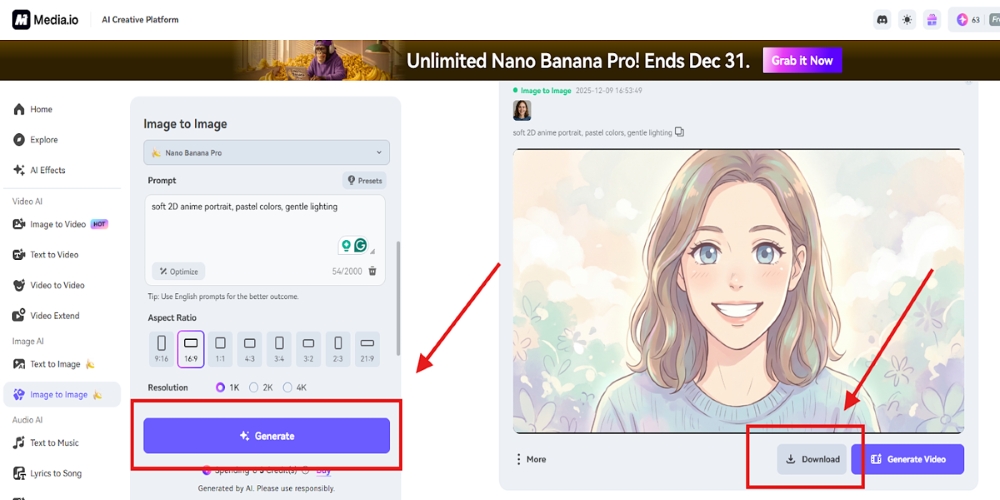
Step 3. Generate and Download Your Anime Image

Media.io: How to Turn a Photo into an Anime Image with AI

Photo Courtesy: Media.io

Click Generate, and the system will redraw your photo in just a few seconds. When the anime version appears, download it instantly or continue editing. If you want a more stylized result, you can try additional prompts, adjust lighting descriptions, or use Media.io’s AI change photo tools to refine the final look.

Final Thoughts — Start Turning Your Photos into Anime Today

Turning a regular photo into an anime-style image no longer requires any drawing skills. A single upload is usually enough for the AI to generate a clean, stylized version of your picture, which makes it handy for avatars or quick visual ideas.

What helps with Media.io is that you can adjust the result right after it’s generated—sharpen it, change the look slightly, or try another variation without leaving the page.

If you’re curious how your own photo would turn out, test one. Upload it, type a short note about the style you want, and let the tool create the anime version.

The Digital Co-Pilot: How LeVelo Is Reengineering Canada’s Urban Cycling Infrastructure

By: Matthew Kayser

In a world of fitness trackers and map apps, one Canadian platform is doing something entirely different. It is mapping the support network every rider needs, but no one else thought to build.

The modern cyclist lives in a data-rich paradise. We have apps that track our heart rate variability, computers that measure our wattage output, and satellites that map our elevation gain to the nearest foot. 

Essentially, we are like the most quantified athletes on the planet.

Yet, for decades, a single, analog problem has persisted, immune to all this Silicon Valley innovation. It is the mechanical failure. 

The flat tire in a strange neighborhood. 

The loose bolt is three miles from home. In that moment, the biometric data is useless. 

The rider is no longer a master of mobility; they are a pedestrian pushing a broken machine.

Enter LeVelo.

Rising out of the dense urban centers of Canada, LeVelo has emerged as the first platform to successfully digitize the mechanical infrastructure of the city. 

It is not a fitness app. 

It is not a social network. 

It is a utility in the purest sense of the word. 

By mapping, verifying, and connecting a network of over 500 public repair stations and hundreds of partner bike shops, LeVelo has done what no one else thought to do: they have engineered the anxiety out of the ride.

Mapping the Mechanical Ecosystem

The Digital Co-Pilot: How LeVelo Is Reengineering Canada’s Urban Cycling Infrastructure

Photo Courtesy: LeVelo

At its core, LeVelo does something deceptively simple: it tells you where the help is.

The app creates a digital overlay on the physical city, pinpointing a network of over 500 verified public repair stations across Canada. But it goes beyond simple location data. It provides intelligence.

Using a crowd-sourced model similar to Waze, LeVelo allows its community to help verify station status in real-time. Before you detour five blocks to use a public pump, the app tells you if it’s working. It lists the tool inventory available at each stand. 

It turns “hope” into “logistics.”

Crucially, this network is living and breathing. Users are able to add stations themselves onto the map after verification. This means the database is expandable and scalable, ensuring it is available in every city that has stations, growing organically alongside the cycling community.

Currently operating in Toronto, Ottawa, Vancouver, and Montreal, this network has fundamentally changed the psychology of the ride. By making the safety net visible, LeVelo removes the issue that keeps casual riders tethered to familiar routes by unlocking the city.

To understand why LeVelo is a “first of its kind” innovation, one must understand the psychology of the urban commuter.

Urban planners talk a lot about “barriers to entry.” Why don’t more people cycle? They cite safety, weather, and sweat. But there is a silent barrier that veteran riders know intimately: Range Anxiety.

It is the subconscious calculation every rider makes before leaving the house. If I ride to that new neighborhood, what happens if I get a flat? Is there a shop nearby? Is it open? Do I have the tools to fix it myself?

This anxiety tethers cyclists to known routes. It limits exploration. It keeps the bicycle from becoming a true vehicle of freedom and relegates it to a vehicle of routine.

LeVelo attacks this psychology by treating mechanical support as a data point. The platform has created a digital layer over the physical city. 

It pinpoints public bike repair stations—those overlooked metal stands equipped with pumps and hex keys that cities install but rarely advertise. Before LeVelo, finding one of these stations was a matter of luck or rote memorization. 

Now, it is a matter of logistics.

And with over 50,000 active users, the platform has become a crowd-sourced intelligence network. 

The Death of the Analog Shop

While LeVelo changes the game for the rider, its impact on the local economy is perhaps even more significant.

The local bike shop (LBS) is a cornerstone of community urbanism. It is a hub of knowledge, culture, and essential services. However, the LBS has historically been a strictly analog business operating in an increasingly digital world.

If a cyclist suffers a mechanical failure in an unfamiliar neighborhood, their instinct is to search Google Maps. They see a list of businesses. They see phone numbers. But they don’t see availability. They don’t see capacity. They don’t see if the shop has the specific tube they need or the time to fix it right now.

LeVelo has bridged this gap with its Premium Partner Network.

LeVelo allows bike shops to broadcast their presence directly into the cockpit of the passing cyclist. 

Over 150 leading bike shops (including staples like Urban Cycles in Toronto and Pacific Bike Co. in Vancouver) have joined the network. The app acts as a beacon, driving high-intent traffic directly to their doors when riders need them most. 

The results are staggering: partner shops are reporting a 25% to 40% increase in foot traffic, while the app transforms the bike shop from a destination that must be searched for into a beacon that appears when needed. 

This traffic increase is not merely a “nice to have” marketing boost; for many independent retailers, this digital visibility is the difference between surviving and thriving in a post-Amazon retail landscape.

It drives high-intent traffic—cyclists who are currently riding and currently in need, directly to the storefront.

LeVelo has created a symbiotic ecosystem. The rider gets immediate, professional support. The shop attracts customers exactly when they are ready to spend. The city gets a more robust, interconnected mobility network. 

It is a rare instance of a tech platform strengthening, rather than disrupting, brick-and-mortar commerce.

The Mind Behind the Map

This innovative ecosystem is the brainchild of Founder Ahmed Hassan, a 21-year-old student at York University. Originally from Egypt, Hassan is currently studying business, government planning, and international development. 

He started out building websites and e-commerce platforms, but he always possessed a deeper passion for solving fundamental issues in the daily world.

Driven by this vision, Hassan self-taught himself computer science, AI, and marketing to develop and found LeVelo and the entire LeVelo ecosystem.

From Navigation to Co-Pilot

If LeVelo’s current utility is impressive, its roadmap suggests an ambition to fundamentally rewrite how we move through cities. The company is currently transitioning from a static resource to an active co-pilot.

The most anticipated development is the rollout of AI-Powered Route Optimization.

Most navigation apps operate on simple logic: shortest distance or fastest time. But for a cyclist, “fastest” is rarely the only metric that matters. 

A route that saves two minutes but forces a rider onto a six-lane arterial road with no shoulder is a bad route. 

A scenic route that lacks repair infrastructure is a risky one.

LeVelo’s new AI engine digests a massive array of variables. It looks at weather patterns (avoiding headwinds or wind tunnels), traffic density, bike lane availability, and (crucially) the proximity of the repair network. It suggests routes that keep the rider within the “safety net” of repair stations and partner shops. It is routing based on survivability and enjoyment, not just speed.

This moves the platform into the realm of Augmented Reality (AR). The Q1 2026 roadmap includes features that will overlay navigation and station data onto the rider’s view, keeping heads up and eyes on the road.

Furthermore, LeVelo is preparing for the electrification of urban transport. The boom in e-bikes has created a new set of anxieties: range and charging. An acoustic bike with a flat tire is a hassle; a heavy e-bike with a dead battery is a crisis. 

LeVelo is mapping charging infrastructure with the same rigor they applied to repair stations, preparing to become the essential OS for the electric commuter.

Gamifying the Commute

There is a secondary, subtler benefit to the LeVelo ecosystem: the gamification of utility.

While apps like Strava focus on competition, wattage output, and calorie deficits, LeVelo focuses on the lifestyle of the ride. It has introduced a rewards program that feels less like a gym membership and more like a loyalty card for the city itself.

Users earn points not just for riding fast, but for riding often. They are rewarded for verifying station status, for visiting partner shops, and for contributing to the community data pool. These points aren’t just digital confetti, though. They unlock exclusive perks and discounts at local businesses. 

This creates a feedback loop of engagement. A rider uses the app to find a station. They verify the station is working, earning points. They use those points to get a discount on a tune-up at a local shop. The shop gets a customer. The map gets better data. The rider gets a better bike.

It turns cycling from a solitary athletic pursuit into a communal civic activity. It reinforces the idea that the cyclist is a part of the city’s organism, maintaining the health of the network simply by participating in it.

The Verdict

We live in an era of “vaporware,” where tech companies promise to revolutionize our lives with algorithms that solve problems we didn’t know we had. 

We have smart juicers and Wi-Fi-enabled toasters.

LeVelo is the antithesis of this trend. 

It is a digital solution to a very hard, very physical reality.

Cities across North America are spending billions of dollars painting lines on asphalt, erecting bollards, and trying to encourage micro-mobility to fight climate change and congestion. But paint is not enough. Infrastructure is useless if it is invisible. A bike lane is only as good as the bike riding on it.

LeVelo has recognized that for the cycling revolution to truly take hold, the rider needs to feel supported. They need to know that the city has their back. By digitizing the physical support network, LeVelo has removed the fear of mechanical failure. 

They have turned luck into logistics.

For the thousands of Canadians already using the platform, LeVelo has become as essential as the helmet. It is the invisible passenger that ensures the ride always finishes at the destination, not on the side of the road.

With a 4.8-star app rating and a rapidly growing user base, LeVelo is moving fast. 

Their roadmap includes an ambitious national expansion to Calgary, Edmonton, and Halifax by late 2026.

A Blueprint for the Future of Mobility

The current iteration of LeVelo is impressive, but the roadmap suggests a company with aggressive ambition. The platform is currently rolling out AI-powered route optimization. This technology goes beyond finding the shortest path. 

It analyzes weather patterns and traffic density to suggest the safest, most enjoyable route.

Future updates promise Augmented Reality navigation and dedicated support for the booming e-bike market, including charging station mapping.

LeVelo has successfully identified a massive gap in the micro-mobility sector. Cities build bike lanes. Tech companies build fitness trackers. But until now, no one has built the digital infrastructure to support the machine itself.

LeVelo creates a world where the rider is never truly alone. It is sleek, essential, and undeniably smart. For Canada’s cycling community, the ride has finally evolved.

Experience the New Standard

The city is yours to explore, but you don’t have to do it alone. Join the movement that is redefining urban mobility.

Download LeVelo on the App Store or Google Play today, or visit LeVelo.info to view the live map and find a partner shop near you.

Sidebar: The LeVelo Roadmap – What’s Next?

  • Q4 2025 (Completed): Initial launch across Toronto, Ottawa, Vancouver, and Montreal. Implementation of the Rewards System and Repair Network Mapping.
  • Q1 2026: The launch of AI-Powered Route Optimization, integrating weather and traffic data for smarter, safer routing.
  • Q2 2026: Expansion of social features, allowing for group ride planning and community connection.
  • Q3 2026: Dedicated E-Bike integration, featuring battery optimization, routing, and charging station mapping.
  • Q4 2026: National expansion to Calgary, Edmonton, Halifax, and Victoria.

Pull Quote for Layout:

“LeVelo treats a public pump or a hex key station with the same importance that Waze treats a traffic jam.”

Why 2026 Will Be the Year of No-Code/Pro-Code Fusion – And How Progressive UX Is Leading the Hybrid Development Shift

By: Content Strategy Division, Progressive UX

Clearwater, FL — The software development industry stands at a potential inflection point. For years, businesses have faced a challenge: build applications quickly using no-code platforms, but often sacrificing customization, or spend months on custom development for complete control. Progressive UX, a digital development agency with operations across five countries, believes that 2026 could likely mark the end of this either-or paradigm.

The company recently announced its commitment to a hybrid development methodology, combining visual no-code interfaces with hand-coded custom features. This approach addresses what Progressive UX’s CEO describes as “the productivity paradox” in modern software development, where speed and sophistication have traditionally been seen as mutually exclusive.

Market Forces Driving the Convergence

Several concurrent trends are influencing the industry toward this middle ground. Enterprise software budgets grew tighter in 2025, yet digital transformation demands continued to accelerate. Companies find themselves needing applications faster, but without compromising on features that differentiate them competitively.

Recent data shows that 67% of businesses now use some form of low-code tooling, yet 82% of those same companies report hitting platform limitations within six months. Progressive UX has responded by developing what it calls “escape hatch architecture,” where no-code foundations can potentially transition seamlessly to custom code when requirements warrant it.

The company’s approach allows marketing teams to update content and basic workflows via visual interfaces, while developers focus on complex integrations, custom algorithms, and performance optimization. This division of labor can reduce development timelines by up to 40% compared to traditional methods, according to internal project data.

Technical Debt Meets Practical Reality

Progressive UX’s clients span industries such as healthcare providers, financial services firms, and e-commerce retailers across North America, Europe, and Australia. These organizations face regulatory requirements, security standards, and integration complexities that pure no-code platforms may struggle to address.

“We saw consulting firms selling no-code dreams that turned into technical nightmares,” explains a senior developer at Progressive UX who works on the company’s Web 3.0 and blockchain projects. “When a client needs HIPAA compliance or wants to integrate with legacy enterprise systems, visual builders can reach their limits. But starting from scratch could potentially waste the 70% of functionality that no-code handles well.”

The hybrid model also addresses talent constraints. Progressive UX reports that projects using their fusion approach require fewer senior developers, as mid-level engineers can handle no-code layer maintenance while specialists tackle custom components. In a market where experienced developers command premium salaries, this efficiency could offer a practical solution.

Why 2026 Will Be the Year of No-Code/Pro-Code Fusion - And How Progressive UX Is Leading the Hybrid Development Shift

Photo Courtesy: Progressive UX

Real Applications Beyond the Hype

The company points to recent implementations as examples of its approach in practice. An e-commerce client needed a product configurator with real-time pricing that connected to an ERP system dating to 2012. Progressive UX built the user interface and basic product catalog in a no-code environment, then wrote custom API layers and calculation engines in traditional code. The hybrid project launched in around eight weeks, which was much quicker than the estimated five months for full custom development.

Another healthcare client required patient scheduling with complex insurance verification and HIPAA-compliant data handling. The scheduling interface and basic workflows used no-code components, while authentication, encryption, and third-party insurance verification ran on custom-coded microservices.

Why 2026 Will Be the Year of No-Code/Pro-Code Fusion - And How Progressive UX Is Leading the Hybrid Development Shift

Photo Courtesy: Progressive UX

Looking Past the Technology Trend Cycle

Progressive UX maintains that hybrid development succeeds because it aligns with what actually happens inside companies. Business users want autonomy to make changes without developer tickets. Developers want to solve interesting problems rather than build another contact form. No-code provides the former, while custom code enables the latter.

The company is optimistic that within 18 months, most mid-market software agencies will adopt similar hybrid models or could risk losing projects to competitors who can deliver both speed and sophistication. Whether that prediction proves accurate will depend on whether other development shops can replicate the technical orchestration required to make the approach work.

For businesses planning digital initiatives in 2026, Progressive UX suggests that the conversation has shifted from “no-code versus custom code” to “which parts get which treatment.” That nuance may help define the next generation of enterprise software.

Businesses exploring hybrid development strategies for 2026 projects can learn more about Progressive UX’s approach at www.progressiveux.com or contact their consultation team at (332) 208-1621.


Disclaimer: This article contains information about Progressive UX services and offerings. While we strive to provide accurate and up-to-date information, readers should conduct their own research and due diligence before engaging with any publishing services. This content is for informational purposes only and should not be considered professional advice. Some details about services, pricing, and availability may change over time.

The Focus Fallacy: Why Silicon Valley’s Sacred Advice Is Killing Founder Potential

Silicon Valley has convinced an entire generation of founders that success requires singular focus. Pick one thing. Pour everything into it. Don’t get distracted. But this orthodoxy is creating a massive blind spot, one that’s costing founders their resilience, their momentum, and often their businesses entirely.

Pablo Gerboles Parrilla, who built multiple technology companies by deliberately ignoring this advice, sees the focus doctrine for what it really is: a recipe for fragility disguised as discipline. His companies, including Pabs Tech Solutions, AliveDevOps, and Pabs Marketing, weren’t built through laser focus on a single opportunity. They were built through strategic diversification, which most advisors would call a distraction.

The data backs him up. While the business press celebrates focused founders who bet everything on one vision, they rarely follow up on the casualties— the thousands of entrepreneurs who put all their resources into a single project that failed, leaving them with nothing: no income, no momentum, no psychological foundation to rebuild from.

Why Focus Creates Catastrophic Risk

The focus fallacy rests on a dangerous assumption: that entrepreneurial success is primarily about execution intensity rather than strategic resilience. But the reality of building businesses is that failure is common, market timing is unpredictable, and factors outside your control regularly destroy even well-executed plans.

When Gerboles Parrilla was building his first crypto venture in 2018, conventional wisdom said to shut down his development services business and focus exclusively on the higher-potential opportunity. That advice would have been catastrophic. When the crypto project failed, taking a six-figure investment with it, the services business wasn’t just financial backup. It was proof of capability, evidence that he could execute, and the momentum that kept him in the game.

This is what focus advocates miss: putting everything into one project creates a single point of failure. When it collapses, and statistically, most startups do, you’re starting from zero. No cash flow. No confidence. No evidence that you can execute anything successfully. The psychological damage often exceeds the financial loss.

Strategic diversification eliminates this vulnerability. Multiple projects properly structured don’t dilute focus, they create antifragile business systems that get stronger through adversity. When one project fails, the others maintain your momentum, preserve your confidence, and prove your capability to keep executing.

The Three-Project Framework That Actually Works

The key to making multiple projects work isn’t about working harder or having superhuman energy. It’s about structural design. Each project in your portfolio needs to serve one of three strategic purposes:

Cash flow projects generate immediate revenue and financial stability. These are services, consulting, or low-risk products that reliably produce income while you build higher-potential ventures. They’re not meant to scale into billion-dollar companies, they’re meant to keep you alive and operating while you develop what will.

Capability-building projects develop skills, systems, or operational excellence that will scale into larger opportunities. Gerboles Parrilla’s early development work taught him distributed team management, quality control under deadline pressure, and how to deliver complex software projects reliably. When he later scaled his automation business, he wasn’t learning these skills for the first time; he was applying proven patterns.

High-potential ventures are the projects that could scale significantly but require time, capital, or market development. These are your shots at building something substantial. But they shouldn’t be your only shots because most of them will miss, and having others running in parallel means you stay in the game long enough to eventually connect.

The critical insight is that these projects should share underlying capabilities even while serving different functions. If one project teaches you how to automate operational processes and another requires those same skills, they reinforce rather than compete. You’re building a stack of complementary capabilities, not managing disconnected chaos.

Why This Works For Creative Founders

This approach isn’t universal, and that’s precisely the point. The focus doctrine treats all founders as identical, but they’re not. Some founders need deep, sustained concentration on single complex problems. They’re doing fundamental research, building deep technology, or working on challenges that require years of uninterrupted effort.

But there’s another category of founder, arguably the majority, who naturally generate ideas, get energized by variety, and maintain quality across different contexts. These founders aren’t distracted by multiple projects. They’re bored and less effective when constrained to one. Forcing them into singular focus doesn’t create discipline; it creates frustration and suboptimal performance.

The question isn’t whether focus is good or bad. It’s whether your cognitive style matches the conventional advice and having the honesty to admit when it doesn’t. Some founders are sprinters who need singular targets. Others are endurance athletes who perform better with varied terrain. Neither is superior; they’re optimized for different types of minds and markets.

The Real Cost of Following Bad Advice

The tragedy of the focus fallacy isn’t just that it creates fragile businesses; it’s that it eliminates founders who could have succeeded with a different structure. How many capable entrepreneurs quit after their singular project failed, not because they lacked ability, but because they lacked the resilience that comes from having multiple sources of momentum?

The entrepreneurial advice industry loves simple rules because they’re easy to teach and remember. But these rules often paper over nuance that matters enormously. Not all founders are the same. Not all markets reward the same strategies. Not all business models require identical approaches.

For creative founders who naturally generate ideas and maintain quality across contexts, strategic diversification isn’t inferior to focus; it’s a different path to the same destination. One that might, counterintuitively, get you there faster and more sustainably than betting everything on a single point of failure.

The focus doctrine will continue dominating startup advice because it’s simple, memorable, and occasionally produces spectacular successes. But for every focused founder who builds something extraordinary, dozens followed the same advice into oblivion, not because they failed to execute, but because they structured their entrepreneurial portfolio to maximize risk rather than manage it. It’s time to recognize that for many founders, the most disciplined choice isn’t focus at all. It’s the strategic courage to ignore it.

Pablo Gerboles Parrilla is a former Division I golfer and founder of multiple technology companies, including Pabs Tech Solutions, AliveDevOps, and Pabs Marketing. He specializes in building automated systems that eliminate operational inefficiencies and helping founders structure businesses for sustainable growth.

LakeFusion Draws Global Support to Address Data Chaos

By: Bernard Ramirez

Impossible deadlines meet flawed information in boardrooms every week, where entire businesses stall for want of answers buried in disorder. In Austin, a force emerges aiming to excise the confusion at its source—one trusted record at a time.

LakeFusion’s Databricks-native Master Data Management (MDM) platform is designed to bring order where organizations once found fragmentation and friction. With the close of a seed funding round led by Carbide Ventures, the company is now poised to enter new markets across Europe, the Middle East, and Africa, thanks to a fresh charge.​

Broken Data, Real Consequences

Picker scripts and endless meetings cannot solve the issue of scattered data. Every marketing director knows the pain of duplicate customer files or mismatched supplier lists—errors that cripple analytics, machine learning, and compliance alike. LakeFusion refuses to skirt the dangers of chaos. “Most enterprises battle unreliable analytics and governance issues because their data is fragmented across systems,” explains Vikas Punna, Founder & CEO of LakeFusion. He adds, “LakeFusion’s approach is about creating a unified, trusted foundation for organizations to accelerate toward advanced analytics and trustworthy automation.”

Carbide Ventures has recently recognized that unresolved data inconsistencies stop progress in its tracks. Their backing positions LakeFusion’s MDM platform far from the legacy platforms that once required lengthy deployments, clunky infrastructure, and complex maintenance. By operating directly within Databricks environments, LakeFusion’s zero-copy model eliminates the persistent fear that data will leave company custody. In contrast, seamless integration and explainable decision models provide transparency for both operations and audits. This approach ensures that sensitive information remains protected while still offering the flexibility to meet diverse operational needs. As a result, organizations can scale confidently, knowing their data governance processes are fully transparent and secure.

Securing Trust at Scale

Sidelining buzzwords, the platform’s commitment is straightforward: destroy barriers between systems so banks, manufacturers, and research networks witness insight, not error. New client wins—Guidepoint, a research network, and Elliot Turbo, a global manufacturing group—demonstrate how the system performs at an industrial scale. Punna clarifies, “With Guidepoint and Elliot Turbo, we show the flexibility to meet requirements in very different sectors, establishing one ‘golden record’ to serve all analytical and operational needs.” LakeFusion’s architecture doesn’t require data relocation; the unified record is built directly where the organization’s data already lives.

Few rivals can match the blend of Databricks-native automation, full Unity Catalog support, and explainable data lineage. While Reltio, Tamr, and Informatica continue to lead in features, LakeFusion’s quick time-to-value and transparent workflow offer a welcome departure from the slow and costly traditional MDM platforms. In joining the Databricks ISV Partner community, LakeFusion signaled its arrival as a forward-leaning solution for high-volume enterprises. This partnership further reinforces its ability to deliver cutting-edge data management solutions, positioning LakeFusion to stay ahead of evolving industry demands. With its innovative approach, the platform is primed to redefine how businesses manage and integrate their data.

Scaling to Meet Demand

LakeFusion’s strategy is clear: remove uncertainty from both boardroom decisions and compliance reporting. Fresh capital from Carbide Ventures arrives as the platform launches across Azure and AWS Marketplaces, with Frisco Analytics providing global delivery muscle. Healthcare, finance, and real estate clients want consistent internal data and rapid market pivots; LakeFusion’s services grant access, transparency, and adaptability. The company’s approach empowers enterprises to pursue trustworthy analytics in a climate of relentless scrutiny.​

Such progress seldom goes unnoticed. Industry analysts agree that demand for platforms capable of managing messy data—securely and transparently—is surging. LakeFusion’s growth, driven by strategic investment and pilot clients, reflects a significant shift in enterprise priorities. The classic utility of MDM gains real traction when data scientists, legal teams, and operational leaders work from a single, trusted source of information.

With headquarters in Austin and an expanding presence throughout EMEA, LakeFusion now stands as a leader in organizing the world’s information sprawl. The pursuit is clear—confidence in data must become the expectation, not the exception.

Disclaimer: The information provided in this article is for general informational purposes only and does not constitute legal, financial, or professional advice. While we make every effort to ensure accuracy, we do not guarantee the completeness, reliability, or suitability of the information presented. Any reliance on this information is at your own risk.

PointFive’s Pointer Wants to Make Cloud Efficiency a Conversation, Literally

By: Jake Smiths

The next wave of cloud optimization may not come from another dashboard or spreadsheet, but from a natural-language conversation. PointFive, the Tel Aviv-based pioneer behind Cloud Efficiency Posture Management (CEPM), is introducing a new context-aware AI agent called Pointer, designed to put cloud cost visibility and optimization within reach for anyone in the organization, from engineering leaders to finance executives to operational teams who may have limited exposure to cloud tooling.

Pointer’s pitch is straightforward: ask a question, and get a clear, contextualized answer about your cloud and AI spend. In an era when nearly 30% of cloud spend is often wasted, enterprises are increasingly looking for tools that simplify, rather than complicate, the workflow for identifying, analyzing, and remediating inefficiencies. That mandate has shaped PointFive’s product strategy from the beginning: transforming sprawling cloud cost data into clarity, actionable insights, and ongoing efficiency.

“Pointer gives users a direct way to explore their infrastructure, identify inefficiencies, and optimize their efficiency posture through simple natural language,” said Sharon Gross, VP of Product at PointFive. “Our goal is to reduce barriers that slow down efficient cloud operations.”

A New Interface for Cloud Efficiency

Pointer marks a shift away from the traditional “FinOps-first” experience, where only a handful of specialists can navigate cost analytics. Instead, the AI agent interprets, explains, and guides users using everyday language. Ask, “What are my top AWS cost drivers this month?” and Pointer responds with a clear breakdown. Ask, “Explain this inefficiency, how can I remediate?” and it outlines both the issue and the possible path forward.

Because Pointer is context-aware, it understands where a user is on the platform and adjusts its responses accordingly. If a team member is viewing anomalies, resources, commitment optimizations, or integration issues, Pointer’s responses reflect the real-time data of the current screen. This helps minimize friction from switching between tools, interfaces, or dashboards just to understand where costs originate.

One of Pointer’s more significant capabilities is its ability not just to analyze but to assist with remediation. When it identifies a savings opportunity, it can prompt the user toward relevant actions, facilitating follow-through that would traditionally require manual queries, engineering tickets, or time-consuming searches.

A Continuation of PointFive’s AI-First Strategy

Pointer is the latest expansion of PointFive’s broader AI roadmap. The company already offers AI Prompt Remediation, its MCP server, and the AI-Enhanced Analytics Engine, all introduced earlier this year as part of its effort to democratize cloud data and drive continuous efficiency across large multi-cloud environments.

AI Prompt Remediation tackles the long-standing gap between waste detection and action. It generates ready-to-run remediation code that engineers can apply without introducing new tools or slowing down development cycles. Because the prompts are secure and permission-aware, teams can remediate misconfigurations or inefficiencies more quickly than before.

PointFive’s Model Context Protocol (MCP) server goes a step further by embedding cost optimization into engineering workflows. Developers can query PointFive data directly through MCP-enabled environments like ChatGPT, Claude, and other LLM-based tools. The integration also extends to CI/CD pipelines and IDEs, creating a unified layer of cost intelligence that follows engineering teams wherever they work.

Its AI-Enhanced Analytics Engine (also known as Data Explorer) helps users turn natural-language questions into deep-dive analysis. Instead of writing SQL or exporting spreadsheets, users can ask complex analytical questions and receive AI-generated visualizations and insights.

Pointer sits at the center of this ecosystem, bringing all of these capabilities together in an interface that non-experts can use with little to no training.

Why Cloud Efficiency Posture Management Matters

PointFive has positioned Cloud Efficiency Posture Management as a new pillar of modern cloud governance. Instead of treating cost optimization as an after-the-fact initiative, CEPM emphasizes proactive monitoring, context-rich insights, and fast remediation. PointFive’s platform continuously scans infrastructure, identifies hidden waste, correlates cost data with usage patterns, and enables one-click fixes, capabilities that have helped customers achieve 20-40% savings on average.

By pairing deep technical visibility with user-friendly AI agents like Pointer, PointFive aims to close the gap between teams that understand cloud architecture and those responsible for budgeting, forecasting, and operational performance.

From December 9-11, 2025, Pointer will be showcased at the Gartner IOCS booth 546, where attendees can see the agent in action and explore how conversational AI may transform how enterprises approach cloud efficiency. For organizations where cloud waste is still a persistent drain on budgets and productivity, Pointer presents a timely shift toward accessibility, speed, and intelligent remediation, one natural-language question at a time.

Justwebworld Announces Commitment to Empowerment and Knowledge Sharing

By: Nic Abelian

A Digital Magazine Empowering Minds Globally

In today’s fast-paced digital landscape, where information overload is a daily struggle, Justwebworld has become a trusted ally for readers looking for clarity, insight, and actionable advice. This digital magazine has carved out a unique space by offering insightful, engaging, and educational content on topics ranging from technology and business to lifestyle and education. Its goal is clear: to empower readers across the globe by simplifying complex subjects and making them accessible to everyone.

A Vision for Empowerment

Founded with a deep commitment to knowledge-sharing, Justwebworld has grown to become more than just a magazine; it’s a resource that helps readers make informed decisions both personally and professionally. The platform’s mission is to ensure its audience is equipped with the tools they need to navigate an ever-changing world, whether it’s understanding the latest tech innovations or learning practical business strategies.

“Our mission is simple: to provide content that both entertains and educates, offering readers the knowledge they can use in their daily lives,” says Harshil, the owner of Justwebworld.

Crafting Impactful Content for a Global Audience

What sets Justwebworld apart from other online publications is its dedication to offering high-quality, meaningful content. While many websites focus on sensational headlines to attract clicks, Justwebworld emphasizes real-world problems and provides actionable solutions. It’s not just about sharing information; it’s about sharing information that makes a tangible impact on its readers’ lives.

The platform’s business guides, for example, provide entrepreneurs with actionable strategies for growing their ventures, while its educational content gives students and professionals the tools they need to stay ahead in their respective fields. Justwebworld’s lifestyle section goes beyond typical wellness advice, offering content that promotes holistic personal growth, including tips on productivity, health, and mental well-being.

Some of Justwebworld’s popular content categories include:

  • Technology: Stay updated with the latest tech innovations, gadgets, and breakthroughs shaping the future.
  • Business: Expert advice for entrepreneurs and corporate professionals to navigate the corporate world.
  • Digital Marketing: Practical guides on SEO, content marketing, social media strategies, and more.
  • Lifestyle: Articles that focus on health, wellness, personal growth, and productivity.
  • Education: Offering career advice, study tips, and trends to help students and professionals succeed.

Blending Education with Entertainment

A distinctive feature of Justwebworld is its ability to blend education with entertainment seamlessly. By creating content that is both engaging and informative, the magazine has created a niche where readers can learn while being entertained. For instance, its travel section combines destination recommendations with essential travel tips, making it both exciting and practical. Similarly, the entertainment section dives deep into the latest films, TV shows, and music, providing insightful commentary for a more informed audience.

“We aim to inspire our readers, helping them enrich their lives with content they can use every day,” Harshil explains. “It’s not just about presenting facts—it’s about ensuring those facts resonate and have a real-world impact.”

A Growing Digital Presence

Since its launch, Justwebworld has experienced remarkable growth, both in readership and engagement. The platform has built a strong community of global readers through its active social media presence on platforms like Facebook, Instagram, and X (formerly Twitter). This engagement has allowed Justwebworld to share its content with a broader audience and create meaningful conversations around the topics it covers.

“Our audience is diverse, and that’s one of the things that makes Justwebworld so unique,” says Harshil. “We’re able to connect with people from all walks of life, offering them content that’s relevant to their personal and professional needs.”

Looking Ahead: The Future of Justwebworld

Justwebworld’s success so far is just the beginning. As the platform continues to evolve, it is focused on adding new features that will enhance the reader experience. Plans include offering expert interviews, interactive content, and real-time updates that will further solidify its place as a go-to resource for digital content.

“We’re committed to staying ahead of the curve,” Harshil concludes. “Our goal is to provide the most up-to-date, relevant, and reliable information to our readers, ensuring that Justwebworld remains a trusted platform for knowledge and inspiration.”

Discover the Power of Knowledge with Justwebworld

Justwebworld is your go-to digital magazine, offering insightful and high-quality content across a range of categories, including technology, business, lifestyle, education, and digital marketing. Committed to empowering a global audience, Justwebworld delivers articles that not only inform but also inspire. Stay ahead of the curve and get ready for the future with the knowledge you need to thrive.

Connect with Justwebworld 

Don’t miss out on our expertly crafted articles that are designed to help you succeed. Explore our content, stay informed, and join a community of readers who are passionate about growth and knowledge.

Visit our website now: Justwebworld
Stay connected:

For media inquiries, contact:
Harshil, Owner
Email: apzomdigital@gmail.com