Why Your Phone Is Smarter Than You Think And Doesn’t Need the Cloud to Prove It

For years, the standard playbook for machine learning applications meant sending data to remote servers, processing it in massive data centers, then returning results to users. This cloud-centric approach has generally worked but introduced latency, privacy concerns, and dependency on constant connectivity. Edge computing introduces a different model by running inference directly on local devices, such as smartphones, tablets, embedded systems, and specialized hardware. The shift isn’t only about convenience; it also opens up new possibilities in real-time applications, offline scenarios, and privacy-sensitive contexts where sending data externally could create unacceptable risks.

The Case for Local Processing

Cloud inference can create friction in applications requiring immediate responses. A voice assistant that needs to phone home before answering might introduce a perceptible delay that could disrupt the illusion of natural conversation. Real-time audio classification for live performance monitoring may struggle with network round-trip times without introducing timing issues. Medical devices analyzing patient data typically need to function reliably regardless of internet connectivity. These constraints have led developers to consider edge deployment even when cloud infrastructure offers more computational power.

Privacy considerations provide equally compelling motivation for on-device processing. Users are increasingly concerned about sending sensitive data to external servers, whether that’s health information, personal conversations, or proprietary business content. Running models locally means data never leaves the device, minimizing transmission interception risks and reducing the attack surface for potential breaches. Regulatory frameworks like GDPR may create additional incentives by imposing strict requirements on data handling that edge computing can sidestep. When inference happens locally, compliance becomes significantly easier.

Cost and scalability concerns also tend to favor edge deployment for certain applications. Cloud inference charges often accumulate with every API call, creating variable costs that scale directly with usage. A successful application might face exponentially growing infrastructure bills as adoption increases. Local inference can shift costs to one-time model deployment rather than ongoing per-use charges. For applications with millions of users making frequent predictions, this economic model may prove more sustainable. Network bandwidth savings can compound these advantages when dealing with high-resolution audio, video, or sensor data that would otherwise be expensive to transmit continuously.

Technical Challenges of Shrinking Models

The most obvious constraint in edge deployment involves computational resources. A smartphone or embedded processor typically has a fraction of the power available to server GPUs. Running the same models that work smoothly in the cloud might drain batteries in minutes and produce unusable lag. Model optimization becomes a necessity rather than an option, requiring techniques that maintain acceptable accuracy while drastically reducing computational demands.

Quantization represents one key optimization approach, converting model weights from 32-bit floating point precision to 8-bit or even 4-bit integers. This reduction shrinks model size by 75% or more and speeds up inference significantly because integer operations require less power than floating-point calculations. The tradeoff involves slightly reduced accuracy as the model loses numeric precision. Careful quantization can preserve performance on most inputs while making deployment feasible on resource-constrained hardware. Testing across diverse examples helps ensure quantization artifacts don’t create unacceptable behavior in edge cases.

Pruning removes redundant or minimally important connections within neural networks, creating sparser models that require fewer computations during inference. Not all network connections contribute equally to final predictions; many can be eliminated with minimal impact on accuracy. Structured pruning removes entire neurons or filters, creating models that run faster on standard hardware without specialized sparse computation support. The challenge lies in identifying which components to remove while maintaining the performance characteristics users expect. Iterative pruning with retraining may work better than aggressive one-shot reduction.

Knowledge distillation transfers capabilities from large, accurate models into smaller, faster ones suitable for edge deployment. A large “teacher” model trained in the cloud generates predictions on a training dataset, then a compact “student” model learns to mimic those predictions rather than learning from raw labels alone. This approach has been shown to produce smaller models that tend to outperform those trained conventionally on the same data. The student learns not just the correct answers but the nuances of how the teacher model represents uncertainty and relates different categories.

Hybrid Architectures That Split the Difference

Many applications can benefit from combining edge and cloud processing rather than choosing one exclusively. Initial screening or preprocessing happens locally to filter relevant events before sending anything to the cloud. A sound monitoring system might perform simple threshold detection on-device, only uploading audio segments that contain interesting events for more sophisticated analysis. This hybrid approach minimizes data transmission and latency for common cases while maintaining access to cloud capabilities when needed.

Progressive enhancement allows applications to function at basic levels locally while accessing enhanced features when connectivity permits. A music recognition application might perform genre classification on-device instantly, then query cloud services for detailed metadata about specific songs when network access exists. Users get near-instant feedback in all circumstances while benefiting from expanded capabilities when possible. This graceful degradation helps ensure consistent core functionality regardless of external conditions.

Model updating presents another dimension where hybrid approaches excel. Edge models must stay current as new patterns emerge and capabilities improve, but updating millions of deployed devices efficiently requires careful orchestration. Differential updates that transmit only changed parameters rather than entire models can reduce bandwidth requirements. Federated learning frameworks allow devices to improve models locally based on user-specific data, then aggregate improvements across many devices without exposing individual data. These techniques make it possible to achieve continuous model evolution without the privacy and bandwidth costs of centralized retraining.

Hardware Acceleration Making It Practical

Specialized processors designed specifically for neural network inference have revolutionized what’s possible at the edge. Neural processing units, tensor processing units, and similar accelerators deliver orders of magnitude better performance per watt compared to general-purpose CPUs. Modern smartphones routinely include dedicated machine learning hardware that makes sophisticated on-device processing feasible without destroying battery life. These accelerators optimize for the specific mathematical operations neural networks perform most frequently: matrix multiplications, convolutions, and activation functions.

Efficient memory architectures also play an important role because data movement often consumes more power than computation. Accelerators designed for edge deployment minimize data transfer between memory and processors through techniques like in-memory computation and tightly integrated caches. Some architectures support mixed-precision arithmetic natively, running quantized models with maximum efficiency. The close integration of specialized hardware with optimized software frameworks has created an ecosystem where sophisticated models run smoothly on surprisingly modest hardware.

The democratization of edge deployment tools means developers no longer need deep hardware expertise to target these platforms. Frameworks like TensorFlow Lite, Core ML, and ONNX Runtime provide high-level interfaces that compile models for various edge devices automatically. Optimization happens largely behind the scenes, converting trained models into efficient formats suited to target hardware. While expert tuning may still yield better results, the barrier to entry has dropped dramatically compared to early edge deployment efforts that required extensive low-level optimization.

When Cloud Still Makes More Sense

Edge computing isn’t universally superior, despite its advantages. Applications requiring massive computational resources, training new models, processing huge datasets, or running ensemble methods combining multiple large models still need cloud infrastructure. The most accurate models often remain too large for practical edge deployment regardless of optimization. Tasks where latency doesn’t matter, and privacy isn’t sensitive, might not justify the complexity of edge deployment.

Maintenance and updates might favor cloud deployment in some scenarios. Server-side models can be updated instantly for all users, while edge models require device updates that may happen sporadically or never for some users. Debugging issues becomes more complex when models run in diverse environments across millions of devices rather thana  controlled server infrastructure. Security vulnerabilities in deployed edge models could require urgent updates that are difficult to address without reliable update mechanisms.

The optimal approach depends entirely on specific application requirements, user expectations, and resource constraints. Edge computing can enable categories of applications that wouldn’t work with cloud dependency, while cloud infrastructure provides capabilities that are difficult to replicate on individual devices. Understanding the tradeoffs can help developers make informed architectural decisions that match technical capabilities to actual needs rather than following trends. The future likely involves thoughtful combinations that leverage each approach’s strengths rather than dogmatic adherence to either extreme.

Common Salesforce Testing Challenges and Practical Ways to Overcome Them

Salesforce is powerful. Flexible. And sometimes… a little tricky to test. On the surface, it looks simple. Configure a few workflows. Add some automation. Push changes live. But under the hood? Salesforce testing is a different game altogether.

  • Multiple clouds
  • Constant releases
  • Custom code mixed with clicks-not-code logic

That’s why teams often struggle with common Salesforce testing challenges, and why skipping proper testing almost always backfires. This guide breaks down the most common Salesforce testing challenges and the practical ways to overcome them. No heavy info, just clarity.

Why Salesforce Testing Feels So Challenging

Salesforce isn’t a traditional app.

It’s:

  •     Metadata-driven
  •     Highly customizable
  •     Continuously evolving

One small change can ripple through:

  •     Workflows
  •     Apex triggers
  •     Lightning components
  •     Integrations

And suddenly, something breaks. Usually in production. At the worst possible time. Understanding the challenges is the first step. Fixing them is the real win.

Challenge 1: Complex Customizations Everywhere

Salesforce allows deep customization. That’s a strength. It’s also a testing nightmare.

A single org may include:

  •     Apex code
  •     Lightning Web Components (LWC)
  •     Flows and Process Builders
  •     Validation rules
  •     Custom objects and fields

Everything talks to everything.

A change in one flow can affect:

  •     Data updates
  •     Triggers
  •     User permissions
  •     Reports

And the impact isn’t always obvious.

Practical ways to overcome it

Break testing into layers.

  •     Test business logic separately from UI
  •     Validate flows independently
  •     Test Apex logic in isolation

Layered testing keeps complexity under control.

Challenge 2: Frequent Salesforce Releases

Salesforce rolls out three major releases every year. Automatically. That’s great for innovation. Not so great for stability.

New features can:

  •     Deprecate existing behavior
  •     Modify APIs
  •     Affect UI rendering

Your existing functionality may break without warning.

Practical ways to overcome it

Be proactive. Not reactive.

  •     Use preview sandboxes
  •     Review release notes relevant to your org
  •     Run regression tests before production upgrades

Preparation beats firefighting. Every time.

Challenge 3: Maintaining Apex Test Coverage (Without Cheating)

Salesforce requires 75% Apex test coverage for deployment. So teams rush to hit the number. And that’s where things go wrong.

Coverage-only tests:

  •     Pass deployments
  •     Miss real logic flaws
  •     Fail silently in production

Practical ways to overcome it

Write meaningful tests. Not filler. Focus on:

  •     Core business logic
  •     Edge cases
  •     Negative scenarios

Use:

  •     A test Setup for reusable data
  •     Clear Arrange–Act–Assert patterns

Coverage is a requirement. Quality is the goal.

Challenge 4: Test Data Management Chaos

Good testing needs good data. Salesforce makes that… complicated.

Common issues:

  •     No production-like data
  •     Data privacy restrictions
  •     Inconsistent sandbox data

Without realistic data, tests lose value.

Practical ways to overcome it

Create a test data strategy.

  •     Use masked production data where allowed
  •     Seed test data using scripts
  •     Maintain reusable data templates

Good data = reliable tests. Simple math.

Challenge 5: Integration Testing Is Hard

Salesforce rarely works alone. It integrates with:

  •     ERPs
  •     CRMs
  •     Payment gateways
  •     Marketing tools

External systems aren’t always available for testing. That’s a big problem.

Practical ways to overcome it

Mock smartly.

  •     Use HTTP callout mocks
  •     Simulate success and failure responses
  •     Test error-handling paths

You don’t need live systems to test logic. You need predictable behavior.

Challenge 6: Automation Testing in Lightning UI

Lightning UI looks modern. It behaves dynamically. That makes automation brittle.

Issues testers face:

  •     Changing DOM elements
  •     Dynamic IDs
  •     Frequent UI updates

Scripts break. Often.

Practical ways to overcome it

Automate selectively.

  •     Focus on critical business flows
  •     Avoid over-automating cosmetic paths
  •     Use stable locators and page object models

Automation should reduce effort. Not increase maintenance.

Challenge 7: Sandbox ≠ Production

Sandboxes are helpful. But they’re never perfect replicas.

Common gaps:

  •     Missing integrations
  •     Partial data
  •     Different user permissions

What works in the sandbox may fail in production.

Practical ways to overcome it

Acknowledge the gap.

  •     Validate user roles explicitly
  •     Test permission-sensitive flows carefully
  •     Document known differences

Awareness prevents surprises.

Challenge 8: Regression Testing Takes Too Long

Salesforce orgs grow fast. So do test cases.

Manual regression becomes:

  •     Time-consuming
  •     Error-prone
  •     Exhausting

Teams skip it. Then bugs slip through.

Practical ways to overcome it

Be strategic.

  •     Automate high-risk workflows
  •     Keep regression scope focused
  •     Review and prune test cases regularly

More tests don’t mean better testing. Smarter tests do.

Challenge 9: Performance and Governor Limits

Salesforce enforces limits. Strict ones.

Examples:

  •     SOQL query limits
  •     CPU time limits
  •     Bulk data processing constraints

Ignoring them leads to runtime failures.

Practical ways to overcome it

Test for scale.

  •     Simulate bulk data operations
  •     Monitor long-running processes
  •     Optimize queries early

Performance issues are easier to fix before users complain.

Challenge 10: Security and Access Control Testing

Salesforce security is granular. Very granular. Profiles. Permission sets. Field-level security. Miss one setting—and data leaks.

Practical ways to overcome it

Test from the user’s perspective.

  •     Validate access for different roles
  •     Test visibility at object and field levels
  •     Include security checks in QA cycles

Security isn’t optional. It is foundational.

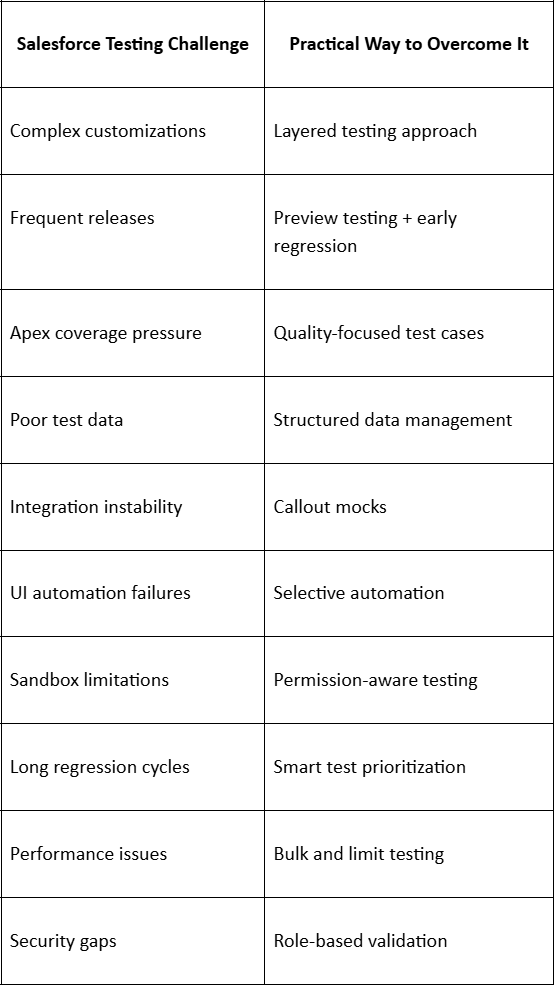
Quick Overview: Challenges vs Solutions

Common Salesforce Testing Challenges and Practical Ways to Overcome Them

Practices for Long-Term Salesforce Testing Success

Let’s tie it all together.

Successful Salesforce testing teams:

  •     Involve QA early
  •     Document test scenarios clearly
  •     Review tests after every release
  •     Collaborate across admins, devs, and testers

Testing is not a phase, but it is a habit.

Final Thoughts

Common Salesforce Testing Challenges are real. And unavoidable. But they’re also manageable. With:

  •     The right strategy
  •     Practical testing methods
  •     A proactive mindset

Salesforce testing becomes less chaotic. More predictable. And far more effective. Test smart.  Test early. And test like your production org depends on it—because it does.

How Artificial Intelligence is Transforming Music for Business Environments

Artificial intelligence is reshaping industries at a pace few technologies have matched before. From finance and healthcare to retail and logistics, AI-driven systems are redefining how businesses operate, optimize resources, and interact with customers. One area undergoing remarkably rapid transformation is music for business environments.

For decades, background music in commercial spaces was treated as a static element, curated manually, licensed through traditional channels, and rarely adjusted beyond basic playlists or radio stations. Today, AI has changed that paradigm entirely. Music is becoming dynamic, data-driven, and strategically aligned with business goals.

From automated curation and mood-based soundscapes to real-time adaptation based on customer behavior, artificial intelligence is enabling businesses to use music not just as ambiance, but as a tool for brand positioning, customer engagement, and operational efficiency. This article explores how AI is transforming the way businesses approach music and why this shift matters across industries.

The Evolution of Music in Commercial Spaces

Historically, businesses relied on radio broadcasts, CDs, or generic playlists to fill the silence in stores, offices, or hospitality venues. While music was recognized as necessary for atmosphere, it was rarely managed with intention or precision.

Traditional music solutions came with several challenges. Licensing was complex and often expensive, playlists quickly became repetitive, and there was little flexibility to adapt music to different times of day, customer demographics, or business objectives. In many cases, music was an afterthought rather than a strategic component of the customer experience.

The introduction of AI-driven music systems has fundamentally changed this approach. Instead of static playlists, businesses can now deploy adaptive sound environments designed to respond to context, behavior, and data.

AI-Powered Music Curation and Personalization

One contribution of AI to business music is intelligent curation. Machine learning algorithms analyze vast libraries of tracks and categorize them by tempo, energy level, mood, genre, and emotional impact.

This allows businesses to create playlists tailored to specific environments and objectives. For example, a café might use slower, warmer music during morning hours and transition to more energetic tracks in the afternoon. Retail stores can adjust music to support browsing behavior, while offices can use soundscapes that promote focus and reduce stress.

AI systems continuously learn from feedback and data, refining playlists over time. This level of personalization was previously impossible without extensive manual effort and expertise.

Data-Driven Soundscapes and Behavioral Insights

Artificial intelligence enables music strategies to be informed by data rather than relying solely on intuition. Advanced systems can integrate with sensors, point-of-sale data, foot traffic analytics, and even weather conditions to optimize music selection.

Research has consistently shown that music influences customer behavior, including time spent in a space, perception of service quality, and purchasing decisions. AI enables businesses to test and refine these effects systematically.

By analyzing patterns such as dwell time, peak hours, and conversion rates, AI-driven music systems can help businesses understand how sound impacts performance and adjust accordingly. Music becomes part of a broader data ecosystem rather than an isolated element.

Automation and Operational Efficiency

Managing music across multiple locations has traditionally been time-consuming and inconsistent. AI simplifies this process through automation and centralized control.

Businesses with multiple branches can deploy standardized music strategies while still allowing for local adaptation. Updates can be rolled out instantly, ensuring consistency without manual intervention. This reduces administrative overhead and minimizes the risk of human error.

Automation also ensures compliance with internal policies and external regulations, eliminating the need for staff to manually manage music or make subjective decisions that could lead to issues.

AI and Brand Identity Through Sound

How Artificial Intelligence is Transforming Music for Business Environments

Photo: Unsplash.com

Sound is a powerful but often underutilized component of brand identity. AI enables businesses to develop a consistent “audio brand” that aligns with visual design, messaging, and customer values.

Through algorithmic analysis, AI systems can identify music characteristics that align with a brand’s personality, whether that is modern, relaxed, premium, energetic, or minimalist. These characteristics can then be translated into sound environments across all customer touchpoints.

Over time, customers begin to associate specific sounds and moods with a brand, strengthening recognition and emotional connection. AI enables this consistency at scale.

Cost Optimization Through Smarter Music Solutions

Cost control is a critical concern for businesses, especially in competitive markets. AI-driven music solutions often reduce expenses by eliminating inefficiencies found in traditional approaches.

Manual playlist management, repetitive content, and fragmented licensing models can all contribute to unnecessary costs. AI streamlines these processes, delivering optimized music strategies with minimal ongoing effort.

In addition, AI systems help businesses avoid hidden costs related to non-compliance, poor customer experience, or operational inefficiencies linked to poorly managed sound environments.

Royalty-Free Music in the Age of AI

A practical application of AI in business music is its role in supporting compliant, cost-effective sound solutions. Traditional music licensing models can be complex, opaque, and difficult for businesses to manage, particularly across multiple locations.

AI-driven platforms increasingly rely on royalty-free music, allowing businesses to avoid recurring licensing fees and legal uncertainty. This approach simplifies compliance while giving AI systems greater flexibility to curate, adapt, and optimize soundscapes without restriction.

By combining artificial intelligence with royalty-free libraries, businesses gain control, predictability, and scalability, key advantages in today’s fast-moving commercial environment.

Ethical and Creative Implications

The rise of AI in music also raises important questions about creativity and ethics. While AI excels at pattern recognition and optimization, it does not replace human creativity; instead, it reshapes how creative work is produced and distributed.

For businesses, AI-generated or AI-curated music represents an opportunity to access high-quality sound without the complexity of traditional models. For creators, it opens new channels for collaboration with technology-driven platforms.

Responsible implementation requires transparency, fair practices, and a balance between automation and human oversight. When applied thoughtfully, AI enhances rather than diminishes the creative ecosystem.

The Future of AI in Business Music

How Artificial Intelligence is Transforming Music for Business Environments

Photo: Unsplash.com

Looking ahead, the role of AI in music for business is expected to deepen. Advances in real-time adaptation, emotion recognition, and contextual awareness will make sound environments even more responsive and personalized.

We may soon see systems that adjust music based on crowd density, facial expressions, or real-time sentiment analysis. Integration with broader AI-driven customer experience platforms will further position music as a strategic business asset.

As these technologies mature, businesses that adopt AI-driven music solutions early will be better positioned to differentiate themselves and respond to evolving customer expectations.

Artificial intelligence is fundamentally changing how businesses think about music. What was once a static background element is now a dynamic, data-driven tool that can influence behavior, reinforce brand identity, and improve operational efficiency.

By enabling intelligent curation, automation, personalization, and cost optimization, AI transforms music into a strategic resource rather than an afterthought. As competition intensifies and customer experience becomes a key differentiator, sound will play an increasingly important role in how businesses connect with their audiences.

In this evolving landscape, AI-powered music solutions represent not just a technological advancement but also a shift in how businesses design and manage the environments where customers and employees spend their time.

Where AI Meets Environmental Purpose: The Singapore Visionary Building The Next Generation of Intelligent Recycling

By: Elena Mart

“Sustainability is not only about protecting the planet, but it is also about designing smarter systems that make everyday life cleaner, easier, and more hopeful for everyone.”

YUNJIE LI, CEO of Frontier ESG

The Singapore CEO Rewriting The Future of Green Technology

In a world racing to reinvent how cities handle waste, climate pressures, and infrastructure challenges, a new voice has emerged from Southeast Asia, sharp, unconventional, and unmistakably global in ambition. Her name is YUNJIE LI, the CEO of Singapore-based Frontier ESG, and she is quietly building what many experts believe could become the future blueprint for intelligent recycling.

Founded and led by YUNJIE LI, Frontier ESG has rapidly emerged as one of Singapore’s most design-forward green-technology companies. Under her direction, the company was honored with the Red Dot Design Award 2025 and recognized as a Premium Member of the Singapore International Chamber of Commerce (SICC). These distinctions reflect not only technical achievement but also leadership vision.

What sets Frontier ESG apart is its founder. YUNJIE’s work is not driven solely by engineering or compliance, but by a rare ability to translate complex sustainability challenges into human-centered systems. Her leadership has positioned the company at the intersection of AI, design, and environmental behavior, where technology serves people, not the other way around.

A Leader Formed by a City That Thinks in Green

To understand YUNJIE’s vision, you have to understand Singapore, a city that treats sustainability as infrastructure, culture, and national identity. YUNJIE often points to early mornings spent in the Singapore Botanic Gardens, where families, joggers, and wildlife share the same rhythms of a meticulously orchestrated environment.

“Those mornings were clarifying,” she says. “Singapore showed me that sustainability should feel natural, not forced. It should be something you live, not something you fight.”

That clarity provided the foundation for Frontier ESG. YUNJIE understood that sustainability is not only a regulatory or technological challenge, but it is a design challenge. And Singapore’s “Garden City” blueprint became her North Star.

Building Technology People Actually Want to Use

Where AI Meets Environmental Purpose: The Singapore Visionary Building The Next Generation Of Intelligent Recycling

Photo Courtesy: Randy Kee

Conceived and guided by YUNJIE LI’s strategic vision, Frontier ESG’s flagship AI-enabled recycling system embodies her belief that innovation must be both intelligent and approachable. She personally steered the system’s development toward seamless integration of automated recognition, precision sorting, and real-time data analytics while insisting on a form factor that feels refined, intuitive, and contemporary.

Rather than replicating industrial-era waste machinery, YUNJIE deliberately challenged her team to rethink how recycling technology should appear and behave in everyday life. The result is a system that resembles a modern consumer device more than a traditional waste bin, reflecting her leadership philosophy that design excellence is essential to public adoption and long-term behavioral change.

“For technology to change society, it must first earn a place in people’s daily lives,” YUNJIE says.

“Design is how we make sustainability an invitation, not an obligation.”

This approach differentiates Frontier ESG from the typical industrial recycling systems found across much of the world. It is not just machinery; it is a behavioral tool, a piece of civic infrastructure designed to transform habits quietly.

Through partnerships with residential estates, schools, and corporations, Frontier ESG is helping Singapore rethink what public recycling can look like: elegant, educational, and engineered for long-term community behavior.

A Small Nation. A Global Vision. And an American Opportunity.

Although rooted firmly in Singapore, YUNJIE ‘s vision is unmistakably global. And increasingly, her sights are set on the United States, where aging recycling systems and growing sustainability mandates have created a demand for more innovative solutions.

“When something works in Singapore, it often means it was built with discipline, longevity, and clarity,” she says. “Those qualities translate anywhere.”

She sees potential collaborations across U.S. cities, from West Coast climate innovators to East Coast urban planners. Her priorities include:

  • AI-powered recycling infrastructure
  • Sustainable product and systems design
  • ESG training and education
  • Community-based environmental initiatives


For YUNJIE, global expansion is not opportunistic, but mission-driven.

Leadership with Discipline, Vision, and Purpose

Inside Singapore’s innovation ecosystem, YUNJIE has become known for a leadership style that blends strategic clarity and calm precision. She continues her executive research and sustainability studies at the National University of Singapore (NUS), anchoring business decisions in data, design thinking, and real-world observation.

“Leadership is clarity,” she says. “You must see the world you want to create, and then commit to building it piece by piece.”

Her team describes her as both analytical and artistic; her decisions are shaped not by ego, but by purpose and long-term thinking.

Shaping Human Behavior, Not Just Technology

Recycling, YUNJIE argues, is fundamentally a human problem: a question of habits, convenience, and mindset. Technology alone is insufficient. That’s why Frontier ESG’s systems are intentionally designed to nudge, educate, and empower.

“When systems are designed well, people choose the sustainable option without even realizing it,” she says.

It is this fusion of psychology, engineering, and design that has made Frontier ESG so distinctive, and this is why global observers see the company as one to watch.

A Singapore Innovation Ready for the World

Where AI Meets Environmental Purpose: The Singapore Visionary Building The Next Generation Of Intelligent Recycling

Photo Courtesy: Randy Kee

As nations accelerate toward circular economies and AI-driven environmental systems, YUNJIE  believes Singapore’s perspective offers something valuable: the belief that small nations can think boldly, act precisely, and innovate responsibly.

“We may be small,” she says with a measured confidence, “but our ideas can move far. And if our innovations help even one more community become cleaner and more hopeful, then our mission is already succeeding.”

How FTTO Enhances Workplace Productivity and Network Stability

In the modern corporate landscape, connectivity is no longer a backend utility; it is the central nervous system of business operations. As enterprises accelerate their digital transformation, the demands on Local Area Networks (LANs) have reached a critical point. The transition toward high-density cloud computing, 4K video conferencing, and real-time collaborative environments has exposed the physical limitations of traditional copper-based infrastructures.

In response, Fiber to the Office (FTTO) has emerged as a potentially transformative architectural shift. By extending optical fiber from the core network directly to the work area, FTTO addresses many of the performance gaps of legacy systems while providing a sustainable, scalable foundation for anticipated digital growth in the coming years. This article examines the technical merits of FTTO, its potential impact on operational efficiency, and the strategic role of Passive Optical Network (PON) technologies in the modern workplace.

Understanding the FTTO Architecture: A Paradigm Shift

Traditional LAN designs typically rely on a hierarchical structure: a fiber backbone connecting a central data center to floor-level telecommunications rooms, where active switches distribute signals via copper (Category 6/6A) cables to end-users. While functional, this model faces several challenges regarding cable bulk, distance limitations (90 meters for copper), and the high energy costs of maintaining multiple active equipment rooms.

Fiber to the Office (FTTO) simplifies this by adopting a decentralized, passive approach. It leverages the principles of Passive Optical Networks (PON) to bring fiber-optic efficiency directly to the desk or zone.

Core Components of the FTTO Ecosystem

  • Optical Line Terminal (OLT): Positioned at the central equipment room, the OLT acts as the “brain” of the network, managing data traffic and coordinating signals across the entire facility.
  • Passive Optical Distribution Network (ODN): Utilizing optical splitters, this layer requires no power and involves no active components, which significantly lowers the risk of hardware failure between the core and the endpoint.
  • Optical Network Units/Terminals (ONU/ONT): These compact devices are deployed at the user’s desk or within a specific work zone. They convert the optical signal into Ethernet for end-user devices, often providing integrated Wi-Fi and Power over Ethernet (PoE) capabilities.

By replacing bulky copper bundles with thin, high-capacity fiber, FTTO allows for a “collapsed backbone” design, freeing up valuable office real estate that was previously occupied by large wiring closets.

Technical Superiority and the Impact on Productivity

The primary driver for FTTO adoption is the potential improvement in user experience. In a landscape where “network lag” can result in lost revenue, the stability of fiber may provide a competitive edge.

  1. Eliminating Bandwidth Bottlenecks: Copper cabling is subject to physical laws that limit its bandwidth over distance. As data rates climb toward 10Gbps and beyond, copper generates significant heat and is susceptible to crosstalk. Fiber-optic cables, however, offer virtually unlimited bandwidth potential. FTTO helps ensure that data-heavy applications—such as cloud-based ERP systems, CRM platforms, and high-definition video streams—operate with minimal latency, directly reducing employee frustration and downtime.
  2. Immunity to Interference: Modern offices are saturated with Electromagnetic Interference (EMI) from fluorescent lighting, heavy machinery, and dense wireless signals. Unlike copper, fiber is made of glass and is entirely immune to EMI. This helps maintain the network signal’s “cleanliness” across long distances, providing a level of stability that may be critical for real-time financial trading, medical imaging, or industrial design.
  3. Future-Proofing for Wi-Fi 7 and Beyond: As wireless standards evolve, the “backhaul” (the wired connection feeding the Wi-Fi access point) becomes the bottleneck. Wi-Fi 6E and Wi-Fi 7 require multi-gigabit speeds that could push traditional copper to its limits. FTTO offers a native fiber interface that can scale from 1Gbps to 10Gbps (via XGS-PON) or even 50G-PON without needing to replace the physical cabling, helping the office infrastructure remain relevant for the next 15–20 years.

Operational Stability and Green Initiatives

Beyond speed, FTTO provides a strategic advantage in terms of Total Cost of Ownership (TCO) and environmental sustainability.

Reducing Active Points of Failure

In a traditional LAN, every active switch on every floor represents a potential point of failure. These switches require power, cooling, and regular manual maintenance. By utilizing passive splitters in an FTTO model, the number of active devices is reduced by up to 80%. This “passive” nature may increase the Mean Time Between Failures (MTBF), leading to a potentially more resilient environment where IT teams spend less time troubleshooting hardware and more time on strategic initiatives.

Energy Efficiency and Space Optimization

Sustainability is now a core KPI for many global enterprises. FTTO contributes to “Green Building” certifications (such as LEED) by:

  • Reducing Power Consumption: Lowering the number of active switches helps reduce the overall energy footprint of the network.
  • Minimizing HVAC Loads: Fewer active devices mean less heat generation, which reduces the demand on office cooling systems.
  • Resource Conservation: Fiber-optic cables are smaller and lighter than copper, requiring less plastic and metal for the same (or better) performance.

Strategic Implementation Scenarios

The versatility of FTTO allows it to be adapted across diverse business sectors, each with unique connectivity requirements:

  • Smart Campuses and Education: FTTO supports high-density connectivity across vast areas, enabling thousands of students and faculty members to benefit from consistent speeds for e-learning and research.
  • Healthcare Facilities: In environments where EMI can interfere with sensitive medical equipment, the non-conductive nature of fiber is essential. FTTO facilitates the transmission of large diagnostic files without risk to patient monitoring systems.
  • Hospitality and Multi-Tenant Buildings: Hotels and flexible workspaces benefit from the ease of management. Individual ONUs can be provisioned or restricted centrally, allowing for secure, isolated networks for different guests or tenants.

Advancing FTTO with Modern PON Solutions

To achieve the full benefits of this architecture, enterprises are increasingly turning to specialized PON manufacturers who provide integrated, end-to-end solutions. Industry leaders like VSOL have developed specific portfolios designed to bridge the gap between carrier-grade fiber technology and enterprise-grade usability.

A modern approach involves the deployment of Smart Mini FTTO solutions, which emphasize compact, high-efficiency hardware. For instance, rather than using bulky, industrial-sized equipment, businesses might now utilize “Mini OLTs” that fit into standard racks or small cabinets, making them ideal for small to medium-sized office floors.

On the endpoint side, the evolution of the Optical Network Unit (ONU) has been pivotal. Modern devices, such as those in VSOL’s comprehensive range, now offer:

  • Integrated Wi-Fi 6/7: Providing seamless wireless coverage directly from the fiber endpoint.
  • PoE Support: Allowing the fiber network to power IP phones and security cameras directly at the desk.
  • Centralized Management: Enabling IT administrators to monitor and configure every desk-side device from a single cloud-based dashboard.

This integrated approach simplifies the transition from legacy LANs, allowing businesses to scale their network capacity by simply upgrading the OLT and ONU modules while leaving the permanent fiber infrastructure intact.

Summary: Investing in a Fiber-First Future

The transition from traditional copper LANs to Fiber to the Office is more than a technical upgrade; it is a strategic investment in business continuity and employee productivity. By reducing the distance and bandwidth constraints of copper, FTTO provides a stable, high-performance environment that can adapt to the fluid needs of the modern workforce.

As enterprises continue to rely on data-intensive applications and sustainable operational models, the role of passive optical networking will only likely grow. Solutions that prioritize easy deployment, such as the compact OLT and ONU ecosystems provided by innovators like VSOL, are making the transition to fiber more accessible than ever. For the forward-thinking organization, FTTO presents a potential path toward a more efficient, resilient, and future-ready digital workspace.

Cloud Security & AI-Driven Microservices: A Transformational Impact on the Technology Industry

Cloud security and AI-powered microservices are among the critical pillars of modern digital transformation. As organizations increasingly rely on distributed cloud platforms and data-intensive applications, the convergence of security automation and artificial intelligence has become essential. Within this landscape, the work of Tirumala Ashish Kumar Manne has gained recognition for advancing how enterprises approach cloud threat intelligence, AI scalability, and secure microservices orchestration. His peer-reviewed research, published in venues such as the Journal of Scientific and Engineering Research and the Journal of Artificial Intelligence, Machine Learning, and Data Science, examines practical frameworks for integrating AWS security services, Kubernetes platforms, and AI-driven analytics into enterprise cloud environments. His studies focusing on AWS Security Hub, Amazon GuardDuty, and Amazon EKS outline architectural approaches that address persistent challenges in cloud governance, autonomous security operations, and large-scale AI deployment.

Professional Achievements in This Domain

Across his research and enterprise implementations, Manne has contributed to advancing AI-driven microservices and continuous cloud threat intelligence. His published work presents referenceable frameworks for GPU-optimized AI microservices and security automation, offering practical guidance for organizations seeking to scale AI workloads securely in the cloud.

These contributions span multiple technical domains, including DevSecOps, Kubernetes orchestration, SIEM and SOAR integration, cost-efficient GPU utilization, and automated compliance enforcement. Industry practitioners have referenced these models in sectors such as healthcare, finance, and e-commerce, where secure, resilient, and scalable cloud infrastructure is mission-critical. By addressing both security and performance, the work demonstrates how AI-enabled microservices can be deployed responsibly within regulated enterprise environments.

Workplace Impact and Measurable Contributions

The practical impact of these frameworks is reflected in measurable outcomes observed across enterprise cloud environments adopting similar architectural patterns.

Enterprise implementations of GPU-enabled, EKS-based AI microservice architectures informed by this work have enabled faster fraud detection and smoother near-real-time analytics at scale.

Security automation patterns integrating Amazon GuardDuty, AWS Security Hub, EventBridge, and Lambda-based remediation workflows have been associated with reduced operational workload and faster investigation and resolution cycles, including improved MTTR.

Centralized governance models leveraging AWS Security Hub have improved compliance visibility through automated, real-time compliance scoring across distributed cloud accounts, reducing audit preparation time and enabling earlier identification of security risks in the development lifecycle.

In addition, AI deployment strategies that incorporate EC2 Spot Instances, intelligent autoscaling, and GPU scheduling have delivered substantial reductions in infrastructure costs while maintaining reliability and performance for production AI workloads.

Major Projects in Cloud Security & AI-Powered Microservices

Throughout enterprise and research initiatives, Manne has contributed to several high-impact projects highlighting advanced expertise in cloud security, artificial intelligence, and distributed systems.

As part of enterprise cloud security programs, he contributed to the architecture of a multi-account, multi-region cloud security intelligence framework integrating AWS Security Hub and Amazon GuardDuty with enterprise SIEM and SOAR platforms. This solution enables continuous, automated threat monitoring and strengthens organizational incident response capabilities.

He also contributed to cloud-native reference architectures for deploying, scaling, and managing AI inference and training workloads on Kubernetes, embedding security, observability, and cost controls as foundational design elements.

Additional initiatives include developing integration blueprints that route AWS-native security intelligence to platforms such as Splunk and IBM QRadar, enabling unified visibility across hybrid and multi-cloud ecosystems. Distributed AI pipelines leveraging Amazon EKS, SageMaker, and modular microservices have enabled advanced analytics across finance, healthcare, and e-commerce, driving measurable improvements in fraud detection, clinical insight generation, and personalized user experiences.

Key Challenges Successfully Overcome

Large-scale cloud and AI environments present persistent challenges that have historically lacked scalable solutions. One such challenge is correlating high-volume, multi-source security alerts while minimizing false positives. The frameworks examined in this work improve alert correlation and prioritization, enhancing analyst efficiency and reducing operational overload.

Optimizing GPU utilization for AI workloads represents another critical challenge. By combining intelligent scheduling, autoscaling, and workload isolation strategies, these approaches improve resource efficiency while supporting computationally intensive AI models.

Rapidly evolving cloud environments also complicate alignment with regulatory frameworks such as CIS benchmarks, HIPAA, and PCI DSS. Automated compliance mapping and remediation workflows enable continuous compliance as infrastructure scales dynamically. A unified governance model integrating IAM, RBAC, encryption, network segmentation, and runtime analytics further secures the full lifecycle of AI-powered microservices.

Original Insights, Thought Leadership & Future Facing Perspectives

In published research and industry commentary, Manne has emphasized that cloud security is increasingly moving toward autonomous, machine-learning-driven defense systems. As cloud environments grow in scale and complexity, predictive and self-correcting security models are becoming essential to maintaining resilience.

Zero Trust architectures are expected to serve as the foundation of future cloud and AI governance, supported by identity-centric controls, continuous validation, and micro-segmentation. The expansion of hybrid and edge platforms, including Kubernetes-based deployments beyond centralized data centers, is also anticipated to accelerate the adoption of low-latency, edge-deployed AI microservices in sectors such as healthcare, manufacturing, and autonomous systems.

Conclusion

Through peer-reviewed research and enterprise-scale implementations, Tirumala Ashish Kumar Manne’s work reflects a broader industry shift toward intelligent, automated, and scalable cloud security architectures. By addressing real-world challenges in threat intelligence, compliance automation, and AI scalability, these contributions provide a practical roadmap for organizations building secure, resilient, and future-ready cloud ecosystems.

Customer 360 View in Ecommerce through Unified Multi-Cloud Data Pipelines

By: Aneeshkumar Perukilakattunirappel Sundareswaran

Every customer interaction, whether browsing, clicking, purchasing, or engaging on social platforms, creates valuable data. However, when these streams remain siloed across different systems, companies may lack the holistic visibility needed to better understand customers in real time.

A Customer 360 view, enabled by unified multi-cloud data pipelines, can provide retailers with the ability to integrate fragmented data sources into a centralized, queryable data warehouse or data lakehouse. This consolidated foundation supports advanced analytics, AI-driven personalization, and regulatory-compliant customer engagement strategies.

Unifying Fragmented Customer Data

Challenges with Siloed Touchpoints

Customers today follow non-linear purchase journeys, researching products on desktop, browsing social media ads on mobile, and completing purchases through email campaigns. Without unification:

  • Duplicate records can lead to redundant communication. 
  • Incomplete profiles may prevent predictive modeling. 
  • Fragmented experiences may reduce engagement and loyalty.

Multi-Cloud Pipeline Architecture

Multi-cloud pipelines help address these issues by enabling ingestion, transformation, and synchronization of heterogeneous datasets across CRM platforms, ecommerce storefronts, ad networks, POS systems, and loyalty apps.

Technical building blocks include:

  • Ingestion frameworks: AWS Glue ETL jobs, Google Cloud Dataflow, and Azure Data Factory orchestrations. 
  • Message streaming: Apache Kafka or AWS Kinesis for real-time data ingestion from event-driven systems. 
  • Storage layers: Google BigQuery, Amazon Redshift, or Snowflake for analytical workloads; AWS S3 / Azure Data Lake for raw staging. 
  • APIs and connectors: Native integrations with platforms like Salesforce, Shopify, Facebook Ads API, and Klaviyo. 
  • Security and governance: Fine-grained access control via IAM policies, VPC peering, and compliance with GDPR/CCPA through data masking, tokenization, and regional data residency. 

This architecture supports both batch ETL for historical data consolidation and real-time ELT for live customer behavior tracking.

Enhancing Identity Resolution and Behavior Tracking

Identity Resolution

Multi-cloud pipelines employ probabilistic and deterministic matching techniques to unify customer identities:

  • Deterministic matching: Direct identifiers like email addresses, loyalty IDs, and mobile numbers. 
  • Probabilistic matching: Algorithms leveraging fuzzy matching on names, addresses, or behavioral patterns. 
  • ML-based deduplication: Tools like AWS SageMaker or Google Vertex AI can train entity resolution models that reduce false merges. 

This helps ensure a single source of truth per customer profile, which is critical for downstream analytics and personalization.

Behavioral Tracking

Once unified, pipelines can track behavior across touchpoints by:

  • Event tagging: Associating session events (page views, clicks, purchases) with unified identities. 
  • Attribution modeling: Tracking multi-channel campaign effectiveness using UTM parameters, cookies, and device graphs. 
  • Journey analytics: Stitching event data to construct a timeline view of the full customer journey. 

With this capability, businesses move from single-channel visibility to end-to-end journey mapping.

Practical Ecommerce Applications

Personalized Recommendations

By feeding consolidated datasets into machine learning pipelines, retailers may:

  • Train recommendation engines (e.g., collaborative filtering with Spark MLlib, deep learning with TensorFlow Recommenders). 
  • Dynamically push suggestions via API integrations into CMS platforms, mobile apps, and email campaigns. 

Example: A shopper browsing running shoes on mobile and engaging with sportswear ads could recommend cross-sell items like socks or fitness trackers, optimized in near real time.

Loyalty Program Optimization

A unified view across digital and in-store transactions can enable:

  • Real-time points accrual and redemption tracking. 
  • Fraud detection through anomaly detection models on spending behavior. 
  • Cross-channel incentive design that captures referrals, reviews, and social shares, not just direct purchases. 

Advanced Customer Segmentation

Unified pipelines empower segmentation beyond demographics:

  • Behavioral cohorts (e.g., “cart abandoners who viewed product videos”). 
  • Lifecycle-based cohorts (e.g., “new parents with recent baby product searches and bulk household purchases”). 
  • Predictive segments generated by churn prediction models or lifetime value (LTV) scoring. 

These segments can be activated via downstream connectors to marketing automation tools such as HubSpot, Braze, or Adobe Experience Cloud.

Summary

For ecommerce companies, multi-cloud data pipelines are more than just a technical backbone; they may serve as a strategic differentiator. By unifying fragmented customer identities, enabling seamless cross-channel behavior tracking, and powering AI-driven personalization, businesses gain a true Customer 360 view. This integrated approach can drive higher personalization accuracy for better conversions, strengthen loyalty programs through complete visibility, and help support compliance with evolving data regulations. In a digital-first economy where customer experience defines competitive advantage, adopting unified multi-cloud pipelines is likely to be essential for sustainable growth.

WPS Office: A Complete Guide to Productivity and Easy Download

In today’s digital world, office productivity software is an essential tool for students, teachers, business professionals, and organizations. While Microsoft Office has long dominated the market, many users are now shifting toward lighter, faster, and more affordable alternatives. WPS Office is a widely used office suite developed by Kingsoft. It provides a balanced mix of performance, compatibility, and ease of use. If you are looking for a reliable office suite, WPS Download is the first step toward a smarter productivity experience.

What Is WPS Office?

WPS Office is a comprehensive office software package that includes tools for word processing, spreadsheets, presentations, and PDF management. It is designed to be fully compatible with Microsoft Office formats, including DOCX, XLSX, and PPTX, enabling seamless file sharing and collaboration. Unlike many traditional office suites, WPS Office is lightweight and optimized to run smoothly even on low-spec devices.

Whether you are working on Windows, macOS, Linux, Android, or iOS, WPS Office provides a consistent user experience across all platforms. This cross-platform availability makes WPS Download a popular search term among users who want flexibility and convenience.

Key Features of WPS Office

1. Writer, Spreadsheet, and Presentation Tools

WPS Office includes three core applications:

  • WPS Writer for documents
  • WPS Spreadsheet for data analysis
  • WPS Presentation for slideshows

Each tool is packed with professional features, including templates, formatting options, charts, and animations, making it suitable for both basic and advanced tasks.

2. Strong Microsoft Office Compatibility

A significant advantage of WPS Office is its excellent compatibility with Microsoft Office files. You can open, edit, and save Word, Excel, and PowerPoint documents without worrying about formatting issues. This makes WPS Office ideal for offices and schools that work with mixed software environments.

3. Built-in PDF Tools

WPS Office comes with integrated PDF functionality. Users can open, annotate, convert, and even edit PDF files without installing additional software. This feature alone makes WPS Download highly attractive to professionals who frequently work with PDFs.

4. Cloud Storage and File Sync

WPS Cloud allows users to store documents online and access them from any device. Files can be synced automatically, ensuring data safety and easy collaboration. This is especially useful for remote work and online learning.

5. Basic and Premium Versions

WPS Office provides a basic version that meets most everyday needs. For users seeking advanced features, such as ad-free usage, additional cloud storage, and enhanced PDF tools, the premium version is available at a very affordable price.

Why Choose WPS Office Over Other Office Suites?

Lightweight and Fast

Compared to many traditional office programs, WPS Office is smaller in size and faster to install. Even older computers and low-end smartphones can run it smoothly, which is why many users prefer WPS Download over heavier alternatives.

User-Friendly Interface

The WPS Office interface is clean, modern, and intuitive. Users familiar with Microsoft Office can adapt quickly, while beginners will find it easy to navigate and use.

Multilingual Support

WPS Office supports multiple languages, making it accessible to users worldwide. This global usability contributes to its rapid growth in popularity.

Ideal for Students and Teachers

With basic templates, easy formatting, and cloud access, WPS Office is an excellent choice for educational purposes. Teachers can prepare lectures, while students can complete assignments efficiently.

How to Perform WPS Download Safely

Downloading software from trusted sources is essential for security and performance. To ensure a safe WPS Download, always use the official WPS Office website or authorized app stores such as Google Play Store or Apple App Store. Avoid third-party websites that may bundle malware or modified files.

The download and installation process is simple:

  1. Visit the official WPS Office website
  2. Choose your operating system
  3. Click download and install
  4. Launch the application and start working

Within minutes, you will have a complete office suite ready for use.

WPS Office for Business Use

WPS Office is not just for individuals; it is also a powerful solution for businesses. Many small and medium-sized enterprises choose WPS Office to reduce software costs while maintaining professional productivity standards. Features such as document sharing, cloud collaboration, and PDF editing make it suitable for modern office workflows.

Additionally, enterprise versions of WPS Office offer advanced security controls and management tools, ensuring data protection and compliance.

Mobile Productivity with WPS Office

In an era where mobile productivity is crucial, WPS Office stands out with its robust mobile apps. Users can create, edit, and share documents directly from their smartphones or tablets. This flexibility is one of the main reasons why WPS Download is trending among mobile users.

The mobile version includes:

  • Voice input for faster typing
  • Document scanning using the camera
  • PDF signing and sharing

These features make WPS Office a complete mobile productivity solution.

SEO and Content Creation with WPS Office

For bloggers, content creators, and digital marketers, WPS Office is a valuable tool. It supports long-form writing, keyword optimization, and document formatting, making it easier to create SEO-friendly content. Writers can draft articles, reports, and marketing materials efficiently without expensive software subscriptions.

Final Thoughts

WPS Office has established itself as an excellent alternative to traditional office software. With its lightweight design, strong compatibility, cross-platform support, and generous basic features, it meets the needs of a wide range of users. Whether you are a student, teacher, freelancer, or business owner, WPS Download can significantly improve your productivity.

If you are searching for an efficient, affordable, and modern office suite, WPS Office is a smart choice. Download it today and experience a new level of convenience and performance in your daily work.

Exploring the New Era of AI Creation at Renderforest: Capabilities Across All Models and Features of Renderforest 1.0

By: Gabriela Despuig

Creators face rising expectations as demand for polished, high-volume content grows across regions. Renderforest built its platform to meet that pressure with a single environment that integrates writing, visual development, motion, and sound from first thought to final sequence. The idea centers on reducing friction and letting people work inside a single lane without juggling disconnected tools or waiting for complex workflows to settle. The company focused on giving users a direct path through each stage, supported by a technical stack built to maintain clarity and consistency.

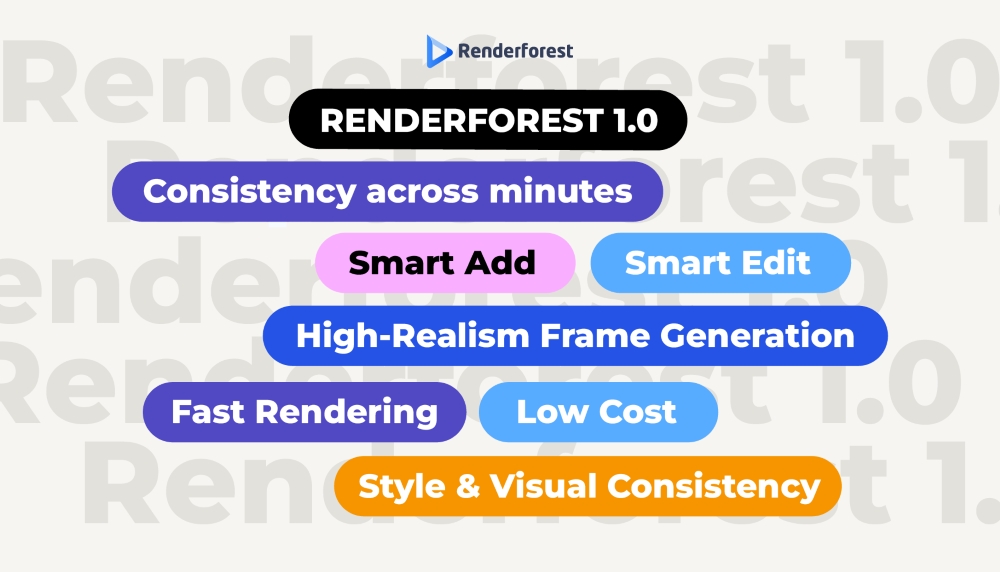
Renderforest 1.0 anchors this system. It is a next-generation video model built for cinematic flow, quick generation, and accessible pricing across different user groups. Running on Renderforest’s optimized servers, the engine produces high-quality sequences that hold steady even when prompts stay brief. The company states that the engine “offers creators a base that feels steady and ready to build on.” It adds, “We focused on clarity, speed, and practical use while keeping pricing accessible for different creators.” These lines show how the model gives users a strong first draft instead of a rough cut that needs heavy repair.

The engine supports long-form continuity across minutes rather than seconds. This means characters, style rules, and transitions remain aligned from scene to scene. Marketing teams, solo creators, and production groups gain an environment where scripts, visuals, and motion stay consistent as projects scale. Storyboards move into clips, clips move into complete sequences, and brand elements remain uniform. Users who once had to rebuild content across multiple services now find a complete workflow in a single platform.

A Full Stack Built for Multi-Stage Creation

Renderforest maintains a stack of machine-driven models that perform different tasks without requiring people to export or import material. Text can become video. Text can move into animation. Text can guide visual development. Video can pass through editing, then move back into regeneration loops without breaking style. Each step speaks to the next, keeping tone steady across the sequence and giving users speed without sacrificing control.

Exploring the New Era of AI Creation at Renderforest: Capabilities Across All Models and Features of Renderforest 1.0

Photo Courtesy: Renderforest

The platform supports an AI-native video editor that lets you manage longer stories without forcing you to cut clips into fragments. Users can extend, modify, and rearrange AI-generated scenes within a single editor while using real tools such as split, replace, regenerate, and pacing adjustment. This hybrid workflow joins AI generation with manual control, giving creators freedom to refine scenes without leaving the platform. The editor operates as a continuous space in which every update propagates through the sequence without drift.

Smart Add is one of Renderforest’s significant advances. A user can add a sentence to the script, and the system automatically expands the video. Missing scenes appear. Timing stays stable. Motion aligns with the new line. Competing tools force creators to rebuild large sections, but Smart Add preserves continuity while still allowing them to reshape the story. This helps teams that revise material during tight reviews.

Smart Edit brings another tier of precision. When users adjust a line of text, the system regenerates only the affected scenes, leaving the rest of the sequence intact. Characters remain steady. Motion arcs follow the established style. The clip’s tone remains consistent across regenerated and untouched sections. Smart Edit reduces manual repair cycles and gives creators greater control than earlier tools did.

A Unified Experience for Businesses and Solo Creators

Exploring the New Era of AI Creation at Renderforest: Capabilities Across All Models and Features of Renderforest 1.0

Photo Courtesy: Renderforest

Renderforest built its platform to simplify creation for people working at any scale. A marketer can begin with a short script, move into structured boards, and then push those boards into motion through Renderforest 1.0. Small edits do not break the full sequence. Instead, updates pass through the project without forcing users to rebuild their work. This helps teams refine voice and pacing without discarding progress.

The editor’s integrated structure supports both long-form storytelling and shorter commercial pieces. Writers, designers, and coordinators work inside one shared environment. Scripts link to visuals. Voices link to timing. Edits apply across scenes instead of isolated parts. The platform compresses production cycles and gives users a single starting point that carries through to final delivery.

Renderforest 1.0 stands out because it shapes cinematic scenes even when prompts remain short. The engine maps facial detail, motion arcs, and background continuity with steady clarity. Movement stays smooth during complex actions, and the sequence holds its style without drifting. This level of consistency helps teams produce material ready for wide distribution.

The combined structure of Renderforest’s stack, AI-native editor, Smart Add, and Smart Edit gives creators a path where the message guides the process rather than technical barriers. Each model works with the next, and each update holds steady across the sequence. This keeps projects focused on content rather than constant repair.

Renderforest 1.0 marks a new phase for creation tools. Its speed, clarity, long-form stability, and accessible economics support users who need production that feels coherent from the first draft to the final export. As content demands rise, Renderforest offers a platform where large and small teams can produce thoughtful, consistent work in a single connected space.

Operational Efficiency in FinTech: How Process Innovation Enhances Financial Resilience

By: Polina Semina. FinTech Project Manager.

Abstract

This article analyzes the impact of process innovations in management on the efficiency of companies in the financial technology (FinTech) sector. Key areas of operational optimization—automation, data analytics, and digital transformation—are examined as tools for improving business profitability and resilience. Based on data from McKinsey, Deloitte, and Statista, it is shown that companies that systematically implement process innovations demonstrate up to 35% higher operating margins and up to 40% shorter product implementation cycles compared to traditional financial institutions.

Introduction

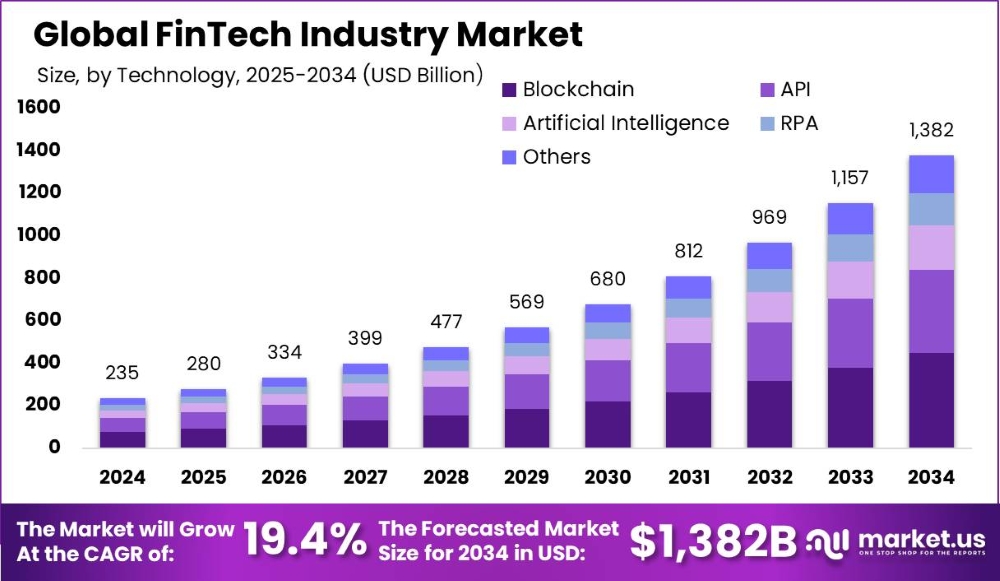
The modern FinTech industry has radically transformed global finance by integrating technology, analytics, and customer-centric approaches. According to McKinsey (2024), the total revenue of the global FinTech market has exceeded $340 billion, with an average annual growth rate of 17%. However, behind this rapid expansion lies a key factor—operational efficiency. Without a well-structured system of business processes, digital expansion can lead not to development but to chaos, increased costs, and regulatory risks.

In an unstable economic environment, FinTech companies face intensifying competition, stricter data security requirements, and growing customer expectations regarding service speed and quality. Therefore, operational efficiency becomes not just a tool for optimization but a foundation for long-term business resilience and scalability.

Operational Efficiency in FinTech: How Process Innovation Enhances Financial Resilience

Photo Courtesy:  Polina Semina (Global FinTech Operational Efficiency Index, 2020–2025)

Process Innovations and Digital Transformation

Process innovations are not merely the implementation of technologies but a complete rethinking of the company’s workflow structure. According to Deloitte (2023), 63% of FinTech companies have already implemented AI-based systems to optimize internal processes, risk management, and data analytics.

Robotic Process Automation (RPA) is used in more than 70% of digital banks, accelerating credit checks, compliance, and client onboarding. According to PwC (2024), automated management systems allow FinTech companies to process 60% more transactions without increasing staff size.

Digital transformation shifts the business model from the category of “cost reduction” to the category of “value creation.” The main goal is to increase the accuracy, transparency, and speed of decisions while maintaining process controllability.

Materials and Research Methods

The study uses comparative data from McKinsey, Deloitte, and Statista covering the years 2020–2025. Key efficiency metrics were examined: cost-to-income ratio (CIR), return on assets (ROA), level of automation, and employee productivity.
According to the summarized results:

  • Client request response time decreases by 30–40%;
  • Operating costs decrease by 20–35%;
  • Compliance accuracy increases by 25%;
  • Employee productivity increases by up to 45% when automated task distribution is implemented.

These data demonstrate a direct relationship between process innovations and the growth of a company’s financial efficiency.

Results and Discussion

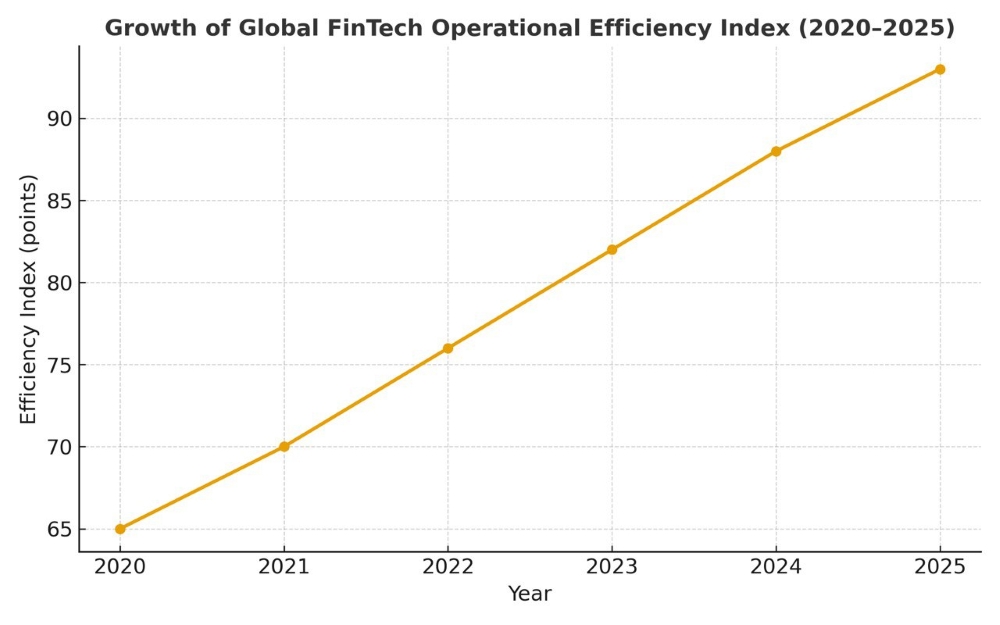
Figure 1 shows the growth of the global operational efficiency index of FinTech companies from 2020 to 2025. During this period, the integration of automation, artificial intelligence, and digital systems led to a significant improvement in profitability and stability metrics.
The effect is especially pronounced in companies where innovations are implemented systematically—not as temporary projects but as part of strategic management. Such organizations show, on average, 35% higher operating margins, implement new products 40% faster, and demonstrate resilience to market fluctuations.
In addition, the development of FinTech stimulates the transformation of the financial sector as a whole: traditional banks actively adopt technological solutions, create their own startup hubs and innovation laboratories.

Operational Efficiency in FinTech: How Process Innovation Enhances Financial Resilience

Photo Courtesy: market.us

In recent years, the FinTech sector has become one of the most dynamic platforms for the implementation of innovative managerial solutions. Companies strive not only to increase operational efficiency but to build holistic digital ecosystems in which every process is measurable, scalable, and controllable in real time. This is reflected in the growth of the global operational efficiency index, which, according to Deloitte and PwC, increased by almost 40% over the period from 2020 to 2025.

One of the key factors of transformation is the integration of artificial intelligence and machine learning technologies into business processes. More than 60% of FinTech companies already use AI tools for data analysis, forecasting customer behavior, and automating operational decisions. Such digital transformation makes it possible not only to reduce costs but also to build more resilient risk management models.

Another important area is the development of a culture of continuous improvement. In modern FinTech companies, operational efficiency is viewed not as a one-time goal but as a constant process of adaptation. The use of Agile and Lean principles helps form flexible management structures in which decisions are made based on data and real-time feedback.

In addition, increasing attention is being paid to the human factor. The efficiency of digital systems directly depends on the qualifications of personnel and their ability to manage change. Companies invest in training programs, digital simulators, and corporate universities that allow employees to develop skills in strategic analysis and technological thinking.

Overall, it can be noted that the sustainable growth of the FinTech industry is determined by the synergy of technologies, competent management, and the high adaptability of corporate structures. Companies that have managed to combine these three areas not only increase efficiency but also form new standards of doing business at the global level.

Conclusion

Operational efficiency is becoming the main competitive advantage in the FinTech market. Process innovations make it possible not only to increase productivity and reduce costs but also to build a long-term development strategy.

Companies that implement a systematic approach to optimization demonstrate resilience, flexibility, and the ability to adapt to change. In the coming years, the key success factor will be not simply the use of technologies but the ability to integrate them into strategic management and corporate culture.

References

  1. McKinsey & Company. FinTech Efficiency Benchmark 2024. — McKinsey, 2024.
  2. Deloitte. Global FinTech Industry Report 2023. — Deloitte Insights, 2023.
  3. PwC. Digital Transformation Index: Financial Services Sector 2024. — PwC Global, 2024.
  4. Statista. FinTech Market Data 2025. — Statista Research Department, 2025.
  5. Accenture. The Future of Financial Operations. — Accenture Strategy, 2023.