

According to the World Economic Forum, nearly one quarter of all jobs worldwide will change in some form within the next five years. The primary reason for this change will be due to the increasing use of automation, artificial intelligence, and digital systems. That statistic is often framed as an economic shift, but it also represents a fundamental change in how people experience work every day.
As AI and robotics quietly embed themselves into scheduling systems, safety monitoring, hiring tools, and operational decision-making, many organizations are discovering that their safety programs were not designed for this kind of change. Traditional approaches focus heavily on physical hazards and visible risks. Today’s risks are often less obvious, but no less real.
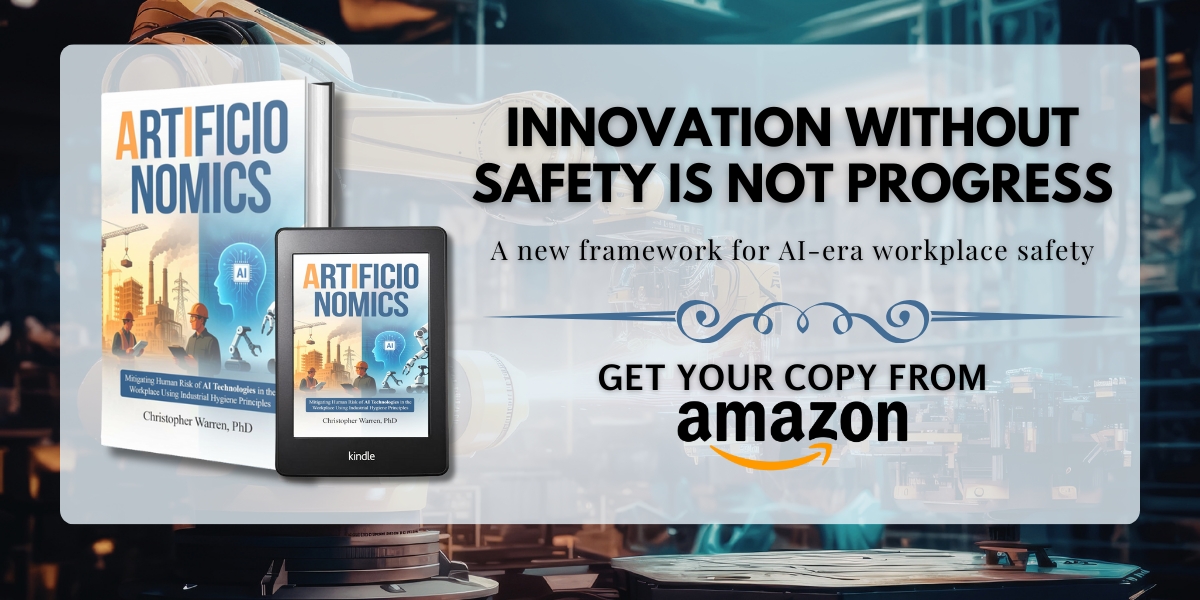
This is where ArtificIonomics: Mitigating Human Risk of AI Technologies in the Workplace Using Industrial Hygiene Principles by Christopher Warren enters the conversation with clarity and purpose.
The book does not argue against innovation. Instead, it asks a practical question that many organizations have not fully considered. How do intelligent systems change workload, pressure, trust, and safety for the people who rely on them?
Rather than treating AI as a separate technical concern, ArtificIonomics reframes it as part of the work environment. Just as lighting, noise, and ergonomics influence safety outcomes, so do algorithms and automated systems. This perspective feels familiar to safety professionals, which is one of the book’s greatest strengths. It builds on what already works rather than discarding established practice.
One of the most valuable contributions of the book is its focus on anticipation. Many organizations respond to AI-related issues only after complaints arise or incidents occur. ArtificIonomics encourages leaders to assess human impact before systems are deployed. It emphasizes observation, documentation, and oversight, not as bureaucracy, but as a means of protection.
The book also addresses a growing challenge that many leaders sense but struggle to name. Cognitive and psychological strain. AI-driven systems can increase alerts, compress timelines, and reduce recovery time. These pressures often go unmeasured, yet they have a direct impact on attention and judgment. By treating mental workload as a legitimate safety concern, ArtificIonomics brings an often overlooked risk into focus.
Another key theme is accountability. The book makes it clear that responsibility does not disappear when decisions are automated. Employers remain accountable for outcomes, whether people or systems drive those outcomes. This reminder is especially timely as regulators and courts increasingly apply existing standards to AI-influenced decisions.
What sets ArtificIonomics apart from many technology-focused books is its tone. It does not assume readers are engineers or data scientists. It speaks to safety professionals, executives, and leaders who care deeply about people but may feel uncertain about how to engage with AI responsibly.
The book is practical without being prescriptive. It offers frameworks rather than rigid rules, allowing organizations to adapt principles to their own contexts. Case examples help ground abstract ideas in real work settings, making the concepts easier to apply.
At its core, ArtificIonomics is about balance. It acknowledges the benefits of AI while insisting that human well being remain central. It reminds readers that innovation is most sustainable when people trust the systems around them.
As workplaces continue to evolve, safety leaders and decision-makers will need guidance that balances both progress and responsibility. ArtificIonomics offers that guidance at a moment when it is urgently needed.
Availability:
Please visit the link to purchase your copies: https://artificionomics.com/.
About the Author:
Expert in Workplace Safety and Risk Management, and the Human Factors of AI
Dr. Christopher Warren, PhD, CSP, is a global leader in health, safety, and risk management across high-hazard industries. He brings extensive expertise in heavy civil construction, public utilities, new commercial building, facility safety management, environmental and safety consulting, and critical infrastructure projects.
Book Details:
Book Name: ArtificIonomics: Mitigating Human Risk of AI Technologies in the Workplace Using Industrial Hygiene Principles
Author Name: Christopher Warren
ISBN Number: 978-1971228556
Ebook Version: Click Here
Hardcover Version: Click Here
Paperback Version: Click Here