

By: Sangji Han
Sangji Han Receives Honorable Mention at London Design Summit High-tech Challenge 2024
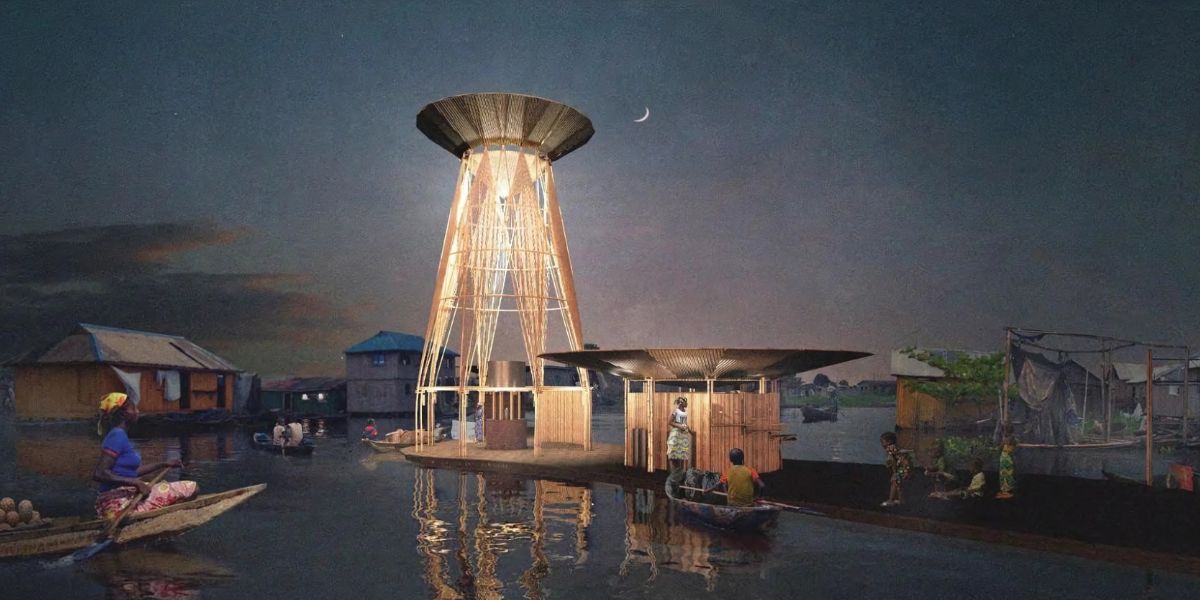
Sangji Han, an emerging talent in sustainable architecture and design, has been awarded an Honorable Mention at the London Design Summit High-tech Challenge 2024 with the jury’s comment: “Ganvie Light Tower demonstrates a deep understanding of SDG principles by blending sustainable energy solutions with cultural sensitivity, earning a well-deserved Honorable Mention.” The competition, known for emphasizing innovative design solutions that align with the United Nations Sustainable Development Goals (SDGs), acknowledged Han’s notable contribution to sustainable infrastructure.
A Celebration of Innovation and Sustainability
The London Design Summit High-tech Challenge 2024 brought together creative thinkers and researchers to explore cutting-edge technology in addressing global challenges. The competition focused on three SDGs: Clean Water and Sanitation, Affordable and Clean Energy, and Sustainable Cities and Communities. Entries were evaluated based on their alignment with SDGs, innovation and creativity, practicality and applicability, and clarity in presentation.
Han’s project, the Ganvie Light Tower, was selected for its innovative approach to sustainable infrastructure in underserved communities. Developed as part of her architectural research, the project proposes a self-sustaining infrastructure system for Ganvie, a village built on stilts in Lake Nokoué, Benin. The design aims to convert organic waste into biogas and light, creating a decentralized network that provides essential resources like sanitation facilities and community lighting, while integrating into the local environment.
The Judging Criteria and Han’s Project Alignment
The London Design Summit High-tech Challenge 2024 assessed submissions based on four key aspects. Han’s project demonstrated strong performance in these areas:
Alignment with the Sustainable Development Goals: Han’s project supports clean water and sanitation, clean energy access, and sustainable urban development. By addressing these fundamental needs, the project illustrates how sustainable solutions can be advanced through design and technology.
Innovation and Creativity: The Ganvie Light Tower explores the potential of waste as a resource, presenting a system that transforms organic material into biogas and light while leveraging locally sourced materials and modular design for adaptability. The project’s approach integrates technology and ecological principles to enhance living conditions in water-based communities.
Practicality and Applicability: The project received recognition for its feasibility, as it prioritizes cost-effective, scalable materials and community-driven implementation. Its design suggests that the solution is not only visionary but also has practical potential, making it a viable model for similar communities worldwide.
Presentation and Clarity: Han’s submission was noted for its detailed design documentation, well-defined technical specifications, and structured prototype testing. By presenting a comprehensive case for the project’s viability, Han effectively conveyed both the theoretical and practical aspects of her proposal.
An Award-Winning Vision for Sustainable Cities
The judging panel, composed of industry professionals and sustainability advocates, highlighted Han’s work for its practical considerations and its potential to create meaningful community-driven impact. By designing a system that utilizes available materials and empowers the community with sustainable solutions, Han’s project offers a model for urban development in water-based communities.
One of the aspects recognized in Han’s work was her ability to merge innovative design with social responsibility. Inspired by her engagement with the community of Ganvie, Han’s project was praised for its human-centered approach—one that acknowledges the traditions and daily lives of the local people while introducing environmentally friendly solutions.
The Influence of a Master Architect

Photo Courtesy: Sangji Han / Tian Xu
Han credits much of her architectural philosophy to her mentor, Pritzker Prize-winning architect Francis Kéré, who champions socially responsible and sustainable design. Under his guidance, Han refined her project beyond conceptualization, constructing a 1:5 scale prototype to demonstrate the feasibility and scalability of her system. Using readily available materials such as bamboo, corrugated metal, and brick, the prototype ensured that the solution could be realistically implemented in Ganvie and similar communities worldwide.
A Step Forward in Architectural Innovation
Receiving an Honorable Mention at the London Design Summit High-tech Challenge 2024 positions Han among emerging voices in sustainable and high-tech design. The recognition underscores her ability to apply innovation and highlights the role of architecture in addressing global challenges through thoughtful design.
As she advances her career, Han remains committed to developing sustainable architectural practices that integrate people, the environment, and technology. Her recognized project reflects the potential impact of architecture, demonstrating that design can be both technologically advanced and socially conscious.
For more information on the London Design Summit High-tech Challenge 2024 and other recognized projects, visit London Design Summit results page.
Published by Jeremy S.