


Enterprise leaders increasingly recognize that custom enterprise software is not just a technical initiative but a structural business investment. Companies that partner with experienced vendors such as https://www.trinetix.com/ often do so to overcome limitations imposed by rigid, off-the-shelf platforms and fragmented digital ecosystems. Yet despite this strategic intent, many organizations still attempt to measure ROI using simplified, short-term financial models that were never designed to capture the real impact of tailored digital systems.
When organizations engage in custom software development, they are effectively redesigning how value flows through their enterprise—from data ingestion and decision-making to execution at scale. The challenge is that much of this value emerges gradually, compounds over time, and materializes across multiple business dimensions simultaneously. Traditional ROI calculations, which focus narrowly on upfront cost versus immediate savings, struggle to account for these dynamics.
Another often-overlooked complexity is attribution. Custom enterprise software rarely replaces a single function; instead, it reshapes interconnected workflows, roles, and systems. Improvements in one area (for example, faster approvals) may unlock gains elsewhere (such as reduced risk exposure or improved customer retention). These cascading effects are real, measurable, and economically meaningful—but they are rarely isolated neatly enough to fit into conventional ROI spreadsheets.
Finally, enterprise software ROI is inseparable from organizational behavior. Adoption, governance, and process maturity all influence outcomes as much as the technology itself. Measuring ROI, therefore, requires not only financial rigor but also a systemic understanding of how software alters decision-making velocity, operational resilience, and strategic optionality. This is precisely why ROI in custom enterprise software remains one of the most misunderstood—and underestimated—metrics in digital transformation.
Redefining ROI for Enterprise Software: Beyond Cost Savings
One of the most persistent misconceptions in enterprise IT is that ROI equals cost reduction. While savings from automation or system consolidation are important, they represent only a fraction of the value custom software delivers. A more accurate ROI model treats enterprise software as an economic multiplier that reshapes how efficiently an organization converts inputs—data, labor, and capital—into outcomes.
Beyond direct savings, custom enterprise software creates economic leverage. For example, a system that reduces decision latency by even a few hours can dramatically improve outcomes in industries where timing affects pricing, risk, or customer satisfaction. These benefits rarely show up as line-item savings, yet they influence revenue quality, margin stability, and competitive positioning.
Another dimension often ignored is option value. Custom software gives organizations the ability to respond to future opportunities or disruptions at a lower marginal cost. Launching a new product, entering a new market, or complying with regulatory change becomes faster and less expensive when the underlying systems are designed for adaptability. In financial terms, this is equivalent to reducing the cost of future strategic moves—an advantage that compounds over the years.
ROI must also account for value protection, not just value creation. Reducing operational risk, minimizing data inconsistencies, and lowering dependency on third-party vendors all protect future cash flows. From an enterprise perspective, preventing losses or disruptions can be just as valuable as generating new revenue, yet this protective ROI is rarely modeled explicitly.
Redefining ROI means shifting from a static, retrospective calculation to a forward-looking assessment of how software reshapes the organization’s economic engine.
Establishing a Baseline: What to Measure Before Development Begins
Credible ROI measurement starts long before the first line of code is written. Establishing a baseline is not about documenting obvious inefficiencies; it is about uncovering hidden economic drag that the organization has normalized over time. This includes manual reconciliations, shadow systems, duplicated data entry, and decision delays caused by poor information flow.
A particularly underappreciated baseline metric is cognitive load. When employees spend significant time navigating systems, validating data, or compensating for process gaps, they are effectively performing non-value-generating work. While difficult to quantify directly, this load manifests in slower throughput, higher error rates, and reduced capacity for strategic tasks. Capturing these indicators pre-development provides a powerful reference point for post-implementation ROI.
Another critical baseline is the cost of inaction. Legacy systems impose opportunity costs: delayed launches, inability to personalize offerings, or failure to scale efficiently. These costs do not appear in financial statements, but they represent real foregone value. Estimating missed revenue opportunities, compliance risks, or customer churn tied to system limitations strengthens the ROI narrative significantly.
Finally, baseline measurement should include systemic fragility—how often failures occur, how long recovery takes, and how much management attention is consumed during incidents. Resources such as industry benchmarks from trusted research organizations like Gartner or McKinsey can help contextualize these metrics against peers, making ROI discussions more objective and defensible.
Quantifying Direct Financial Impact
Direct financial impact remains a cornerstone of ROI, but it must be approached with greater precision than simple headcount reduction formulas. Productivity gains, for instance, should be measured in terms of capacity unlocked, not just hours saved. When teams process more transactions, serve more customers, or analyze more scenarios without proportional cost increases, the financial value becomes tangible.
Revenue enablement is another area where custom enterprise software delivers measurable impact. Faster onboarding, dynamic pricing engines, or personalized customer workflows often lead to higher conversion rates and lifetime value. The key is to link system capabilities to revenue drivers explicitly, rather than attributing gains vaguely to “digital improvement.”
Infrastructure and licensing costs also deserve a lifecycle perspective. While custom software may require higher upfront investment, it often reduces long-term expenses associated with per-user licenses, forced upgrades, and complex integrations. Over a multi-year horizon, total cost of ownership frequently favors custom-built platforms, especially as organizations scale.
To make these impacts visible, finance and technology leaders should collaborate early on shared assumptions and measurement intervals. This alignment prevents ROI from becoming a post-hoc justification exercise and instead positions it as a transparent, auditable business metric.
Measuring Operational ROI: Efficiency, Reliability, and Scale
Operational ROI reflects how effectively custom software improves the mechanics of everyday work. Efficiency gains can be measured through cycle time reduction, throughput increases, and error rate declines. Reliability, meanwhile, manifests in reduced downtime, fewer incidents, and faster recovery—all of which have direct cost implications.
Scalability is perhaps the most misunderstood operational metric. It is not merely about handling more users or data; it is about maintaining performance and cost efficiency as demand grows. Custom enterprise software designed with scalability in mind allows organizations to grow without linear increases in operational expense.
Below is an example of how operational ROI metrics can be structured:
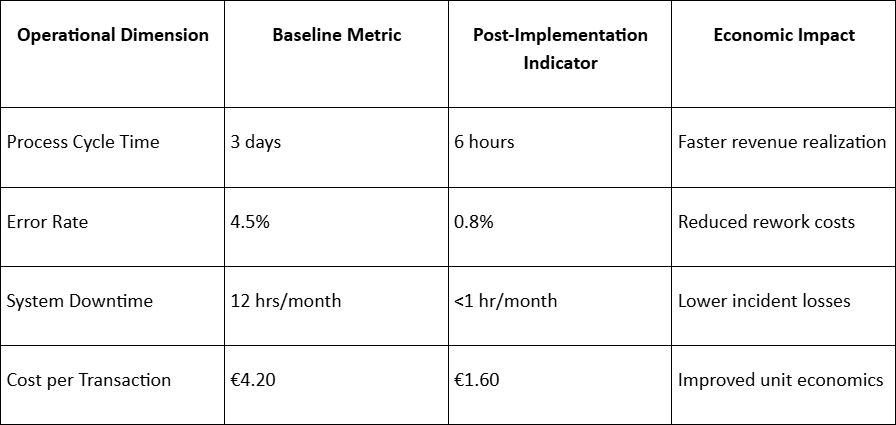
Operational ROI often delivers the most immediate and observable gains, making it a critical component of executive reporting.
Strategic ROI: Competitive Advantage That Compounds Over Time
Strategic ROI is where custom enterprise software differentiates itself most clearly from packaged solutions. One of the most significant benefits is improved decision quality. When leaders have access to consistent, real-time data tailored to their context, decisions become faster, more confident, and less reactive.
Another strategic advantage is organizational agility. Custom platforms reduce the friction associated with change—whether driven by regulation, market shifts, or internal innovation. This agility lowers the cost of transformation itself, making the organization more resilient over time.
Ownership of intellectual property is also a strategic ROI factor. Custom software embeds proprietary workflows, logic, and insights directly into the organization’s systems. This creates defensible differentiation that competitors cannot easily replicate by purchasing the same tools.
These advantages compound. Over several years, they shape market positioning, customer trust, and internal capabilities in ways that far exceed the original investment.
Building an ROI Measurement Framework That Survives Executive Scrutiny
An effective ROI framework must resonate with diverse stakeholders. Executives care about strategic outcomes and financial predictability, while operational leaders focus on performance and risk. The framework should map technical metrics—like deployment frequency or data latency—to business outcomes such as revenue stability or compliance confidence.
Continuous measurement is essential. ROI should be tracked at defined intervals, allowing organizations to adjust processes, prioritize enhancements, and surface additional value opportunities. This transforms ROI from a static justification into an ongoing management tool.
Equally important is communication. Translating technical achievements into business language ensures ROI discussions remain relevant at the board level, reinforcing trust in technology investments.
Common ROI Pitfalls in Custom Enterprise Software Projects
One frequent pitfall is underestimating change management. Even the best-designed software fails to deliver ROI if adoption is poor. Measuring training effectiveness and usage patterns is therefore integral to ROI assessment.
Another mistake is focusing excessively on development cost while ignoring lifecycle value. Software that is cheaper to build but expensive to adapt or scale often delivers inferior ROI over time.
Finally, many organizations stop measuring once the system goes live. This prematurely caps ROI visibility and obscures long-term gains that emerge only after stabilization and optimization.
From ROI Justification to ROI Realization
The most mature organizations treat ROI as a living metric embedded in governance, not a one-time approval artifact. They continuously refine systems, processes, and metrics to extract incremental value over time.
Custom enterprise software, when measured correctly, becomes a strategic asset that evolves with the business. Its ROI is not exhausted at delivery—it grows as the organization learns, adapts, and leverages the platform more deeply.
Disclaimer: The content of this article is intended for informational purposes only and should not be construed as financial, legal, or professional advice. The views expressed reflect the author’s perspective on custom enterprise software and its impact on ROI. Organizations should consult with appropriate experts or financial advisors before making decisions related to software investments or ROI assessments.