

By: Liu Qilin
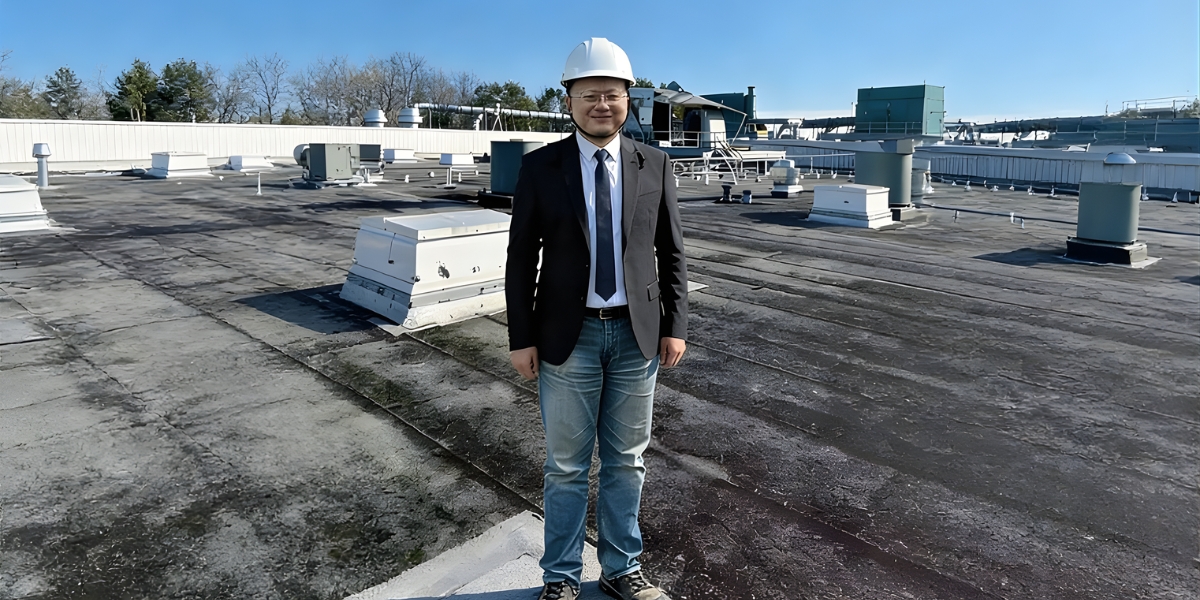
Amid the new round of technological revolution and industrial transformation, the construction of global smart factory production lines has entered a new phase of racing for development and integration. Digital transformation has become a core track for countries to compete for in the high-quality development of the manufacturing industry. Dr. Wu Yunpeng, who has been deeply engaged in this field for many years and currently serves as the Equipment Installation Manager at Firstseed Construction and Machinery Installation Corp in the United States, has leveraged his over-decade-long interdisciplinary accumulation and practical experience. With a global perspective, he accurately connects cutting-edge international technologies with local industrial needs and promotes the intelligent upgrading of production lines through concrete actions, contributing expert wisdom to the new industrial ecosystem. Focusing on intelligent technology as his core tool and industrial needs as his guide, he has successfully transformed from a technical expert to an “intelligent innovation pioneer,” driving the implementation of numerous production lines across the United States.
Removing Upgrading Barriers through Compliance and Collaboration
The intelligent upgrading of production lines is by no means a simple pile-up of technologies, but rather the accurate alignment of technological value with industrial needs within a compliant framework. To ensure that intelligent technologies can fully deliver on their value while meeting compliance requirements, Wu Yunpeng proactively passed the NASCLA (National Association of State Contractors Licensing Agencies) examination and became a holder of the general contracting certificate in multiple U.S. states. This qualification enables him to deeply integrate multi-disciplinary knowledge of Mechanical, Electrical, and Plumbing (MEP) with U.S. regulations, defining a “safety boundary” for the upgrading of smart production lines.
Since 2024, all key projects led by him have centered on the core goal of “smart production line transformation and upgrading”. He has promoted cooperation between Firstseed and enterprises such as Tesla and BMW to advance the transition from traditional to smart production lines; he has helped Chinese enterprises like Zhejiang Minglei overcome geographical constraints and implement smart production lines efficiently in their U.S.-based factories. The success of these projects not only verifies the feasibility of his technical solutions but also provides the industry with valuable experience in cross-border smart production line upgrades.
In advancing the “intelligent integration of China-U.S. manufacturing,” Wu Yunpeng blazed a trail through uncharted territory and innovatively developed a balanced principle centered on “technical professionalism as the foundation, compliance as the bottom line, and institutionalized collaboration as the link.” In terms of technical details, he adopts a strategy of “focusing on core issues while delegating secondary tasks”. Concentrating on key connection points between MEP expertise and smart production lines, he personally oversees core technical standards while authorizing professional technical teams to implement other details. In management and coordination, he adheres to the principle of “establishing mechanisms and clarifying responsibilities,” building a cross-departmental collaboration platform, defining team responsibility boundaries across technology, compliance, procurement, and construction, and resolving connectivity issues through regular synchronization meetings to avoid fragmented work.
Cross-cultural collaboration was once an “invisible barrier” to the implementation of smart production lines. The Chinese team prioritizes “smart efficiency,” while the U.S. team emphasizes “process standardization first.” In the early stages of projects, the two sides had differences in the debugging rhythm of smart equipment and the alignment of data standards. To address these challenges, Wu Yunpeng innovatively established a “dual-track communication mechanism”: first, he formulated detailed process documents and milestone plans in advance to meet the U.S. team’s compliance requirements; second, he organized weekly cross-team rapid coordination meetings to promptly address flexible adjustment needs. Additionally, he assigned team members familiar with both cultures to serve as communication bridges, reducing cognitive dissonance.
Developing Core Systems to Drive Industrial Intelligent Transformation
If compliance and collaboration serve as the “safety net” for implementing smart production lines, then core technological innovation is the “engine” driving industrial upgrading. Two smart systems developed under Dr. Wu’s leadership have fundamentally solved the technical bottlenecks in the upgrading of traditional production lines, leading the industry into a new phase of intelligent upgrading.
The Intelligent Collaborative Path Simulation and Optimization Platform, led by Dr. Wu, can be called the “master planner” for smart production line upgrading. Traditional production line transformations often fail to maximize the efficiency of smart equipment because of unreasonable path designs. This platform uses digital twin technology to replicate factory scenarios at a 1:1 ratio, simulating in advance the layout of smart equipment, material transportation paths, and process connection flows, allowing potential issues to be identified and resolved in a virtual environment. Its built-in multi-objective optimization algorithm can find optimal solutions for efficiency, energy consumption, and safety, and automatically generate personalized upgrade plans. More importantly, the platform can seamlessly connect with systems such as MES (Manufacturing Execution System) and ERP (Enterprise Resource Planning), realizing real-time circulation of production data and endowing smart production lines with the true ability of “self-adjustment and efficient collaboration.”
The AutoAlignSense—Self-Sensing Alignment System with Multimodal Sensor Fusion, also led by Dr. Wu, has overcome the bottleneck challenge in high-precision manufacturing, providing core support for the upgrading of high-end smart production lines. In optical lens manufacturing, it has improved assembly accuracy by 30%; in semiconductor chip packaging, it has increased the yield rate by over 15%; in aerospace component assembly, it has reduced alignment time from several hours to a few minutes. The birth of this system has completely changed the traditional model of “relying on manual work” in high-precision manufacturing, promoting a qualitative leap in the smart production lines of high-end manufacturing industries.
Facing the wave of global intelligent transformation in the manufacturing industry, Dr. Wu has a clear judgment on the future of production line upgrading: “Global standards are the foundation, and localized adaptation is the key. Only by making smart production lines conform to both international norms and local market needs can we truly promote the sustainable development of the industry.”
In the future, Dr. Wu will continue to focus on the core needs of intelligent transformation in the manufacturing industry, develop more breakthrough technologies, lead more enterprises in completing production line upgrades, and contribute his expertise to promoting the high-quality development of the entire industry.