


By: Vince Louie Daniot
If you’re preparing to sell a plumbing business, there’s a hard truth that doesn’t show up in most “how to sell your company” articles:
Your marketing stack becomes part of due diligence.
Modern buyers (strategics and PE-backed platforms in particular) want evidence that demand is measurable, attributable, and repeatable—and that they can scale it without guessing. That’s why the fastest way to defend valuation is to build a buyer-grade marketing data system that ties every lead to bookings, jobs, and revenue.
If you’re aiming to sell your plumbing company at a premium, treat this as an implementation checklist for audit-ready attribution, reporting, and governance.
The Buyer’s Technical Question (And the Answer You Need)
Buyers don’t just ask, “Do you get leads?” They ask:
- Where do leads come from? (source, campaign, keyword, geo)
- What happens to each lead? (call answered, booked, completed)
- What does each channel actually cost per booked job?
- How durable is demand without the owner? (brand, reviews, memberships)
- Can we scale growth with confidence? (trend lines, conversion rates, CAC)
When you sell your plumbing company, your goal is to make the answer a dashboard—not a story.
The Plumbing “Marketing Data Stack” (Reference Architecture)
Here’s a technical stack that’s realistic for a multi-truck plumbing company and looks great to buyers.
Data Sources
- Lead capture: Google Business Profile (GBP), Google Local Services Ads (LSA), paid search, SEO landing pages, referrals
- Call tracking: CallRail (or equivalent), including dynamic number insertion (DNI)
- Web analytics: GA4 + Google Tag Manager (GTM)
- Forms/chat: website forms, chat widget
- Field service / CRM: ServiceTitan, Housecall Pro, Jobber, or CRM + dispatch tool
- Accounting: QuickBooks / Xero
Data Warehouse + Transformation (Optional but “Premium”)
- Warehouse: BigQuery (common), Snowflake, or Redshift
- ETL: Fivetran, Stitch, Airbyte, or native exports
- Transform: dbt (for durable models)
Reporting + Governance
- BI: Looker Studio (lightweight), Looker, Power BI, Tableau
- Definitions: KPI dictionary + channel taxonomy
- Access: role-based permissions (important for confidentiality)
If you don’t want a full warehouse, you can still produce buyer-grade reporting by standardizing UTMs, using call tracking, and exporting consistent monthly KPI packs.
Step 1: Implement Event Tracking Like an Engineer, Not a Marketer
Your Event Map (What Must Be Tracked)
You need a small set of high-integrity events. Think in funnel stages.
Acquisition events
- call_click (tap-to-call)
- phone_call_started (DNI call begins)
- form_submit
- chat_lead
- lsa_lead (from LSA)
Disposition events (from dispatch/CRM)
- lead_answered
- lead_booked
- job_completed
- job_invoiced
- job_paid
Retention events
- membership_sold
- membership_renewed
- membership_canceled
- repeat_customer_job
How to implement (GA4 + GTM)
- Set up GTM container with:
- GA4 configuration tag
- conversion event tags (calls/forms)
- click triggers for phone/email
- Standardize conversion event names in GA4 (avoid ad-hoc naming).
- Enable enhanced measurement but don’t rely on it alone—explicit events are more defensible.
Critical: Make sure every event includes:
- utm_source, utm_medium, utm_campaign, utm_content (if used)
- landing_page
- gclid (when available)
- geo (city/ZIP if possible)
Step 2: UTM + Campaign Taxonomy (So Your Data Doesn’t Rot)
Buyers lose confidence fast when attribution is a mess.
A Practical UTM Standard
Use a consistent schema across all campaigns:
- utm_source: google | bing | facebook | nextdoor | referral | email
- utm_medium: cpc | lsa | organic | referral | email | display
- utm_campaign: svc-{service}_geo-{city}_obj-{goal}
- utm_content: adgroup/creative variant
Example:
- utm_campaign=svc-draincleaning_geo-atlanta_obj-leads
Naming Rules
- Never use spaces
- Use lowercase
- Freeze naming before launch
- Maintain a single “Campaign Dictionary” sheet
This alone improves reporting quality dramatically.
Step 3: Call Tracking That Survives Due Diligence
For plumbing, calls are the primary conversion. If calls aren’t attributed, nothing else matters.
Minimum Viable Call Tracking
- DNI on the website (unique number per visitor/session)
- Number pool sized to traffic (avoid collisions)
- Call recording (with consent where required)
- Call scoring (duration threshold or manual tags)
The Technical “Gold Standard”: CRM-Linked Call Outcomes
Push call metadata into your CRM/FSM record:
- call_id
- first_time_caller (boolean)
- call_duration
- answered (boolean)
- booking_status (booked/not booked)
- service_line
- zipcode
This gives you buyer-proof funnel analysis: cost per booked job, not just cost per call.
Step 4: Offline Conversion Import (The Big Credibility Upgrade)
A buyer trusts marketing more when ad platforms receive real outcomes.
What to Send Back to Google
- Booked job (conversion)
- Completed job
- Revenue (where possible)
If you run Google Ads, use Enhanced Conversions for Leads where possible, and import offline conversions from your CRM/FSM. For LSA, ensure lead outcomes are consistently marked.
Why it matters: it shifts optimization away from “cheap leads” and toward revenue-quality leads.
Step 5: Data Model Your Business Like a Product Team
Buyers love clean data models because they reduce integration risk.
Core Tables (Logical Model)
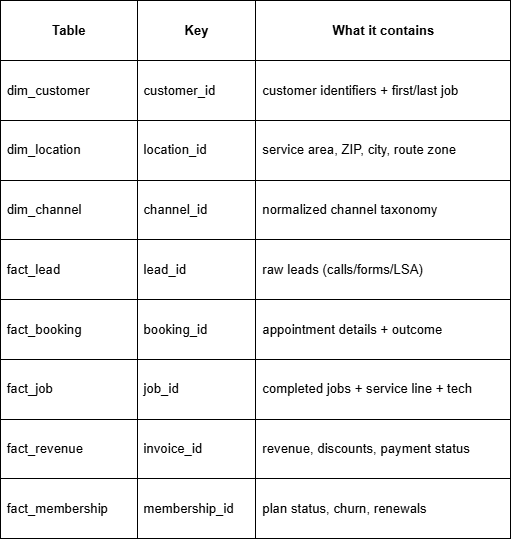
Required Foreign Keys for Closed Loop
- fact_lead.customer_id → dim_customer.customer_id (when known)
- fact_lead.channel_id → dim_channel.channel_id
- fact_booking.lead_id → fact_lead.lead_id
- fact_job.booking_id → fact_booking.booking_id
- fact_revenue.job_id → fact_job.job_id
Even if you don’t implement a warehouse, structure your monthly exports like these tables.
Step 6: Build Buyer-Facing Dashboards (With Defensible Kpis)
A buyer-grade KPI pack should answer:
Channel Performance
- Leads, answered rate, booking rate
- Cost per lead, cost per booked job
- Average ticket by channel
- Gross margin band by channel (if available)
- Repeat rate by channel (90/180/365 days)
Operational Efficiency (Ties Marketing to Profit)
- Calls per tech/day
- First-call completion rate
- Callback/warranty rate
- Drive time proxy (jobs per route zone)
Retention & Durability
- Membership penetration
- Membership churn (monthly)
- Member vs non-member average ticket
The KPI Definitions Document (Non-Negotiable)
Include a one-page KPI dictionary:
- what the KPI is
- how it’s calculated
- which system is source of truth
- how often it’s refreshed
This is boring—and incredibly persuasive in diligence.
Step 7: Attribution the Right Way for Local Services
Attribution fails in plumbing because of:
- phone calls
- cross-device behavior
- “dark social” referrals
- long decision windows for installs
Practical Attribution Approach Buyers Respect
- Last non-direct for operational reporting (simple and consistent)
- Blended CAC model for decision-making (spend / booked jobs)
- Cohort analysis for retention (repeat within 6–12 months)
If you want to go advanced:
- run incrementality tests on branded search and LSA
- implement geo-holdouts for paid campaigns
Even a basic “spend → booked jobs” model is often stronger than fragile multi-touch claims.
Step 8: Technical SEO That’s Measurable and Transferable
Most owners do SEO as content. Buyers want SEO as an asset.
Technical SEO Fundamentals
- Crawlable site architecture (service pages + location pages)
- Fast mobile performance (Core Web Vitals)
- Schema markup (LocalBusiness, Service, FAQ)
- Clean internal linking between service and location pages
- GBP alignment: categories/services match site content
Measurement Layer
- Rank tracking by city/ZIP cluster
- GBP insights tracked monthly
- Conversion rate by landing page
This turns SEO into a predictable channel—not a mystery.
Step 9: Audience Strategy for Higher-Margin Growth
If you want this to feel “AudienceScience-native,” think in audiences and activation:
High-Value Plumbing Audiences
- Water heater replacement-ready (age + neighborhood proxies)
- Repeat emergency buyers
- Membership upsell candidates (recent service call, no plan)
- Commercial maintenance prospects
Activation Tactics
- Customer Match / hashed audiences (privacy-safe)
- Geo-fenced campaigns by route zone
- Lookalikes based on high-LTV customers
- Creative variants by intent stage (emergency vs planned install)
The buyer story: you don’t just market—you segment, target, and measure.
Step 10: Security, Privacy, and Governance (The Diligence Accelerant)
This is where technical sellers win.
Governance Checklist
- Role-based access to CRM, analytics, and ad accounts
- Central password manager
- Documented consent language for call recording/SMS
- Data retention policy (even simple)
- “Buyer view” dashboards that don’t expose sensitive PII
A clean governance posture reduces risk and shortens diligence.
Your 30-Day Technical Sprint (High ROI Before You Go to Market)
Week 1
- Lock UTM taxonomy + campaign dictionary
- Install call tracking with DNI
- Set GA4 + GTM event map
Week 2
- Standardize lead outcomes in CRM/FSM (booked/completed)
- Create monthly export templates (leads/bookings/jobs/revenue)
Week 3
- Build channel scorecard (spend → leads → booked → revenue)
- Set up KPI dictionary
Week 4
- Launch buyer-grade dashboard
- Start offline conversion imports (if applicable)
The goal is trend lines. Even one quarter of clean data can materially improve confidence.
Final Takeaway: Technical Proof Sells
The plumbing businesses that command stronger attention tend to have one thing in common: they can prove performance with data.
Not “we get a lot of calls.”
But:
- here’s our channel CAC to booked job
- here’s our conversion rate by service line
- here’s membership penetration and churn
- here’s repeat revenue by cohort
- here’s the dashboard, definitions, and source systems
That’s the kind of evidence that makes buyers comfortable—and comfort is what supports a premium outcome.
About the Author
Vince Louie Daniot is an SEO strategist and professional copywriter specializing in high-intent service business content that ranks and converts. He helps brands turn complex decisions—like preparing to sell a home services company—into clear, trust-building articles that attract qualified readers and drive measurable growth.
Disclaimer: This article provides general information and technical guidance on preparing a plumbing business for sale. It is not intended as financial, investment, or legal advice. Readers are encouraged to seek professional advice from qualified financial or legal advisors before making any decisions related to the sale of their business.