

Before you shortlist vendors, write down the outcomes you must deliver this year. Do you need real-time asset visibility across hybrid fleets, cleaner license positions for audits, or faster onboarding of remote endpoints? Outcomes act like your north star and prevent the “feature bingo” trap. When you lead with outcomes, you’ll evaluate tools by their ability to solve problems, not by glossy demos.
Translate each outcome into measurable success criteria and timelines. For example, “reduce ghost assets by 40% in two quarters” or “cut audit preparation time from four weeks to five days.” Tie these to business metrics—compliance risk, OPEX, MTTR, and employee productivity—so every stakeholder can see the value path from day one.
Core Capabilities That Matter in 2025
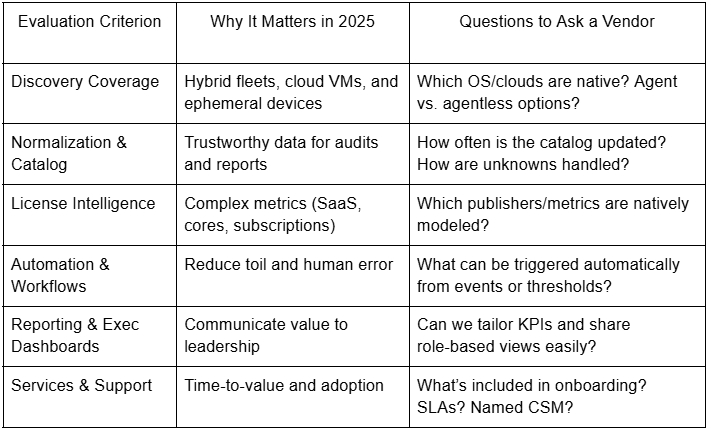
Modern ITAM spans much more than discovery and a CMDB entry. You need multi-platform discovery (Windows, macOS, Linux, mobile, cloud VMs), automated normalization, license intelligence for complex publishers, and tight integration with service workflows. Look for policy-driven lifecycle management: purchase → deploy → move → repair → retire. The platform should reconcile data from multiple sources, eliminate duplicates, and surface trustworthy records that you can audit with confidence.
Automation is no longer optional. You want event-driven updates, enforcement of ownership and location fields, and rules that trigger right-size actions (e.g., reclaim unused software). Add in robust dashboards layered with custom fields, because your executive team will ask for trends on spend, usage, risk, and sustainability (yes, e-waste and power draw now show up in board slides).
Security, Compliance, and Data Trust
Asset data is security data. Your ITAM provider should support strong access controls, encryption at rest and in transit, SSO, and detailed audit logs. If your organization operates in multiple regions, ask about data residency options and attestations (e.g., SOC 2 Type II, ISO/IEC 27001). Software recognition catalogs should be frequently updated to track publisher changes and new license metrics.
Quick security & governance checklist:
- Role-based access with least privilege
- Field-level history and tamper-evident logs
- Automated PII minimization and data retention policies
- Evidence packs for audits (publisher-specific)
- Configurable approval workflows for high-risk changes
When your CISO asks, “Can we trust this inventory for threat remediation?” you want to answer with confidence. That requires near-real-time discovery, reconciled identity-to-device mapping, and clear lineage of data changes.
Total Cost of Ownership: Look Beyond the Sticker Price
Pricing can be per-device, per-user, tiered, or packaged with other ITSM capabilities. Don’t compare line items in isolation; model the full program cost for at least 36 months. Include services, connectors, data normalization, training, customizations, and the often-forgotten cost of manual workarounds if a feature is missing.
Build a TCO sheet with three vendor scenarios and a “do nothing” baseline. The right choice is often the one that removes hidden labor while elevating audit readiness and decision speed.
Integrations and Real-World Fit
A stellar ITAM platform lives where your teams already work. Confirm out-of-the-box connectors to procurement, endpoint management (e.g., MDM/EMM), directory services, identity, and your ITSM tool. Test bi-directional flows: a discovered device should automatically get an owner; a retired asset should trigger a ticket and update financial records. If your environment includes niche systems, evaluate the vendor’s low-code integration options and API maturity.
Insist on a realistic proof of value. Bring a messy slice of your environment—multiple device types, stale records, and tricky licenses. A credible vendor will normalize the data, produce reconciliation reports, and demonstrate how exceptions get handled without weeks of scripting. That’s how you separate marketing from muscle.
Vendor Reliability, Roadmap, and Support Experience
Look for transparent roadmaps, frequent releases, and a proven record of shipping customer-requested features. Community forums, knowledge bases, and enablement content matter more than you think—your admins will rely on them under deadline pressure. Talk to customer references that match your size and industry; ask about rollout time, data accuracy at scale, and how quickly support resolves critical issues.
Don’t overlook the human layer. A strong customer success manager, clear SLAs, and predictable communication rhythms can make the difference between a tool you adopt and a tool you abandon. If the vendor offers guided implementation with best-practice templates for lifecycle stages, you’ll accelerate value and reduce change risk.
Putting It All Together: A Simple Selection Plan
Create a ranked scorecard aligned to your outcomes, not just features—weight discovery accuracy, license intelligence depth, automation capability, integrations, and support quality. Run a two-step process: (1) desk evaluation to narrow to three vendors; (2) proof-of-value using your real data. Require written remediation plans for any gaps discovered during testing. Finally, negotiate success-based milestones in your contract so incentives stay aligned.
If you’re evaluating platforms that combine ITAM with service workflows and mature automation, consider exploring ITAM By Alloy Software during your shortlist phase. It’s smart to compare integrated suites with point solutions to see which approach best fits your team’s skills and timelines.
Disclaimer: The information provided in this article is for general informational purposes only. It does not constitute professional advice, and readers should conduct their own research or consult with a qualified professional before making any decisions.