

M&A timelines rarely slip because one party refuses to negotiate. They slip because diligence becomes a document-chasing exercise: files scattered across inboxes, version confusion, unclear permissions, and delays in answering basic questions.
A virtual data room (VDR) fixes that operational problem. It’s a secure online repository designed to store, share, and track confidential deal documents — most often during mergers and acquisitions.
Why The Shift To a Digital Data Room is About More Than Convenience
On paper, diligence is a checklist. In practice, it’s a coordination problem across legal, finance, tax, HR, IT, and commercial teams, often across time zones and external advisors.
The broader due diligence discipline is also moving away from “periodic, manual exercises.” Deloitte notes that due diligence processes (including KYC and financial crime risk) are transitioning toward digital, automated, integrated models that support a continuously updated view of risk.
Deal teams feel that same expectation in M&A: fewer static snapshots, more traceability, and faster answers without losing control.
That’s where a digital data room earns its keep, not as storage, but as the operational layer for secure access, structured collaboration, and defensible records.
If you want a practical overview of how deal teams run M&A virtual data rooms end to end, this guide lays out typical phases and how the data room supports each stage.
What a VDR is
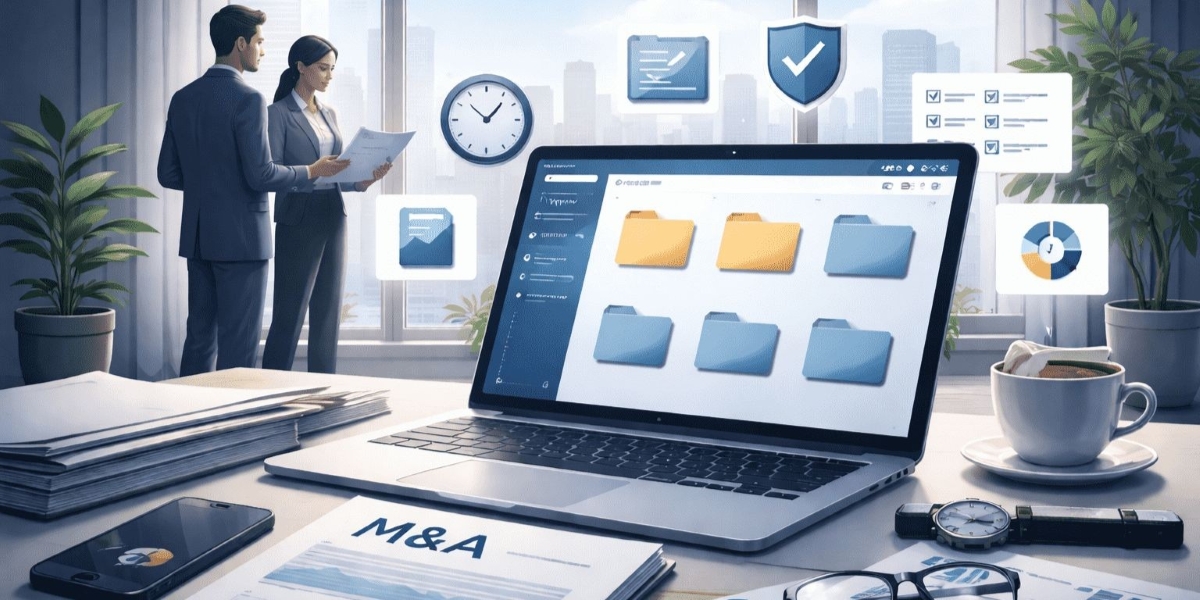
Think of a VDR as a controlled “deal workspace” where every buyer-side reviewer, advisor, and lawyer sees only what you allow — and where every action is recorded.
Compared to ad hoc file sharing, M&A virtual data rooms give you:
- One location for the full diligence set
- Structured permissions (by person, group, folder, or document)
- Built-in tracking so you can see what’s being reviewed and what’s being ignored
Where Deals Lose Time Without a Digital Data Room
“time sinks” in diligence are predictable — and preventable:
- Constant re-sending of documents because someone can’t find a file or doesn’t have access
- Version conflicts when “final_v7” is not actually final
- Unclear ownership of requests (who answers, who approves, who uploads)
- Security workarounds like over-broad access just to keep momentum
A well-run digital data room reduces these issues by consolidating document organization, access control, and collaboration into a single, governed process.
How A VDR Speeds Up M&A Due Diligence
Speed in M&A due diligence comes from removing friction at three points: access, search, and follow-up.
Faster access for the right people
Instead of sharing folders and hoping nothing leaks, you give each group a role (e.g., buyer team, buyer counsel, accounting advisors) and apply permissions once. When new reviewers join midstream, you don’t repackage materials — you simply provision access.
Less time spent “finding the needle.”
A VDR index and consistent naming conventions make it easier to locate contracts, HR files, customer data, compliance records, and financial statements without a round of emails.
Cleaner Q&A and fewer repeat requests
When diligence questions are tied to folders or documents, it becomes harder for requests to disappear in inbox noise. The result is fewer duplicate questions and fewer “we never got that” surprises.
Security Controls That Support M&A Risk Reduction
The bigger advantage of a VDR is often not speed — it’s control.
Practical M&A risk reduction usually comes down to four guardrails:
- Least-privilege access: reviewers see only what they need, when they need it
- Leak deterrence: watermarking and view-only controls reduce casual sharing
- Rapid revocation: access can be removed instantly if a party drops out
- Controlled exports: limiting download/print keeps sensitive files from spreading
Even if everyone on the buyer side is acting in good faith, deals involve many hands. A VDR helps you reduce accidental disclosure risk without slowing diligence to a crawl.
Why an Audit Trail for M&A Deals is the Safety Net
In high-stakes transactions, the question is not whether someone will ask “who saw what?” — it’s when.
A reliable audit trail for M&A deals provides defensible visibility into:
- Which users accessed the room
- Which documents did they view or download
- When permissions changed
- What activity spiked right before key milestones
This matters for internal governance (IC memos), compliance, dispute resolution, and post-close integration planning.
A VDR won’t remove the hard parts of dealmaking. But it can remove the avoidable parts — so M&A due diligence stays focused on risk and value, not file logistics.