

By: Elle dela Cruz
Hospitals run on people, yet too often they are stretched to breaking point. In the UK, shortages of nurses and doctors have pushed patient care to the brink. In the US, hospitals battle the same storm, with burned-out staff and ballooning costs for temporary cover. Shifts go unfilled, beds remain closed, and entire departments carry the weight of missing hands. The struggle is not about technology alone but about time that was lost to paperwork, to middlemen, to processes that drain resources rather than replenish them.
The gap between supply and demand is rarely more visible than in healthcare. Every delayed hire or vacant role represents more than an empty slot; it is an exhausted nurse working another twelve hours, or a patient waiting longer for care. Administrators pour money into agencies to keep wards staffed, yet the cycle repeats. The need for clarity, speed, and control grows sharper each year, and the pressure mounts on systems already at their limits.
This is the world into which Flexzo AI steps. Born out of Britain’s NHS and now preparing to enter the American market, the company positions itself as a re-wiring of how hospitals connect with professionals. Its rise in the UK offers a glimpse of what might come across the Atlantic.
Triumphs Behind the NHS Walls
Flexzo AI grew from frustration with the old model. Its founder, Jack Henderson, once operated in clinical insourcing and saw how NHS trust managers juggled too many agencies and endless admin. He says, “Traditional recruitment processes burden hospitals with hidden costs and cumbersome compliance demands.” Those inside experiences led to the birth of a platform that bridges trust leaders directly to a vetted workforce.
In Britain, the stakes were undeniable. The NHS reported 100,020 vacancies with a vacancy rate of 6.7%. Agency spending soared as a quick but expensive fix. Hospitals sometimes spend billions on third-party staffing just to maintain service delivery.
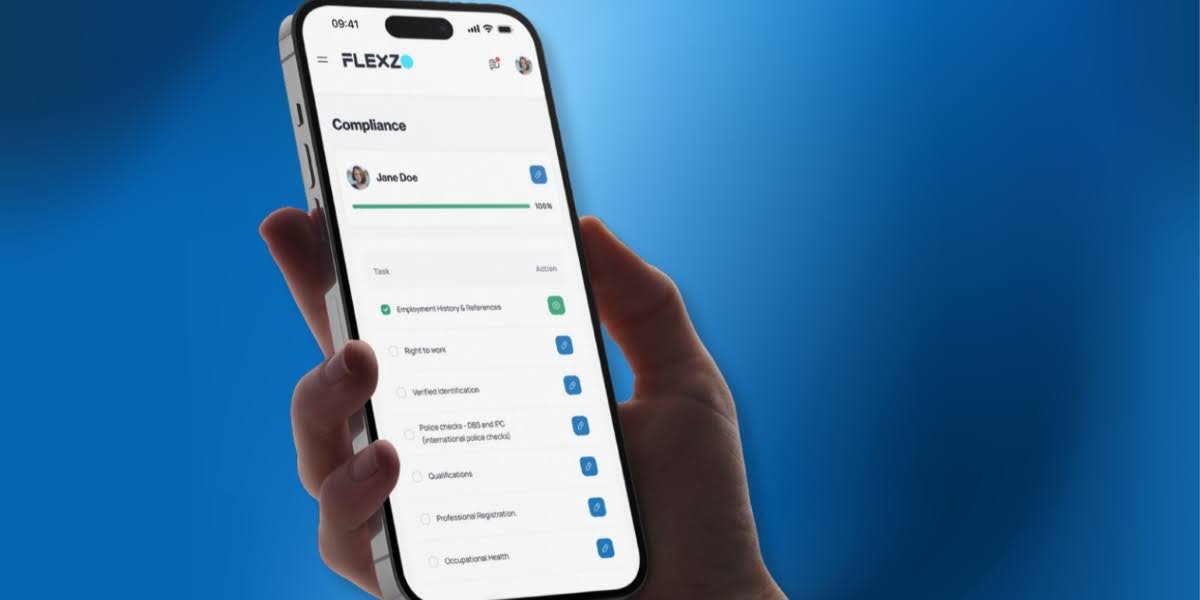
Flexzo AI tackled that by building what it calls a “Collaborative Staff Bank.” Hospitals upload their shifts; professionals signal availability via WhatsApp, email, or SMS; the system matches them in real time. No agency middlemen, no surprise markups. The platform automates compliance checks: license verifications, right-to-work documents, credential renewals, and offers reminders. The result: faster placements, fewer fees, smoother operations. Flexzo claims over 100,000 compliance-ready professionals in its pool.
The AI Advantage Powering Smarter Care
Every year, hospitals spend millions on agency staffing, but the true cost extends beyond mark-ups. The hidden burden lies in inefficiency. Behind every shift filled are countless manual tasks: spreadsheets, compliance checks, calls, and timesheets, each adding layers of unnecessary expense.
Recruitment fees often reflect headcount costs, as hospitals require recruiters to search, resourcers to manage databases, and compliance officers to verify credentials. With Flexzo AI, these operational inefficiencies are eliminated through automation, reducing costs typically passed on to hospitals and healthcare settings.
By re-engineering workforce processes, Flexzo AI enables NHS Trusts and other providers to operate with greater efficiency and precision. The platform automates repetitive recruitment steps, from candidate matching to compliance verification in real time. The result is faster fills, leaner operations, lower workforce costs, and more time devoted to what truly matters: delivering better patient care.
A critical step in their success was funding: in March 2025, Flexzo (via parent HealsGood) closed a £1.5 million round led by Fuel Ventures. That financial boost helped scale features, deepen trust adoption, and expand system capacity. Flexzo has since furthered its funding, with a recent seed round from Octopus Ventures bringing total seed funding to $6.5 million to support its U.S. growth.
Bridging Two Healthcare Worlds
U.S. healthcare is uniquely diverse, spanning private systems, federal and state programs, hospital networks, and insurance carriers. While this creates a complex environment, the underlying challenge mirrors the UK’s: staff shortages, administrative burden, and rising costs. For Flexzo, the opportunity lies in adapting its NHS-born model to this multifaceted landscape.
One promising bridge is technological infrastructure. Flexzo’s platform runs on Amazon Web Services and Google Cloud, placing it on scalable, secure global foundations. Those partnerships give it headroom to grow and the resilience to manage stricter data privacy regimes like HIPAA compliance in the US.
Many US hospitals already operate with electronic credentialing systems and digital personnel databases. Flexzo’s modular compliance workflows are designed to integrate with these setups, while its smart matching, distance-based shift selection, and real-time travel data could ease staffing gaps across busy metro regions.
Beyond technology, success will depend on collaboration. Building strong partnerships with hospital councils, regional staffing consortia, and state regulators will be key. By combining secure infrastructure with deep local alliances, Flexzo aims to demonstrate that its zero-fee staffing subscription can complement and even enhance existing workforce models in the US.
Ambition at a Turning Point
When asked about the US move, Henderson frames it as a new test of the same belief: that healthcare systems deserve simpler, fairer staffing. His conviction echoes in his words: “We’re giving healthcare providers the tools to eliminate agency fees, reduce admin burdens, and take back control of their workforce.”
Momentum already builds. Flexzo is exhibiting at Welsh Confed 25 to demonstrate insourcing tools and AI shift automation. In recent press coverage, it is described as connecting hospitals directly to more than 100,000 professionals, eliminating agency costs and accelerating hiring cycles.
If the US launch succeeds, Flexzo could rewrite American staffing norms. Hospitals might no longer race between agencies for temporary coverage. Healthcare staff could finally navigate shifts and compliance under one system. It will be a drama worth watching, a British-born platform staking its claim where healthcare is as complex as it is vital.