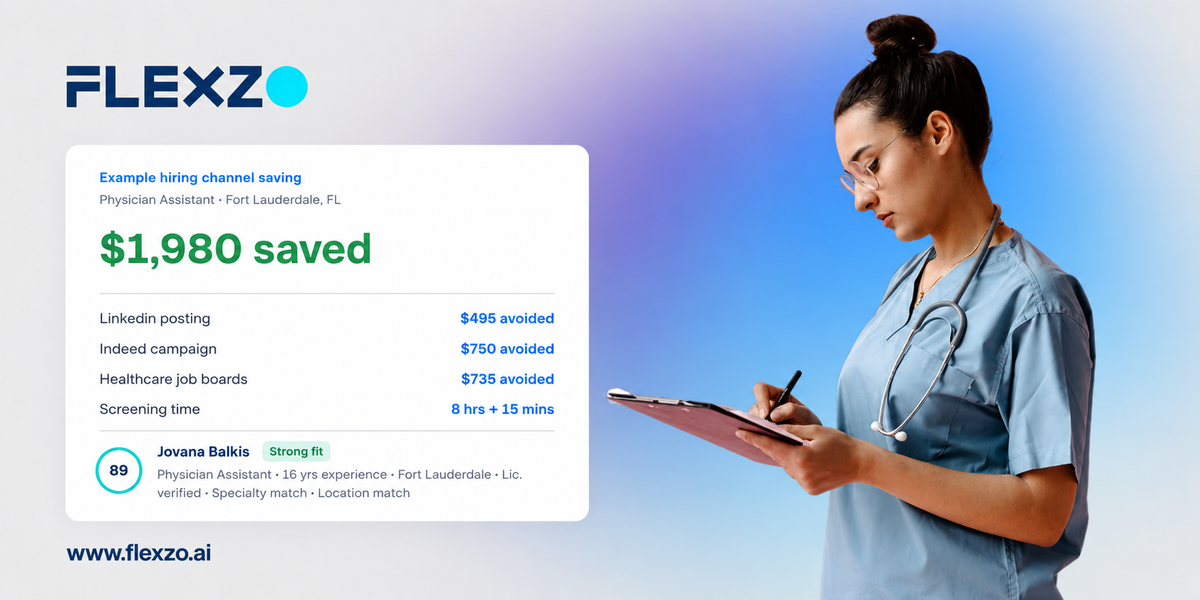

When a hospital finally fills a permanent nursing vacancy after three months of searching, the invoice that follows can be as painful as the vacancy itself. Direct-hire agency fees in US healthcare run 15 to 30 percent of first-year salary, roughly $18,000 for a single $90,000 registered nurse, and considerably more for physicians, where contingency search fees reach a quarter of base compensation.
Multiply that across a year of hiring and recruitment becomes one of the largest unmanaged line items in a provider’s budget. The vacancy itself is no cheaper. The average experienced nursing role now takes 78 to 83 days to fill, and every one of those days is paid for in overtime, premium labor, and lost capacity.
Flexzo, the healthcare workforce technology company, is targeting that line item with Flexzo Talent Flow, a platform it describes not as another applicant tracking system but as an AI Hiring Engine. The term signals a specific architectural choice. A conventional ATS waits. A vacancy is posted, applicants arrive, and a recruiter sorts the pile.
An AI Hiring Engine, as Flexzo describes it, does not wait for applicants. It sources, screens, matches, and closes permanent clinical talent continuously, doing the work of a recruiting agency as software, at a flat monthly price.
How the Engine Works
The system runs a role from intake to signed offer in one connected workflow. A hiring team captures the position once through a structured clinical schema covering profession, specialty, license, facility type, shift, salary band, and eight other fields, and the platform distributes it across major hiring channels, including LinkedIn, Indeed, healthcare job boards, and the employer’s own careers page, from a single screen.
What separates the engine from a job-posting tool is what happens next. Rather than relying on inbound applicants alone, the platform’s AI search surfaces qualified clinicians beyond the applicant pool, enriches them into structured profiles covering work history, licensure, certifications, and skills, and reveals verified contact details on demand. Built-in chat, email, and SMS outreach, with opt-out handling and reply tracking, starts the conversation, and positive replies move themselves into the hiring pipeline.
Every candidate, sourced or inbound, is then scored 0 to 100 against the specific role across eight weighted clinical factors, from profession and specialty fit to licensure, location, and salary alignment. The score is explainable. A full factor-by-factor breakdown is stored with every application, a design decision that matters as AI-hiring regulation tightens across US states.
The company is explicit about where the automation stops. “AI helps prepare the shortlist,” its platform materials state. “Hiring teams make the decision.” The workflow then closes the loop that most recruiting software leaves open. Offer letters are generated, routed for internal approval, and e-signed by the candidate inside the same system that found them, with every stage change, contact reveal, and offer action recorded to an audit trail.
Jack Henderson, CEO of Flexzo, frames the problem as economic rather than technical. “Permanent hiring in US healthcare still runs on a fee structure that predates the software now able to replace it,” he said. “Providers have spent three years proving they can cut contract-labor spend. Talent Flow gives them the same discipline on permanent hiring, the reach and rigor of an agency, without paying a percentage of salary for every hire.”
Why the Timing Is Not Accidental
The launch lands in the middle of a structural shift in hospital labor strategy. Travel-nurse spending has contracted for three consecutive years, with revenue down 37 percent in 2024 alone, and 63 percent of healthcare CFOs say they are actively reducing reliance on outside contracting. Health systems such as Providence and Montefiore have publicly cut agency and contract-labor spend by as much as 70 percent from pandemic peaks. Having tamed temporary-labor costs, finance leaders are turning to the next exposure, permanent placement fees.
The demand side offers no relief. Federal projections put registered-nurse openings at roughly 190,000 per year through 2034, and the average hospital carries dozens of unfilled RN positions at any given time, at a churn cost estimated above $5 million per hospital per year. Providers cannot stop hiring. The question is what each hire costs.
What an AI Hiring Engine Means for Operations
For an administrator or talent leader, the practical difference shows up in three places. The first is breadth of reach, with one role distributed across every major channel and all applicants, along with AI-sourced candidates, landing in a single ranked pipeline rather than per-posting spend scattered across boards.
The second is the shape of the screening step. AI enrichment and explainable scoring order candidates before a recruiter opens the first résumé, a process designed to take pressure off the manual CV review that consumes recruiter capacity. The third is a hiring function that smaller facilities have never had. For skilled nursing operators, urgent-care groups, and clinic networks with no talent-acquisition team, the engine is built to operate as the recruiting department, running from role intake to signed offer without a middleman.
Flexzo has also broken with category convention on pricing. Agencies quote per hire. According to the company, Talent Flow runs instead on self-serve subscription plans starting at $299 per month, with a free tier that includes one live job and one AI candidate search, so an employer can review a shortlist before committing spend.
For providers under budget mandates to justify every recruitment dollar, the structural question is how permanent hiring gets paid for, and whether a fixed monthly subscription belongs in a budget line that agencies have long priced as a percentage of salary. Flexzo is building on the view that it does.
Disclaimer: This article is for informational purposes only. Product features, pricing, availability, and capabilities may change. Hiring results and cost savings may vary by organization. Employers are responsible for ensuring their hiring practices and use of AI-assisted recruitment tools comply with applicable employment, privacy, and AI regulations.