


Most compliance problems start with a reasonable assumption. An owner sees another business doing something and copies the approach. The issue is simple. Rules change by city, county, and industry, so copying often misses key steps.
If you want fewer surprises, treat licensing as a research task with a clear method. Many owners use business compliance services when they want a fast, defensible setup and clean timing.
This guide explains the difference between registrations, licenses, and permits, then shows a no-guess method to identify what applies. You will also see a Texas example and a renewal system that prevents lapses.
Licenses vs Permits vs Registrations
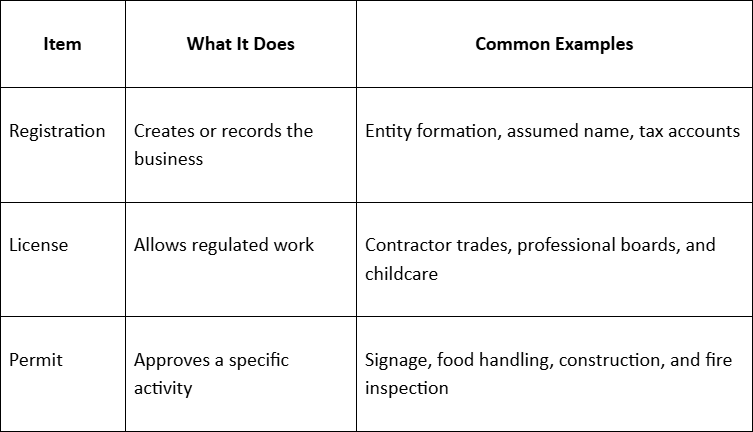
People use these words interchangeably, but agencies do not. Registration puts your business on record. A license authorizes you to operate in a regulated field. A permit approves a specific activity or site condition.
This matters because business licenses and permits rarely come as one bundle. You may complete a state registration, then still need a local license. You may have a professional license, then still need permits for signage or occupancy.
Here is a simple map you can remember:
Guessing wastes time because you often apply to the wrong office first. It also increases the risk of fines or delayed openings. Requirements depend on location plus activity, so the same business model can face different rules in two nearby cities.
The 3-Factor Method To Know What You Need
If you are asking, “What business licenses do I need?” start with three inputs. Write them down in plain language. Then build your list from those facts, not from generic templates.
Factor 1: Exact location or locations.
List the address and the city, and the county jurisdiction. Include every place you operate. A second location often triggers a new local process.
Factor 2: Industry and regulated activities.
The activity drives most requirements. Selling taxable goods, preparing food, storing chemicals, or providing licensed services can change the list quickly.
Factor 3: Your operating footprint.
A storefront, warehouse, jobsite, work, home office, and vehicles can add requirements. Zoning and inspections often depend on the footprint.
These three inputs point you to business permit requirements at multiple levels. Local, state, and federal agencies can each have separate lists and fees. Local requirements often control timing, since inspections and occupancy approvals can take longer than registrations.
This method also helps when your business changes. If you add a service line or open a new site, rerun the three factors. That prevents “silent” gaps that appear after growth.
Where To Check: Reliable Lookup Sources
A clean research sequence saves time and reduces dead ends. Start broad, then narrow to the agency that issues the approval. This approach fits state and local business licensing in most industries.
- Start with SBA guidance. Use it to confirm definitions and common approval types.
- Check your state portals. Look for licensing, tax accounts, and industry-level requirements.
- Confirm city and county rules. Review local business licensing, zoning, signage, and inspections.
- Check federal agencies only when relevant. Some industries require federal approvals.
If you want to know how to find the required permits for a business, focus on the issuing authority. Do not rely on blogs or informal lists. The issuing agency defines the requirement, the fee, and the renewal cycle.
Budget time for approvals and renewals. Some permits require inspections. Some licenses need background checks or proof of insurance. Renewals often come with late penalties and reinstatement steps.
Texas Example and Common Surprise Permits People Miss
Texas shows how layered the process can be. The Governor’s Business Permit Office resources help owners identify state-level permits by business type. That tool speeds up the first pass, but it does not replace local confirmation.
Texas business licenses and permits often include items that owners do not expect. Local rules can also differ between neighboring cities, even within the same county.
Common “surprise permits” include:
- Sales tax permit for selling taxable goods or certain services
- Sign permits for exterior signage
- Zoning or home occupation approval for home-based work
- Health department permits for food or personal services
- Fire inspection or occupancy approvals for some commercial spaces
The fastest way to avoid delays is to confirm local rules early. If you sign a lease before checking zoning, you may limit your options. If you install signage before pulling a permit, you may pay twice.
Texas owners also coordinate compliance timing with tax setup. Some ask a CPA, such as Evans Sternau CPA, to sanity-check timelines. That helps when registrations, sales tax accounts, and payroll planning overlap.
Keep It Compliant: A Simple Documentation and Renewal System
Compliance problems often start after launch. A renewal date passes. A permit sits in an email thread. An address change, and the old record stays on file. A clean system prevents those lapses.
Build a digital “license binder.” Use one folder per approval type. Store the approval letter, number, renewal terms, and agency contacts in the same place. Keep inspection reports and correspondence alongside renewals.
Use a small business license checklist that stays practical. Track the same fields for each item:
- Issuing agency and contact details
- Account, license, or permit number
- Issue date and renewal date
- Renewal steps and required documents
- Inspection history or special conditions
Set calendar reminders 60, 30, and 7 days before renewal. Use a shared calendar if more than one person owns compliance tasks. Update the binder when you move, add services, hire staff, or expand locations. Those changes often trigger new filings.
Owners often ask how to get a business license as if it were one action. In practice, it is a sequence. You identify the correct agencies, apply in the right order, and then keep records and renewal dates current. That is how you avoid penalties without guessing.
Disclaimer: This article provides general information and guidance on business licenses and permits. The content is not intended as legal or professional advice and may not apply to every individual situation. Regulations and requirements vary by location, industry, and specific circumstances. It is recommended to consult with relevant local, state, and federal authorities or a compliance expert to ensure that your business meets all applicable legal obligations.