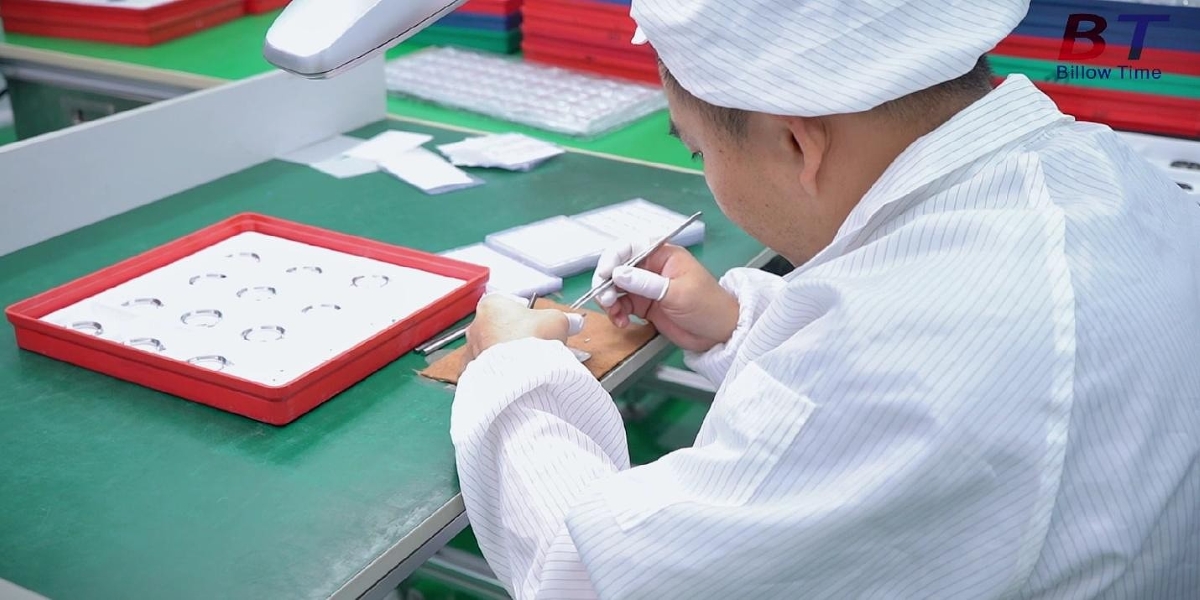


Over the years, several industry developments occurred that made quality assurance an increasingly important part of the watch manufacturing process. During this time frame, both the increase in the number of watches produced and the complexity of the production process created an environment in which the emphasis on quality control and assurance systems was often important to maintaining efficiency while supporting a certain level of standardization.
This broader industrial backdrop provides context for the internal quality control practices that developed at Billow Time Watch Co., Ltd., founded in 2004 in Shenzhen, China, by Chen Fu Jun and Wang Jian. The company began operations with a strong emphasis on visual inspection. At the time, its role centered on handling unprocessed watch cases and accessories such as crowns, glass, case backs, and steel bands. Early quality control focused on identifying surface defects, dimensional inconsistencies, and basic finishing issues before parts moved further along the production chain.
During the company’s initial years, quality control was closely tied to daily operations rather than treated as a separate function. Inspectors worked alongside polishing and drilling teams, conducting checks at each stage. This approach reflected the realities of small-scale manufacturing, where oversight depended heavily on experience and repeated observation. By 2006, inspection routines had expanded to cover a wider range of components, including finished accessories, reinforcing the importance of consistency across batches.
By 2009, Billow Time Watch Co., Ltd. had developed the capacity to inspect accuracy across every processing section. This marked a shift from basic visual checks to more systematic evaluation of machining results. Measurements, tolerances, and surface finishes were reviewed more frequently, aligning with industry practices that emphasized process control rather than end-stage correction. This evolution allowed the company to identify issues earlier in production, which could help reduce rework and delays.
The year 2012 represented another milestone in the company’s quality control development. By this point, staff were capable of overseeing the entire watchmaking process, from component inspection through assembly. Quality control responsibilities expanded to include functional checks during assembly, helping confirm that components interact correctly once combined. This stage-based supervision reflected a move toward multi-point inspection, a method widely adopted in mid-sized manufacturing to manage growing complexity.
As production capabilities expanded, quality control became more formalized. Dedicated QA and QC departments worked in coordination with engineering and assembly teams. Inspections were no longer limited to identifying defects but also involved verifying adherence to specifications provided by clients. This approach was particularly relevant as the company began producing watches from a wider range of materials, each requiring different handling and inspection standards.
Machining and finishing processes introduced additional quality considerations. With the later integration of CNC capabilities, inspection routines were adapted to include checks on precision machining outputs. Quality control teams monitored tolerances and surface consistency, helping verify that parts met documented requirements before moving to assembly. This alignment between machining and inspection supported smoother workflow transitions and reduced production bottlenecks.
Assembly stages introduced another layer of supervision. Quality control personnel observed the fitting of movements, cases, and external components, verifying alignment and functionality. These checks were conducted alongside assembly staff rather than as a final audit. Some industry research suggests that in-process inspection can help reduce defects compared with end-of-line inspection, highlighting the practical value of this approach.
Finishing processes, including polishing and final inspection, completed the quality control cycle. Visual checks were combined with functional assessments, particularly for mechanical and modified watches. Rather than presenting these steps as markers of superiority, the company integrated them as routine procedures necessary to meet client specifications. This process-focused culture reinforced the idea that quality control was an ongoing activity rather than a discrete checkpoint.
Quality Control had been so integrated into all levels of the company that when Billow Time Watch Co., Ltd., was established as a legal entity in 2019, quality control became part of the daily workflow. At that time, there were over 300 employees working for Billow Time, and the company had established teams for R&D, CNC Machining, Assembly, and Customer Service. As part of their daily operations, inspection protocols were instituted in each area, and documentation/records were provided for traceability, which was becoming essential for international customers who needed repeated orders to be consistent from one order to the next.
In a nutshell, the quality control culture at Billow Time Watch Co., Ltd. evolved gradually from basic visual inspection to multi-stage supervision across machining, assembly, and finishing. This development reflected broader manufacturing trends that favored process-based oversight over isolated checks. Under the leadership of Chen Fu Jun and Wang Jian, quality control became a central operational function, shaping workflows and supporting the company’s ability to manage increasingly complex watch production without making claims of technical superiority.