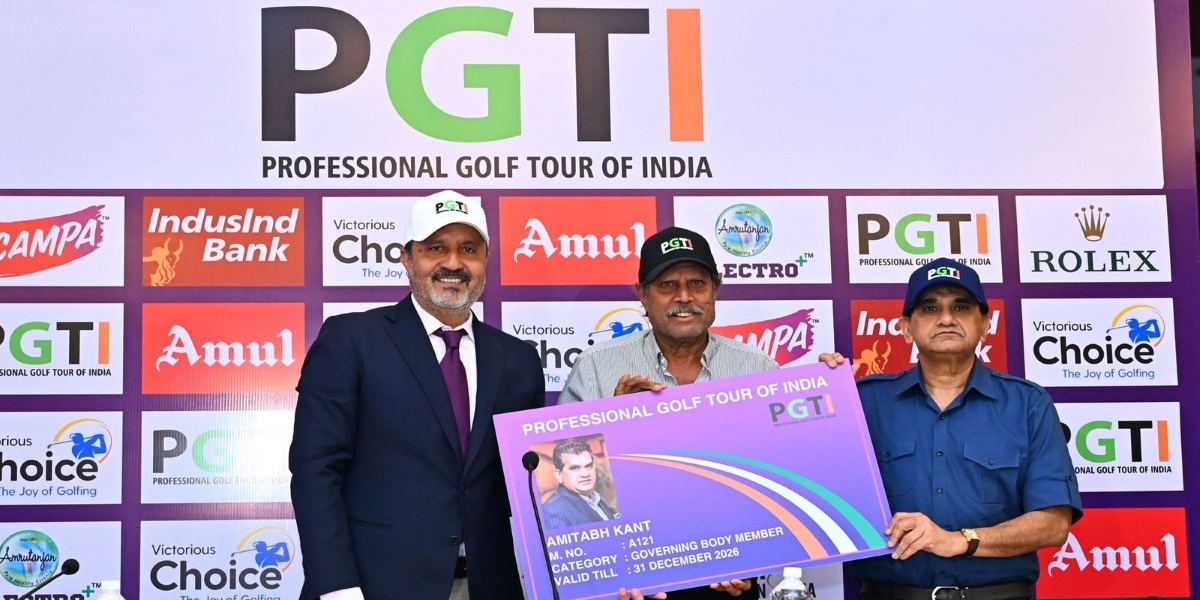


The Professional Golf Tour of India (PGTI) is no longer just an organization managing tournaments; it is steadily transforming into a symbol of India’s sporting ambition on the global stage. Over the years, Indian golf has made sporadic appearances on the international circuit through the achievements of a handful of players. However, the intent is now to move beyond individual successes and create a system that can consistently produce world-class athletes. This shift in direction has been strengthened by the induction of Amitabh Kant to the Board, along with the appointment of global advisors Shantanu Narayen, Nikesh Arora, and Pradeep Bakshi. Their inclusion marks a turning point in PGTI’s journey and reflects its determination to expand beyond the boundaries of Indian fairways and resonate with the world’s golfing community.
The arrival of Amitabh Kant is particularly significant because of his reputation for transformative leadership. Having spearheaded national campaigns such as Make in India and Startup India, he has already proven his ability to create global visibility for Indian initiatives that previously lacked international traction. Kant brings to the table not only his policy expertise but also his extensive international network of contacts and collaborators, making him a figure capable of repositioning Indian golf as a sport of aspiration, opportunity, and global competitiveness. At a time when India is actively looking to diversify its sporting presence beyond cricket, his guidance is expected to provide golf with the kind of credibility and support it needs to attract investments, policy-level backing, and large-scale interest.
Alongside Kant, the advisory team of Narayen, Arora, and Bakshi injects further credibility into PGTI’s mission. Shantanu Narayen, as the CEO of Adobe, has been at the forefront of building one of the world’s successful technology companies, turning it into a brand synonymous with digital creativity and innovation. His ability to shape global brands and engage with younger, digitally savvy audiences is a valuable resource that Indian golf can utilize to reimagine its marketing approach to the world. Nikesh Arora, who leads Palo Alto Networks, is regarded for his acumen in financial strategy and market expansion, bringing a perspective on how PGTI can adopt sustainable models for growth while securing stronger sponsorship deals and investments. Pradeep Bakshi, as the head of Voltas Limited, represents the kind of consumer-driven leadership that ensures accessibility, trust, and scale. His presence ensures that PGTI is not just confined to the elite but gradually transitions into a sport that ordinary Indians can relate to and aspire toward. Together, these advisors embody a blend of global best practices, financial sustainability, and brand-building expertise, forming an environment in which Indian golf can grow at both the grassroots and professional levels.
Amandeep Singh Johl, CEO of PGTI, has described this transformation as a once-in-a-generation opportunity to reshape Indian golf. For him, the vision is not restricted to supporting elite players who already have the means to compete internationally. Instead, it extends to nurturing grassroots programs, creating junior golf academies, and establishing structured pathways for young talent to rise to the professional level. This long-term approach seeks to ensure that India produces golfing champions consistently rather than relying on isolated flashes of brilliance. The focus is on building infrastructure, creating competitions that prepare athletes for international tours, and investing in a pipeline that can sustain the sport for decades to come.
An equally important aspect of this journey lies in the emotional resonance that golf is beginning to create in India, much of which has been strengthened by Kapil Dev’s enduring support. As one of the country’s sporting icons, Kapil Dev brings an aura that few others can match. His presence bridges the gap between golf and mainstream Indian sports culture, drawing attention from audiences who may otherwise dismiss the game as inaccessible or niche. With Kapil Dev’s involvement, golf is slowly being reimagined as a sport of dignity and aspiration, capable of inspiring the next generation of athletes. His ability to connect with fans who associate him with India’s most glorious cricketing triumphs lends golf a sense of familiarity, making it easier for the game to expand its reach and develop a broader fan base across the country.

Photo Courtesy: Professional Golf Tour of India
The developments at PGTI are not just about new appointments and advisory roles. They represent an effort to build a legacy that can stand the test of time. For decades, Indian sports have been characterized by an over-reliance on cricket, while other games have struggled for visibility, funding, and fan support. In recent years, however, badminton, wrestling, and hockey have shown that with the right investment and leadership, Indian athletes can excel on the global stage. Golf, too, is at the cusp of such a transformation. The involvement of a visionary board, global advisors, and iconic ambassadors lays the groundwork for India to evolve into a genuine force in world golf.
The goal is threefold: to provide elite development opportunities that ensure Indian golfers can compete and win at the highest level, to expand the grassroots base by making golf accessible to juniors and amateurs across the country, and to position Indian golf internationally as a competitive force that can attract global audiences, sponsorships, and investments. If executed effectively, this strategy has the potential to create a virtuous cycle where talent, infrastructure, and recognition reinforce each other. The broader ambition is to align Indian golf with the country’s rising stature as a multi-sport nation, much like the trajectory that badminton followed in producing champions such as P.V. Sindhu and Kidambi Srikanth.
The Professional Golf Tour of India now stands at a pivotal juncture. With the visionary leadership of Amitabh Kant, the global insights of Narayen, Arora, and Bakshi, and the inspirational presence of Kapil Dev, the organization is better prepared than ever to shape the future of Indian golf. What started as a domestic tour for professionals is on its way to becoming a movement that aspires for global recognition. The journey ahead will not be easy, but with the right mix of leadership, investment, and vision, Indian golf has an unprecedented opportunity to break barriers and establish itself among the great sporting nations of the world.
Disclaimer: The views and opinions expressed in this article reflect the perspectives of the Professional Golf Tour of India (PGTI) and its leadership, advisory team, and partners. Results and achievements discussed may vary based on individual circumstances, market conditions, and other factors beyond the control of PGTI or its affiliates.