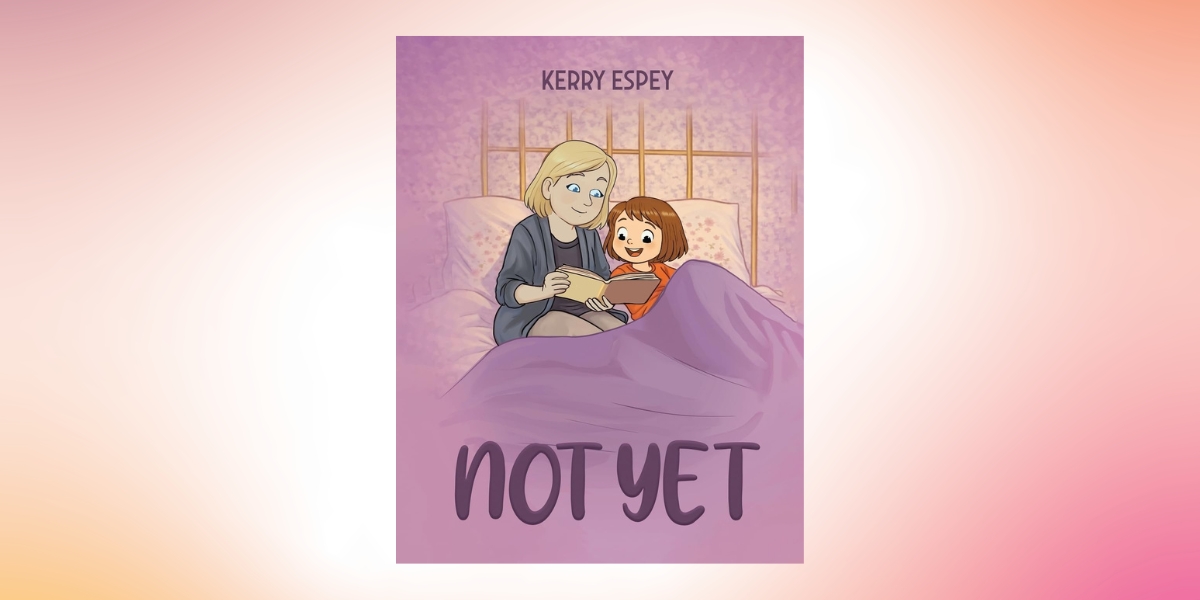


In Kerry Espey’s Not Yet, a small phrase becomes a grammar of love, limits, and longing
There are phrases that parents repeat because they work, not because they are profound. “Shoes.” “Hands.” “Look at me.” And then there are phrases that keep returning, quietly changing their meaning as the years change ours. “Not yet” is one of those. It begins as a practical delay, a pause before lunch, a check before a bike ride, and ends up, in the way language sometimes does, carrying a lifetime of tenderness.
That is the premise and the emotional engine of Not Yet, a new picture book by Kerry Espey, an educator who has written what she calls a true story about her mother and herself. The book matters now not because it announces a trend, but because it answers one: the growing need for children’s literature that doesn’t flinch from complicated feelings, and for adult readers who understand that picture books can be small, potent vessels for grief, caretaking, and memory.
Espey’s choice is deceptively simple: she builds the book around repetition. “Not yet,” the mother says, and the phrase returns with an almost musical cadence. It’s easy to underestimate the artistic risk of that move. Repetition can become rote. It can flatten a story into a lesson. But in Not Yet, the refrain does what refrains do in good songs: it gathers new weight each time it comes back.
In the earliest pages, “not yet” is the voice of safety and responsibility. A child wants to move faster than her world can safely allow. A mother slows the tempo. The phrase does not arrive as scolding; it arrives as a structure that feels like care. “Not yet,” the mother says at one point. “First, I need to meet this boy. I need to make sure he will treat you well and bring you home on time.” The line is plainspoken, almost ordinary, and that ordinariness is the point. In Espey’s hands, protection isn’t dramatic; it’s a practiced habit.
What makes Not Yet quietly arresting is how it allows the same phrase to mature alongside the girl who hears it. The refrain begins as a pause imposed from above. Later, it becomes a pause that the reader recognizes as necessary, the difference between impatience and readiness, between wanting and being able. Without leaning on plot mechanics, the book traces a familiar arc: a child grows into independence, and the rules that once felt like obstacles begin to read as the scaffolding of a life.
Espey’s creation story is embedded in the book’s posture: it reads as if written against disappearance. In the author’s note, she frames the project as an act of holding close to keeping love alive through memory, of cherishing “the quiet moments,” of recognizing how deeply love shapes who we become. That is not marketing language; it’s an ethic. The book’s attention is trained on small rituals, the kind that rarely make it into family lore because they don’t announce themselves as important until later.
The prose mirrors that ethic. Espey writes in short, clear sentences meant to be read aloud, yet they carry an adult clarity about what repetition does to memory. The pacing is measured; the emotional voltage rises not through twists but through accumulation. The structure of the return of a phrase across changing circumstances is a child-friendly version of something literary fiction has long known: that a motif can do the work of time.
If the book has an ambition, it is to make “not yet” feel like a form of love rather than a deprivation. That is a difficult task in a culture that trains children to interpret waiting as punishment and adults to interpret waiting as failure. Espey’s risk is that the refrain could come across as sentimental. But the book avoids that trap by refusing to glamorize. The love here is not ornate. It is practical, repetitive, sometimes imperfect, and therefore believable.
Near the book’s most emotionally charged section, the phrase turns from boundary to plea. “Please God, not yet,” the girl prays. The line lands because it does not explain itself. It doesn’t need to. Almost anyone who has sat beside a loved one in uncertainty understands the instinct: to bargain for time, to ask language to do what it can’t.
A good picture book does not simply “teach” a child; it offers a shared atmosphere in which an adult and a child can sit together and feel something true. Not Yet is that kind of book that invites families to talk about patience and independence, but also about caretaking, tenderness, and the way love keeps reappearing in the phrases we once thought were only instructions.
In the end, the brilliance of “not yet” is that it refuses finality. It is neither yes nor no, neither promise nor refusal. It is a small hinge between now and later, between the life you have and the life that is coming. Espey’s book understands that the hinge is the place where much of living happens and where, if we’re lucky, much of love does, too.