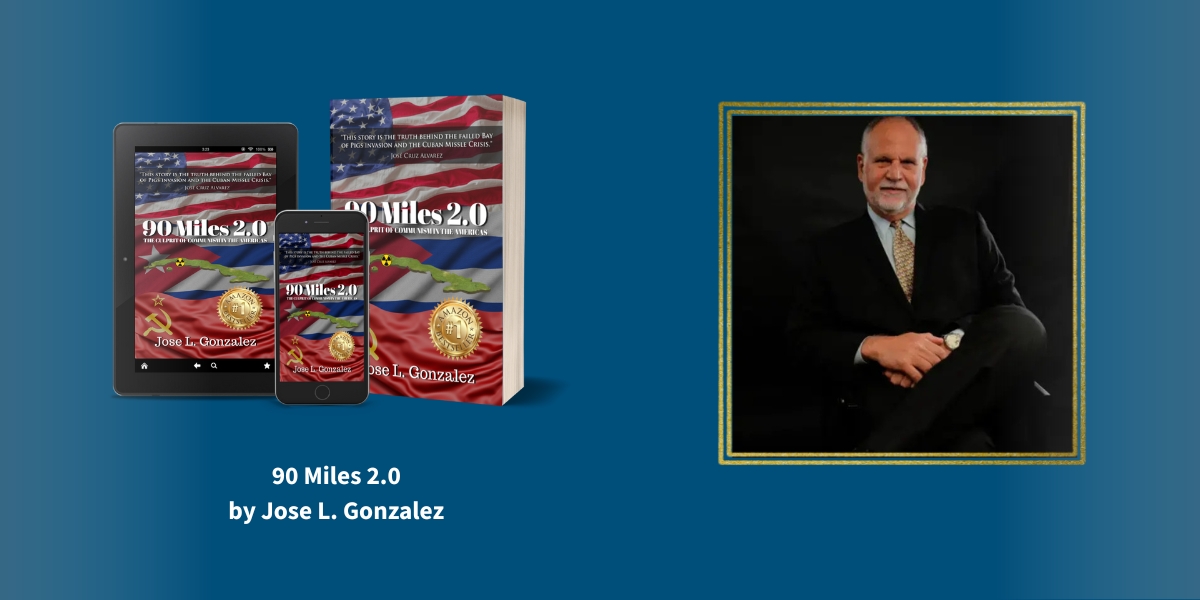


By: AR MEDIA
There’s a particular kind of silence that lives inside immigrant families. It hangs in the pauses at dinner, in the way a parent changes the subject when a certain year or name comes up. It’s the silence of people who have seen more than they can easily say, and who aren’t sure their children are ready, or willing, to hear it.
Jose L. Gonzalez’s 90 Miles 2.0 is, at its core, a story about uncovering that silence.
On the surface, the book is a political thriller and a love story set against the Cuban Revolution. Structured as a feature-length screenplay, it offers all the hallmarks of a cinematic narrative: tense meetings, dangerous deals, torture chambers, breathtaking escapes, and sweeping romantic moments. But beneath the action is a quieter, more intimate drama: a daughter asking her father to finally tell her the truth, and a man deciding whether he has the courage to revisit the worst and most beautiful years of his life.
This is where 90 Miles 2.0 becomes not just entertainment but a profound meditation on memory, trauma, and what it means to inherit a history you didn’t live, but that still lives inside you.
A Quinceañera as a Confession Booth
Gonzalez frames his entire story around a single family moment: Lucia’s fifteenth birthday celebration in Miami. There is music, food, a red Ferrari arriving in style, and the unmistakable vibe of Cuban American success, hard-earned, proudly displayed, and lovingly shared.
But the emotional center of that party is not the dance floor; it’s a quiet conversation between Lucia and her father, Pepe. She knows there’s more to her mother’s story than she’s been told. She knows that whatever happened in Cuba isn’t just “in the past” but has shaped every part of who her father is and how he raised her. On this milestone day, she wants answers.
Pepe’s decision to finally open the old photo album, literally and figuratively, turns the novel into a long, unbroken flashback. What unfolds is his confession: the origin story of their family, wrapped in the rise and betrayal of the revolution.
By choosing this frame, Gonzalez transforms a historical drama into an intergenerational dialogue. Lucia represents the children and grandchildren of exiles everywhere, beneficiaries of sacrifice, but often kept at a distance from the events that made their lives possible. Pepe stands in for a generation that rarely talks about what they survived, partly from pain, partly from pride, and partly from fear that no one will truly understand.
The book asks a haunting question: What happens when those stories are never told, and what might happen when they are finally told?
Revolution as Family Business
Another striking angle in 90 Miles 2.0 is how personal the revolution feels. It does not present a distant, textbook view of Fidel and Che. It shows them as men who charm wealthy donors, inspire young idealists, and slowly reveal just how far they’re willing to go.
For Pepe, Alicia, and their circle, politics is not an abstract ideological debate. It’s a family business. It’s about what happens to their neighbors, their land, their employees, their children. The revolution comes to their homes, their offices, and eventually their consciences.
Gonzalez is especially effective at capturing that initial rush of idealism. Early on, you see why intelligent, successful people might be drawn to Castro’s promise of justice after years of Batista’s corruption. The gatherings feel hopeful, even glamorous, as Havana’s elite plan what they believe will be a better future for their country.
Then the line blurs. Money from questionable sources appears. Allies die under mysterious circumstances. Rules change. Suspicion grows. The characters move from being coauthors of history to potential targets of it.
What’s powerful here is how slowly and painfully that realization dawns. There is no single moment when Pepe and his friends “wake up” to the danger. Instead, Gonzalez shows how complicity and disillusionment accumulate scene by scene, until leaving is no longer an act of betrayal but the only way to survive.
For readers from exile and refugee communities, this progression will feel deeply familiar. Revolutions, wars, and coups rarely begin with moustache-twirling villains. They begin with promises that sound righteous, even necessary. By grounding the politics in the daily lives of one extended family, 90 Miles 2.0 makes a large historical tragedy feel frighteningly intimate.
The Screenplay as an Emotional Archive
The decision to present the story as a screenplay is more than a stylistic flourish. It becomes a kind of emotional archive. Trauma presents itself as scenes rather than neat, linear chapters.
In script form, memories unfold as scenes rather than summaries. You’re placed into the room as conversations happen, instead of being told later how they went. The camera “moves” through time and space the way memory does, suddenly, sharply, sometimes out of sequence.
For example, the screenplay format allows Gonzalez to:
- Cut quickly between past and present, echoing the way trauma resurfaces in flashes.
- Hold close-ups on faces at crucial moments, letting a single expression say what pages of explanation might only dilute.
- Use sound—music, TV announcers, crowd noise—as a backdrop, letting the world’s chaos bleed into his characters’ private crises.
It invites the reader to watch the past with Lucia, almost as if she were sitting beside us in a dark theater, finally seeing how her life began.
Bilingual Storytelling and the Question of Who Gets to Remember
One of Gonzalez’s most meaningful choices is to include the full story in both English and Spanish. This is not just a translation but a statement of who this narrative belongs to.
The English version speaks directly to readers like Lucia, second- or third-generation Cuban Americans, and others, whose primary language is English but whose roots are elsewhere. The Spanish version speaks to those who lived through the events in their mother tongue: parents, grandparents, and elders for whom memory itself is coded in Spanish.
In many immigrant families, language divides generations as much as geography does. Children grow up thinking, dreaming, and reading in English, while their elders remember, grieve, and pray in Spanish. By presenting 90 Miles 2.0 in both languages, Gonzalez creates a shared text where those worlds can meet.
The Cost of Looking Back
If 90 Miles 2.0 were only about the past, it would still be moving. But its real strength lies in how it quietly asks what all of this means now.
We live in a moment when authoritarianism, disinformation, and political cults of personality are again part of the global conversation. Gonzalez never turns the book into a lecture, yet the parallels are hard to miss. Charismatic leaders. Noble slogans. The slow erosion of dissent. The demonization of opponents. The belief that “this time” power will be different.
By showing how quickly hope turned to horror in Cuba, the book gives modern readers a mirror. It challenges us to ask: What would we have seen? What would we have ignored? When would we have spoken up or left?
At the same time, the novel is deeply tender toward those who didn’t always make the right choices. Pepe and his friends are not saints. They misjudge people. They stay too long. They believe too much. They hurt the ones they love, sometimes by action, sometimes by silence. In other words, they are recognizably human.
That nuance is one of the book’s quiet triumphs. It resists easy hero/villain binaries—not in denying the brutality of the regime but in acknowledging the complicated human path that led so many to support it, and then to flee it.
A Story That Invites Your Own
In the end, what lingers most from 90 Miles 2.0 is the feeling that you’ve been allowed to sit with a family at their most vulnerable moment, when the past finally meets the present, and the next generation says, “Tell me everything.”
As a reading experience, the book is ambitious. The screenplay format, the graphic honesty of certain scenes, and the dense political backdrop ask the reader to lean in and stay engaged.
Gonzalez has done something rare. He has turned one family’s private pain into a public work of art that honors both the people who lived it and the descendants who still feel its tremors.
For anyone who has ever sensed there’s a story behind their parents’ silence or for anyone who has carried a story in their heart, unsure how to share it, 90 Miles 2.0 offers both a caution and an invitation:
Silence protects, but it also imprisons. At some point, someone has to speak.
Discover the Untold Story Behind the Cuban Revolution
Get your copy of 90 Miles 2.0 by Jose L. Gonzalez on Amazon, a compelling blend of history, espionage, and human drama.
Disclosure: This editorial review was prepared by AR MEDIA.