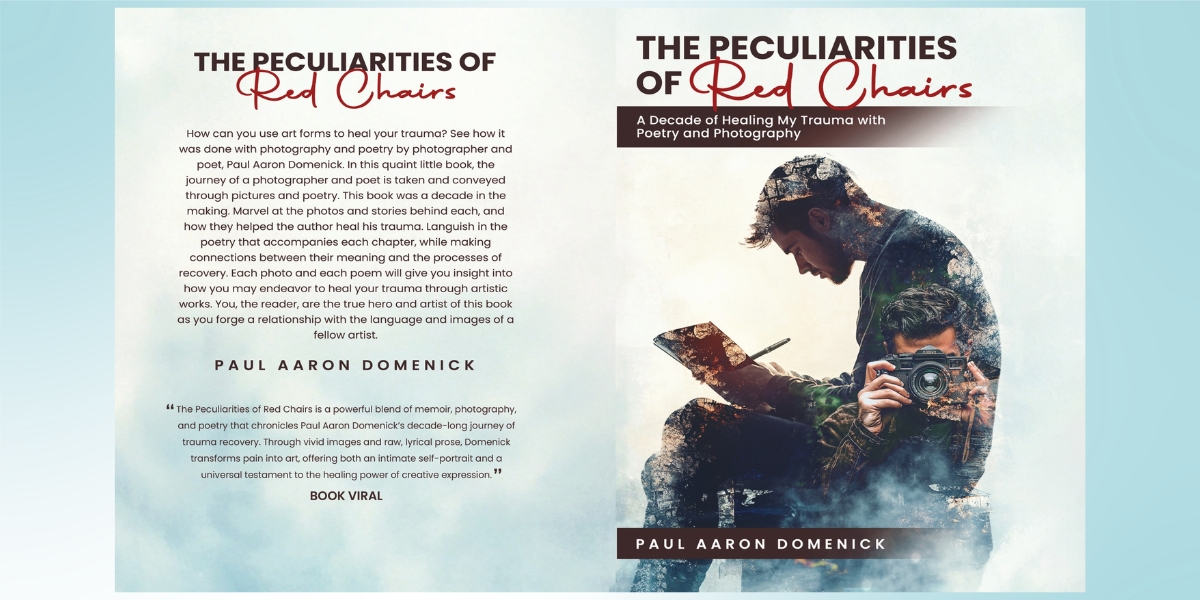


Some books you read. Others you sit with. The Peculiarities of Red Chairs: A Decade of Healing My Trauma with Poetry and Photography by Paul Aaron Domenick belongs in the second group, a hybrid art book that invites you to look, linger, and listen to what images and words can say together.
A photographer, poet, and longtime high school English teacher, Domenick has spent the last ten years building a body of work in which photographs and poems are inseparable.
Each page feels like a quiet conversation between the lens and the line break. An image opens an emotional door, and the poem steps through it. The result is a collection that is as thoughtfully structured as it is deeply felt.
The book unfolds in chapters that mirror different photographic approaches: color and monochrome, candid shots, composites, slow exposures, diptychs, still lifes, portraits, and, finally, the striking Red Chair series.
Each section has its own visual rhythm. In one chapter, richly colored images feel almost cinematic. In another, stark black-and-white compositions strip everything down to form and shadow. Domenick uses these shifts in style the way a poet uses stanza breaks, to signal a new mood or a turn of thought.
Alongside each cluster of photographs, Domenick’s poems act as both echo and counterpoint. They do not simply describe what is in the frame. Instead, they deepen it. A still life might be paired with a poem about memory and the objects we refuse to throw away. A portrait might sit next to lines about identity, love, or the fragile ways people try to be seen. His language is accessible but carefully crafted, with a teacher’s ear for cadence and a poet’s instinct for the one word that makes a line land.
What makes the book especially compelling is its sense of continuity. This is not a random “best of” portfolio. It is a decade-long arc in which you can feel the artist changing, technically and emotionally, as you move through the pages. Early images sometimes carry a raw, searching energy. Later ones feel more deliberate and more willing to sit with nuance and ambiguity. The same is true of the poems. They move from sharply confessional pieces to more spacious and reflective meditations.
Domenick’s perspective as a queer artist and as someone who has wrestled with addiction and pain is present throughout. It is never the sole focus, but it infuses the work with honesty and urgency. The photographs are not just pretty. They are charged. Chairs, rooms, windows, and bodies become recurring motifs, almost like characters returning in a long poem. You start to notice how often the ordinary world, furniture, light, and everyday spaces carry emotional weight.
The Red Chair series, which gives the book its title, is where these elements come together most clearly. The red chair appears in different locations and moods, a visually simple object that serves as an anchor.
Sometimes it feels like a witness. At other times, it feels like a stand-in for the artist himself. Paired with poems that trace inner landscapes of memory, loss, and connection, the series reads like a visual poem presented in chapters.
For readers and viewers, The Peculiarities of Red Chairs offers many points of entry. Photography lovers will appreciate the range of techniques and the careful composition. Poetry readers will find plenty of lines to underline in the margins, lines about love, survival, and self-understanding that linger long after the page is turned. Anyone curious about how art forms can collaborate rather than compete will find the book a compelling case study in interdisciplinary storytelling.
In the end, Domenick’s work suggests that poetry and photography are not separate languages. They are two dialects of the same language. Both are ways of framing experience, of choosing where to focus, what to crop out, and what to bring closer. Over ten years, he has used them together to build something that feels less like a product and more like a life’s ongoing conversation with pain, with beauty, and with the possibility of finding meaning in both.
If you would like to experience this conversation for yourself, pick up a copy of The Peculiarities of Red Chairs and spend some time with its images and poems. Share it with a friend, a book club, or an art lover who appreciates work that lives between genres.
Order your copy from Amazon, and let Paul Aaron Domenick’s decade of poetry and photography find a place on your shelf.