

There is a particular fatigue in the air around modern love. Not heartbreak exactly, though there is plenty of that. Not cynicism either, at least not in its purest form. It is something more ambient and more contemporary: the exhaustion of endless access, endless signaling, endless ambiguity.
People can reach each other at all hours and still fail to arrive. They can text with fluency and remain emotionally illiterate. They can speak of chemistry with near-religious conviction and yet seem terrified by steadiness.
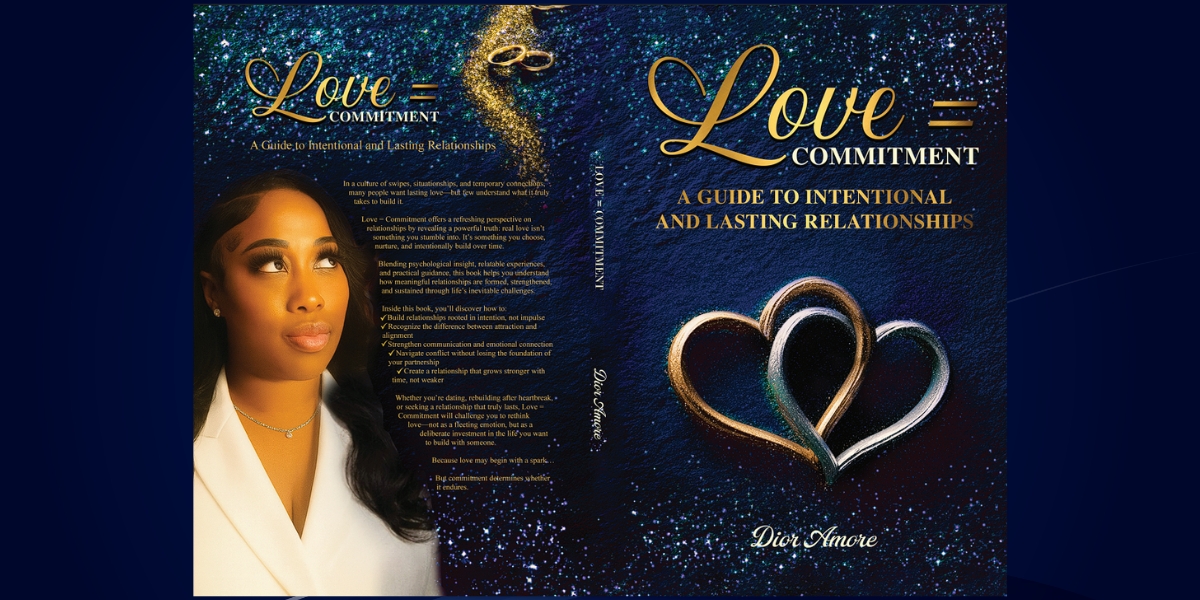
Into that atmosphere comes Dior Amore’s Love = Commitment, a book that refuses the drama of romantic confusion and instead argues, with unusual clarity, for something almost unfashionable: intention.
The provocation at the center of the book is disarmingly simple. Love, Amore insists, is not merely a feeling to be experienced; it is a decision to be practiced. The book returns to this idea again and again, treating commitment not as a grim burden or an antiquated ideal, but as the active proof of love itself. It is an argument that runs counter to a culture trained to confuse immediacy with depth and intensity with durability.
What makes “Love = Commitment” feel timely is not just its message but the world it speaks back to. This is a book written for readers who have grown suspicious of the spectacle of romance. It recognizes the seductions of casualness, the emotional costs of vagueness, and the psychic toll of trying to build a life on intermittent attention. The book explicitly positions intentional dating as a countercultural act in an era of convenience, disposability, and mixed signals. That framing gives the book its charge. It is not offering a mood. It is offering a correction.
Amore writes from a vantage point that is both professional and personal. In the book’s front matter and author section, she identifies herself as a relationship strategist, professional matchmaker, wedding officiant, and founder of Dior Amore Love, someone whose work centers on helping individuals and couples build “intentional, emotionally grounded love” before vows are ever exchanged. That breadth matters.
The book does not read like theory from a distance. It carries the cadence of someone who has spent time near real people making real mistakes, asking real questions, and trying, imperfectly, to love better.
And the word “better” is essential here. The book is not especially interested in romance as ornament. It is interested in romance as infrastructure.
Again and again, Amore shifts the conversation away from attraction alone and toward what sustains a life: self-love, healing, boundaries, communication, accountability, emotional safety, consistency, shared values, resilience. The table of contents itself reads almost like a manifesto against relational passivity, moving from “Love Is Not a Feeling, It’s a Decision” to “Self-Love Is the First Commitment,” then on to healing, intentional dating, choosing the right partner, trust, communication, daily practice, legacy, sacred partnership, and love that survives adversity. The architecture is revealing. This is not a book that treats romance as an isolated emotional event. It treats love as a system.
That systems-based approach may be exactly why the book will resonate with readers weary of advice that either over-spiritualizes love or trivializes it. Amore’s worldview is more disciplined than that. She seems less interested in asking whether someone feels butterflies than whether they can tell the truth, stay present during conflict, respect a boundary, regulate themselves under pressure, and build something that does not collapse the first time life becomes inconvenient.
In one of the book’s recurring ideas, lasting love is shown not as a theatrical feeling but as visible consistency, emotional presence, and daily repair.
That is where the book’s appeal deepens. Love = Commitment is not merely speaking to singles hoping to find a partner. It is speaking to people who sense that romance has been oversold as instinct and undersold as practice. It is speaking to couples who want more than attraction and to marriages that aim not merely to endure, but to thrive. It is speaking, too, to readers who have come to understand that a relationship is never only about two people; it radiates outward into family, home, emotional inheritance, and community.
The book explicitly imagines love as a legacy, something passed forward, something capable of changing not only hearts but households and entire communities when rooted in respect, self-awareness, and purpose.
This is the boldest thing about Amore’s project: she wants to restore moral seriousness to the subject of love without draining it of warmth. In lesser hands, that could become preachy.
Here, it feels urgent. The book’s language suggests that commitment is not a reduction of romance but its maturation. Not a lowering of excitement, but a raising of standards. Not a denial of feeling, but a refusal to let feeling do work it cannot sustain.
In that sense, Love = Commitment arrives as both guide and rebuke. It asks readers to reconsider what they have been calling love, what they have been rewarding, and what they have been tolerating. It offers a vision of partnership built less on fantasy than on fitness: the emotional fitness to communicate, the spiritual fitness to align, the ethical fitness to keep showing up.
That vision may not flatter every reader, and it is not meant to. But it may steady many of them. Because Amore understands something the culture often forgets: people do not only want passion. They want peace. They want clarity. They want to know that love can be more than a brief atmosphere of mutual desire. They want to know if it can survive ordinary life. They want to know if it can be built.
And this book’s answer, delivered with conviction, is yes, available now.