

There’s a particular kind of quiet that arrives right before sleep: the house dimmed to lamp-light, the hallway holding its breath, the last sip of water negotiated like a treaty. In that hush, children turn into philosophers.
They ask the kinds of questions adults might forget to ask, questions that are less about facts than about how the world feels. In Flying Jelly Beans by Kona, illustrated by Victor Tavares, those questions are met not with lectures, but with a gentle invitation: what if wonder is real, and what if kindness has a color?
This is a picture book built for the ritual of being read aloud. The sentences move with the steady rhythm of a bedtime voice, calm, reassuring, just playful enough to keep a child’s attention without revving it up.
The opening domestic tableau establishes the book’s emotional core: a small child tucked into her own bed while a grandfather sleeps nearby, close enough to feel like a lighthouse in the dark.
Before anything “magical” happens, the book signals what it’s really about: care, closeness, and the peculiar tenderness of a household where love is measured in the ordinary, blankets, warm light, and the safety of a familiar room.
Then comes the hook, the kind that’s instantly legible to a child: a jar of candy that looks like it belongs in a dream, luminous and impossibly promising. Flying Jelly Beans understands that children don’t need elaborate mythologies to be captivated. They need a single object that feels both real (you could hold it) and impossible (it shouldn’t exist). From there, the book leans into something rare in contemporary kids’ publishing: magic that doesn’t exist to show off, but to soothe.
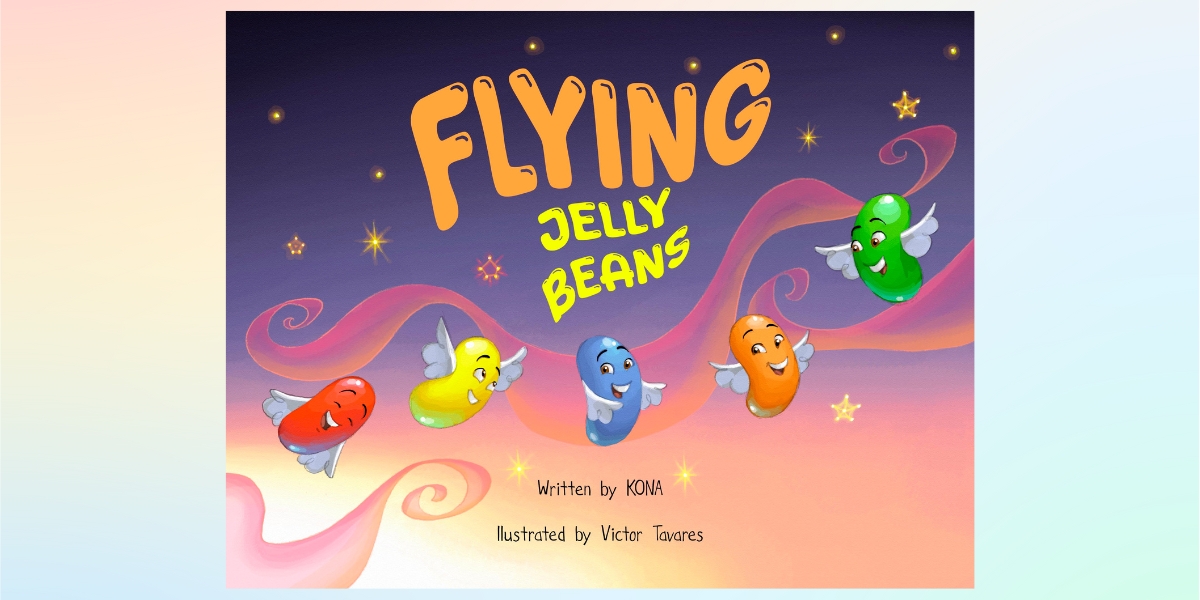
The artwork amplifies that soothing quality. Tavares’s illustrations glow with evening tones and soft gradients, the sort of palette that might make you lower your voice without realizing it. When the book shifts into sky-and-star imagery, it doesn’t suddenly turn loud or frantic; it becomes more expansive, like a lullaby widening into a chorus.
The Flying Jelly Beans themselves are “characters” you may need to track. They’re the sort of figures a child might point to and say, That one is my favorite, not because it’s the hero, but because it matches a mood.
What makes this book special is that it manages to be charming without being saccharine. It offers sweetness, yes—candy literally—but it also makes room for the complicated feelings kids carry around quietly. (Grown-ups, too.) The book’s emotional range culminates in an image of unmistakable poignancy: a child holding the jar, a moment of heaviness settling in alongside the wonder. It’s a reminder that the best children’s books don’t flatten childhood into constant delight. They honor its seriousness.
Who it’s for: families building bedtime traditions, grandparents who want a story that feels like a hug, teachers and librarians looking for a read-aloud that sparks gentle conversation (“What color feels like happy?” “What helps when someone is sad?”) without spoiling anything.
What it offers—without giving itself away: a small-scale miracle, told softly, that leaves readers feeling a sense of steadiness after the story.
Buy Flying Jelly Beans today at your local bookstore or from Amazon, and let tonight’s bedtime story glow.