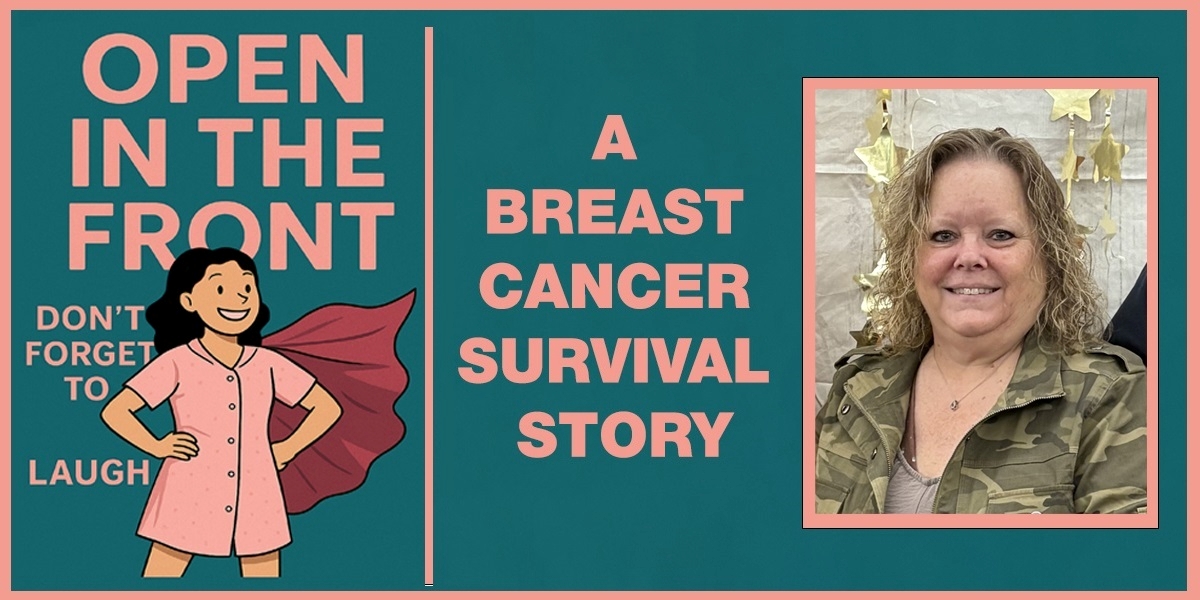


By: Kimberly S. Knutson
When Aimee Kintzel first heard the word “malignant,” she didn’t immediately dissolve into tears or rush to the internet for survival statistics. Instead, she took a deep breath, tilted her head, and thought, well…this tumor needs a name.
That one decision to meet cancer with wit instead of fear would become the heartbeat of her journey and the soul of her memoir, Open in the Front.
“I decided right then cancer wasn’t going to have the last laugh,” she says.
Redefining the Cancer Story
Kintzel’s memoir doesn’t read like a medical manual or a motivational seminar—it’s a candid, laugh-out-loud confessional that invites readers into the most vulnerable chapter of her life. There are awkward hospital gowns, clinic visits turned into comic skits, and moments where humor becomes the only lifeline. She doesn’t shy away from fear. Instead, she shares it openly, often wrapped inside a joke, proving that courage isn’t necessarily the absence of terror, but rather the ability to smile in its presence.
Through each chapter, Kintzel reflects on how humor has the power to transform the experience, not by diminishing the seriousness of the situation but by allowing her to take control of it. Humor gave her the ability to face not just the cancer, but the many emotional challenges that came with it, offering her a coping mechanism when others may have felt helpless.
Finding Humor in the Hardest Days
Aimee’s brand of humor isn’t about pretending everything is fine. It’s about reclaiming some level of control over a situation designed to strip it away. She finds comedy in waiting rooms, turns medical procedures into punchlines, and treats each day as an opportunity to write a new scene in her unscripted, unsensitized life story.
It’s not about brushing off the struggles she faced, but rather about finding a way to laugh in the face of adversity. By embracing humor, she discovered the strength she hadn’t anticipated, and it became a tool that helped her heal both physically and emotionally.
The Power of a Village
Her journey is also a love letter to the people who showed up for her—her husband Jim, a constant source of strength; friends who offered food, comfort, and distraction; and colleagues who knew when to make her laugh. In their own quiet ways, they became co-authors of her survival story.
Through them, she discovered the importance of community during hard times, realizing that strength doesn’t come only from within, but from the connections we share with those who lift us up. These people provided not just support, but a way to find humor and joy even when things seemed bleak.
A Story That Speaks Beyond Cancer
What makes Open in the Front universally appealing is that it isn’t only about breast cancer; it’s about facing any of life’s unwelcome plot twists with honesty, humor, and grace. Whether you’ve battled illness or simply endured a season of uncertainty, Kintzel’s voice resonates like that of a trusted friend who says, “I’ve been there, and yes, you can still laugh.”
Her story speaks to anyone who has ever faced challenges—whether they are physical, emotional, or personal—and reminds them that humor is not just a relief, but a vital part of the healing process. In a world where we often fear vulnerability, Kintzel’s journey shows us the power of embracing it.
Success Beyond the Page
That mix of courage and comedy hasn’t just touched readers’ hearts; it is also turning heads in the publishing world. Open in the Front has been earning prime placement on bookstore shelves, with front-of-store displays introducing her story to new audiences every day.
It’s a sign that Kintzel isn’t just surviving her diagnosis; she is thriving, making a name for herself as a writer whose voice refuses to be ignored. Her memoir is not just a personal triumph; it’s a reminder of the universal human ability to find strength, joy, and laughter in the face of adversity. This has led to her gaining attention beyond the page, with many eager to hear more of her perspective on life, humor, and resilience.
Bottom line: Aimee Kintzel shows that sometimes the bravest thing you can do in the face of fear is crack a joke and that laughter, even in the darkest moments, can be life-saving.