

By: Evan Callister
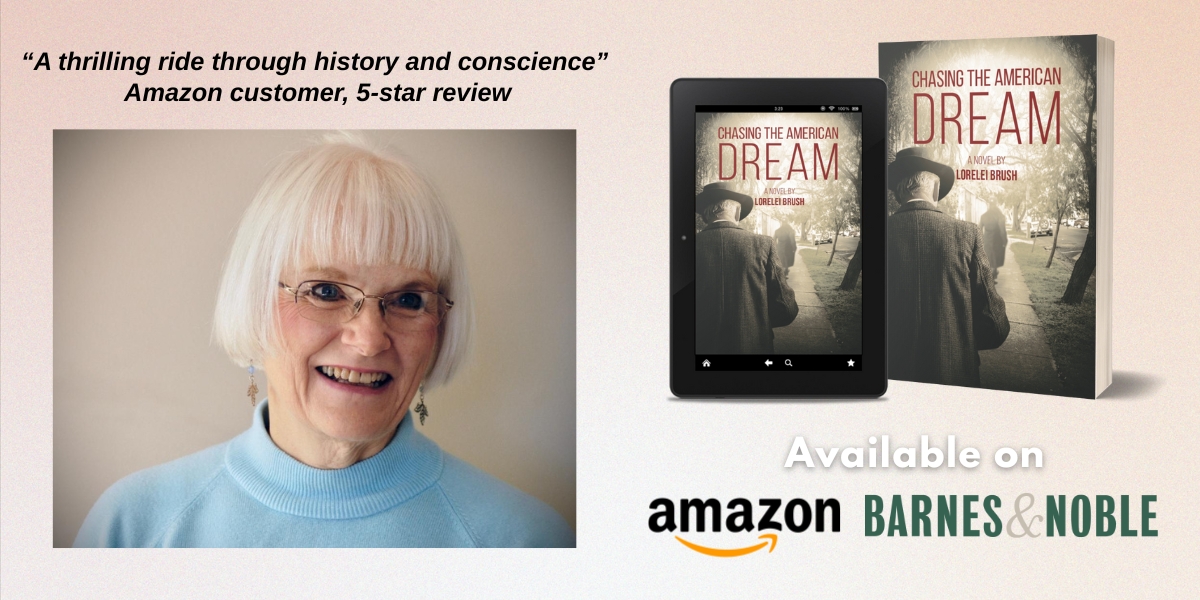
Lorelei Brush’s Chasing the American Dream: A Novel intertwines historical intrigue with deeply personal reflection. Set in 1955, the story follows David, a former OSS operative, on a quest to track a Nazi war criminal hiding in plain sight. But beyond the suspenseful plot, the novel is a profound exploration of family, identity, and the myths we tell ourselves—both about our loved ones and about the nation we inhabit.
Brush’s inspiration for the story stems from a complicated and emotionally charged relationship with her father. “My father was a very angry man and aimed his strong feelings toward everyone in his orbit,” she recalls. A man with unfulfilled ambitions and limited personal success, he had few friends and a volatile temperament. “The discovery that he was not the hero he had described elicited from me several curses at him and then laughter. He wasn’t this perfect god who must be obeyed, but a very human man whose goals were unfulfilled. I was freed to be the person I wanted to be and could forgive him, one adult human to another.”
The revelation that her father’s tales of wartime heroism were essentially inventions became a central emotional thread for Brush, shaping the novel’s exploration of myth, heroism, and moral ambiguity. “Chasing the American Dream was born out of months spent in the National Archives,” she explains. Among the most startling discoveries was the truth behind her own name. Her father had insisted on naming her “Lorelei,” claiming it had been his code name while working as a spy behind German lines—a name that would also, he insisted, keep her safe. Months of research revealed no such code name existed, confirming that much of his wartime narrative was a fabrication.
The 1955 setting offers a unique backdrop, steeped in Cold War tensions, post-war disillusionment, and the Red Scare. David’s story embodies the era’s contradictory spirit: fierce patriotism and optimism coexisting with paranoia and suspicion. David believes that pursuing justice for a Nazi war criminal will give him the heroism he was denied in wartime, yet he is soon confronted with moral gray zones. Accusations of communist sympathies during the Red Scare force him to reconcile his ideals with a flawed reality. “He had to accept that his quiet successes as an ‘everyday’ man could make him a different but satisfying hero,” Brush explains.
This narrative reflects a larger meditation on the American dream. Brush contrasts the early-20th-century vision of freedom, justice, and hard work with the mid-century focus on material prosperity—a house, a car, a comfortable life. Through David’s experiences, she challenges readers to consider how these evolving ideals shape our personal and collective expectations. “We would be more resilient as a country if we returned to a debate on how best to realize ‘freedom and justice for all,’ rather than argue that we’ve been deprived of what we are somehow owed by being citizens,” she says.
Brush’s approach to writing David’s “spycraft” was informed by decades of experience drafting government reports—proposals, statistical analyses, and policy recommendations. “I let my imagination flow, choosing which facts would constrain his behavior and where I’d let him go wild,” she notes. Historical research and knowledge of WWII espionage shaped the technical aspects of his character. At the same time, Brush’s insight into human behavior added emotional depth, resulting in a protagonist whose heroism is as complex as it is compelling.
The novel also examines the moral complexity of evil through Dr. Gerhardt Adler, the Nazi chemist responsible for developing rockets using forced labor. Brush intentionally avoided sensationalism, presenting Adler as both competent and human—a man who could love his family yet orchestrate atrocities. “By seeing the good side of a ‘villain’ as well as the evil, readers can understand his motives without excusing his actions,” she explains, illustrating the book’s nuanced treatment of morality.
Writing fiction offered Brush a creative freedom that contrasted with her structured, fact-driven career. Many scenes were crafted longhand in coffeehouses, where she envisioned characters and settings with cinematic clarity. “Sometimes I’d erase the scene and start again if it didn’t feel right,” she recalls. This immersive approach allowed her to seamlessly weave historical accuracy, emotional realism, and imaginative storytelling.
The process of drafting and revising was extensive. Brush experimented with multiple endings, ultimately choosing one that emphasized emotional growth and community over grandeur. David becomes a family lawyer, deeply respected in his community, rather than a celebrated orator or court hero. “That was the father I would rather have had,” she reflects, connecting her creative decisions to personal reconciliation with her own father.
Beyond family history, Brush encourages readers to examine their inherited myths—both personal and national. Family stories, she observes, can shape identity but also create unrealistic expectations. By studying the realities of her father’s life, Brush found forgiveness and respect for his choices and limitations. She hopes readers will similarly explore their genealogical histories and question the myths surrounding themselves and their nation.
Ultimately, Chasing the American Dream is a story about confronting truths, understanding moral complexity, and navigating the space between myth and reality. It challenges readers to reflect on personal and national ideals as they explore the cost and meaning of heroism.
For readers seeking a novel that blends historical intrigue, emotional depth, and thoughtful reflection on the American dream, Lorelei Brush’s Chasing the American Dream is a compelling choice. Available in both paperback and e-book formats, it offers a story that lingers—prompting questions about family, identity, and the legacies we inherit. Pick up your copy today and experience a journey that bridges history, imagination, and the enduring quest for meaning in an imperfect world.
Get your copy of Chasing the American Dream: A Novel today and discover a story of courage, family, and the pursuit of justice.
Disclaimer: The views and opinions expressed in this article are those of the author and do not necessarily reflect the official policy or position of any entity.