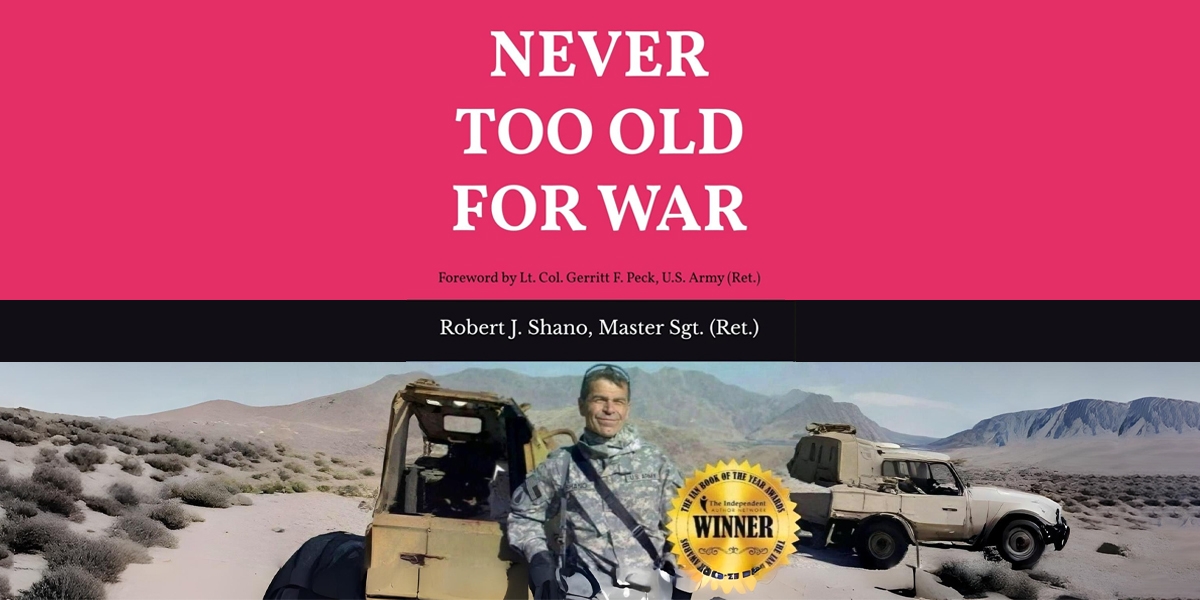


In the wake of the September 11 attacks, as a wave of young patriots flooded recruiting stations, one man’s enlistment stood in stark, almost unimaginable contrast. Robert J. Shano, Master Sergeant (U.S. Army, Retired), AKA Bob Shano, wasn’t a teenager seeking direction or a college student answering a call to duty. He was a 50-year-old Vietnam-era veteran, a former Sergeant First Class with a family, a career outside the military, and a body that had already endured decades of soldiering. His decision to re-enter the U.S. Army as an Infantryman was met with disbelief, even by recruiters. Yet, his subsequent eleven-year journey—which included three combat tours in Iraq and Afghanistan, culminating in a mandatory retirement at age 62—would cement Master Sergeant Bob Shano’s place as a respected figure and lead to a reconsideration of what it means to be a warrior.
Shano’s story, detailed in his unvarnished memoir Never Too Old for War, is far more than a tale of personal grit. It is a profound testament to the timeless soldiering virtues of experience, resilience, and leadership—qualities that are often considered to be overshadowed in a youth-centric modern military. His service acts as a crucial bridge between eras; he carried the pragmatic, no-nonsense ethos of the Vietnam-generation Army into the complex, asymmetric battlefields of the Global War on Terror. Where some saw a man past his prime, the battlefield revealed an asset of great value: a leader whose judgment was shaped by time, not just training.
His firsthand accounts challenge the belief that physical prowess is the sole domain of the young. Arriving in Iraq at 52, Shano was able to consistently max the Army Physical Fitness Test, often outpacing soldiers half his age. He acclimated to the blistering 130-degree heat of the Mesopotamian desert through sheer will and discipline, forgoing the constant hydration of his younger comrades to build endurance. In his gunner’s hatch, exposed and vigilant during countless convoy missions through the dangerous streets of Baghdad, he demonstrated a mental fortitude that often surpassed the nerves of youth. “The battlefield is no place for mercy or compassion,” he writes, a lesson forged in one era and adapted to another. “You had to be ruthless and uncompromising.”
But Shano’s true authority emerges not just in his ability to endure, but in his critique of the institutional army he rejoined. With the unique perspective of a soldier who had served in the stripped-down, mission-focused force of the 1970s, he views today’s military as sometimes overly entangled in bureaucracy, obsessive documentation, and a risk-averse culture. He laments the rise of “toxic leadership”—leaders who manage by PowerPoint and regulation rather than common sense and moral courage. He witnessed, with palpable frustration, a culture where following protocol often took precedence over achieving the mission, recalling an incident where a sergeant refused him a ride across a stream because he wasn’t wearing a helmet, despite the tactical absurdity of the situation.
His critique is not the grumbling of a stubborn relic; it is the hard-earned wisdom of a master tactician. Shano argues that true leadership is often innate, a quality of “guts and brains” honed in action, not necessarily bestowed by a certificate from a leadership course. He saw, in the tragic failures from the Abu Ghraib scandal to the bureaucratic betrayal of veterans by the VA system, the consequences of an institution that at times lost sight of its core values: duty, integrity, and taking care of its people.
Master Sergeant Bob Shano’s ultimate legacy is his redefinition of service. He demonstrated that the warrior spirit is not bound by a birth certificate, but by character. He showed that experience can be a force multiplier on the modern battlefield, where split-second decisions carry profound consequences. And he issued a call for a return to the fundamental principles that make an army effective: trust in its people, leadership from the front, and an unwavering focus on the mission. In an era of rapid technological change, Never Too Old for War is a reminder that the most essential component of any military remains the timeless, resilient, and experienced human heart of the soldier.
Ready to witness a testament of unwavering duty and truth? Secure your copy of Never Too Old for War and explore the unvarnished reality of service, leadership, and sacrifice from the front lines.