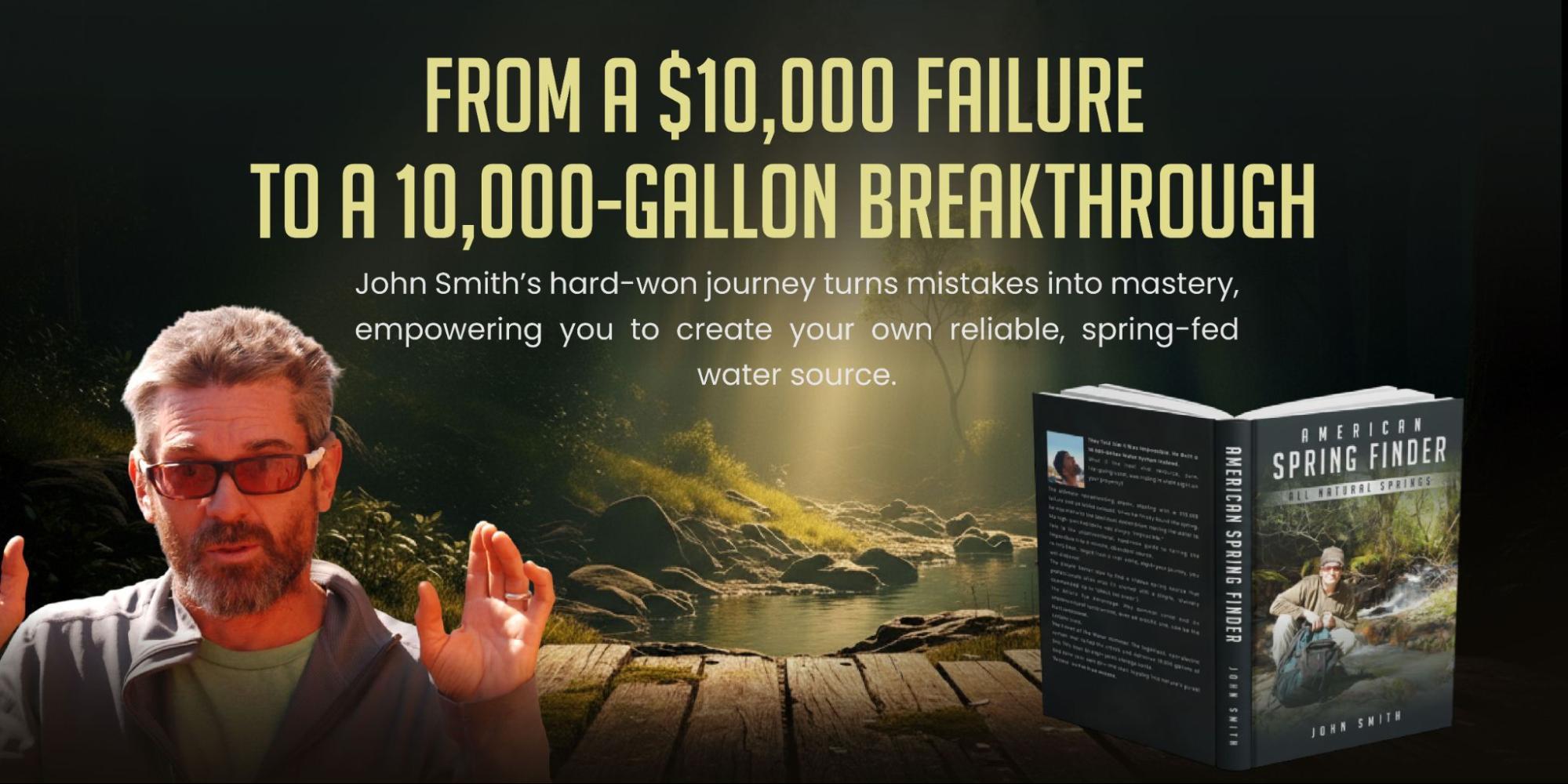


(How John Smith transformed his search for sustainable water sources into a practical guide and philosophy for working in harmony with the natural environment.)
The Artist Who Found a Spring Instead of a Canvas
Before earning recognition as an expert in natural spring development, John Smith built a career that combined creativity, discipline, and exploration. Trained in fine arts, he spent much of his early life documenting the outdoors through photography and film while working as a climbing and kayaking guide. Those years shaped both his understanding of natural systems and his confidence in problem-solving in unpredictable environments. They also developed the observational mindset that later guided his approach to environmental design.
When Smith purchased a rural property in California, a failed attempt to drill a well left him without a water source, forcing him to confront a challenge that would redefine his life. Instead of relying on traditional methods, he began analyzing the terrain, identifying geological indicators of underground flow, and experimenting with small-scale water-delivery systems. Over the course of two years, he designed and constructed a gravity-fed spring network powered entirely by natural pressure. The project marked a shift from art to applied science, transforming a personal struggle into an enduring study of how human ingenuity can align with the intelligence of the earth.
The experience served as the foundation for his book, American Spring Finder, which combines technical instruction, environmental awareness, and philosophical reflection. What began as a single solution to a household problem evolved into a field manual for sustainable living and a testament to the creativity that emerges when art meets necessity.
The Gold Beneath Our Feet
In American Spring Finder, Smith describes water as civilization’s oldest and most valuable resource. The book presents a rare combination of engineering precision and ecological insight, offering readers practical guidance on locating, developing, and maintaining natural springs. Smith’s purpose is not only to teach the mechanics of water sourcing but also to renew a sense of respect for its role in sustaining life.
He explains how natural springs form through the interaction of rock, pressure, and gravity, emphasizing that the most effective systems imitate those same forces. Historical references throughout the book demonstrate how early communities built settlements around springheads for strategic, agricultural, and spiritual reasons. By connecting that legacy to contemporary challenges of water scarcity, Smith positions the spring as both a symbol of self-reliance and a model for sustainable design.
He often refers to water as “liquid gold,” a metaphor that reframes sustainability as stewardship rather than control. For Smith, value lies not in the extraction of resources but in understanding their balance within the natural system. His work encourages a shift from dependency on industrial infrastructure to small-scale, locally managed water sources that reduce environmental impact while strengthening personal responsibility.
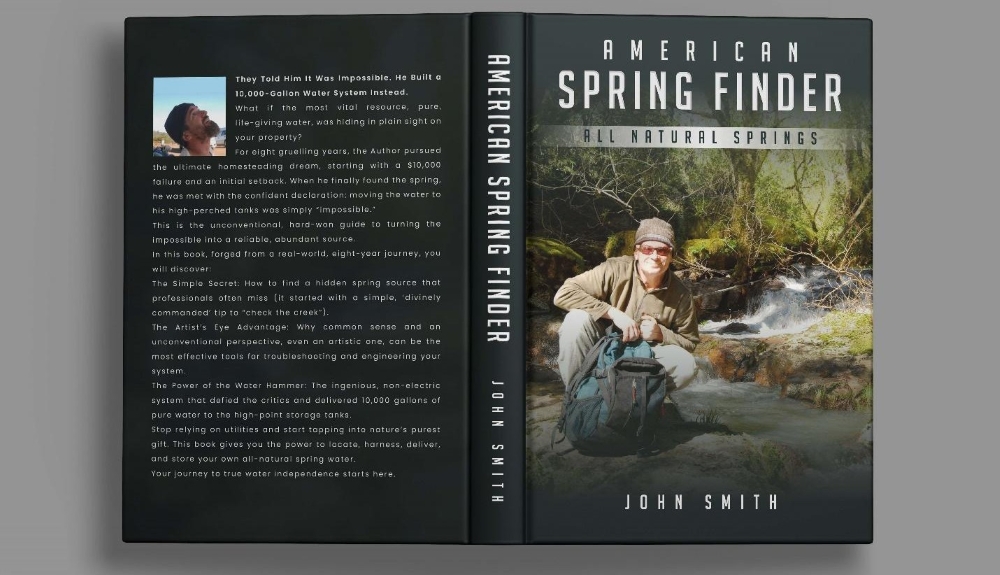
Photo Courtesy: John Smith
A Journey of Faith and Function
Building and maintaining a spring system required precision, persistence, and an unwavering belief in the process. Every setback, from frozen lines to mechanical failures, taught Smith something new about both engineering and endurance. Each problem required him to adapt his design, measure environmental variables, and adjust the equipment until a consistent flow was achieved. Over time, he developed methods that balanced functionality with simplicity, creating systems that could operate indefinitely with minimal intervention.
That process also deepened his understanding of resilience and the importance of cooperation with nature. Smith’s writing emphasizes that environmental success depends less on control and more on partnership. By observing how water behaves under pressure, temperature, and gravity, he learned that sustainable design is about working with natural forces rather than against them.
He believes the lessons from spring development mirror the human condition; patience, humility, and consistency yield results more lasting than force. In American Spring Finder, each technical diagram is paired with a reflection on these themes, reminding readers that the act of building infrastructure can also build character. His philosophy unites practicality and purpose, showing that sustainability and spirituality often share the same foundation, disciplined respect for what already works.
From Innovation to Preservation
Following the success of his book, Smith began consulting for homeowners, small farmers, and conservation groups seeking sustainable water solutions. Over several years, he assisted in developing more than 60 independent spring systems across the United States. His approach remains rooted in observation and data-driven analysis, consistently prioritizing environmental preservation. By promoting natural flow systems over mechanical pumping, he demonstrates that technological progress can be achieved without ecological compromise.
His emphasis on stewardship has influenced a growing movement among rural developers and environmental engineers who view natural springs as viable, renewable water sources. Smith’s consulting projects often begin with on-site surveys, during which he assesses geology, slope, and pressure zones before designing custom systems that maximize yield while minimizing disruption to the landscape. Clients credit his ability to merge practicality with ecological ethics as an uncommon balance in the field of water engineering.
Smith continues to expand on this work in two forthcoming volumes. The Water Hammer explores the physical dynamics behind gravity-powered delivery systems and how ancient techniques can inform modern sustainability. The Language of Water will shift from mechanics to meaning, studying how the movement and sound of water influence human perception and creativity. Together, the books reinforce his belief that understanding natural processes leads to better design, stronger communities, and a more responsible relationship with the environment.
Photo Courtesy: John Smith
Rediscovering What Lies Beneath
John Smith’s journey demonstrates that innovation often begins with observation. His life’s work underscores that nature already offers solutions, but we only need the patience to see them clearly. Through his research, writing, and fieldwork, Smith challenges the assumption that technology must dominate nature to advance society. Instead, he presents water as both a scientific subject and a moral teacher, as well as a living system that rewards respect and punishes neglect.
American Spring Finder ultimately serves as more than a manual for developing springs. It represents a comprehensive philosophy of sustainable living. The book bridges art, engineering, and environmental ethics, inviting readers to rediscover the connection between human progress and natural intelligence. Smith’s message is pragmatic yet profound that the path forward begins by looking downward, into the ground beneath our feet, where clean water still flows, quietly sustaining the future.