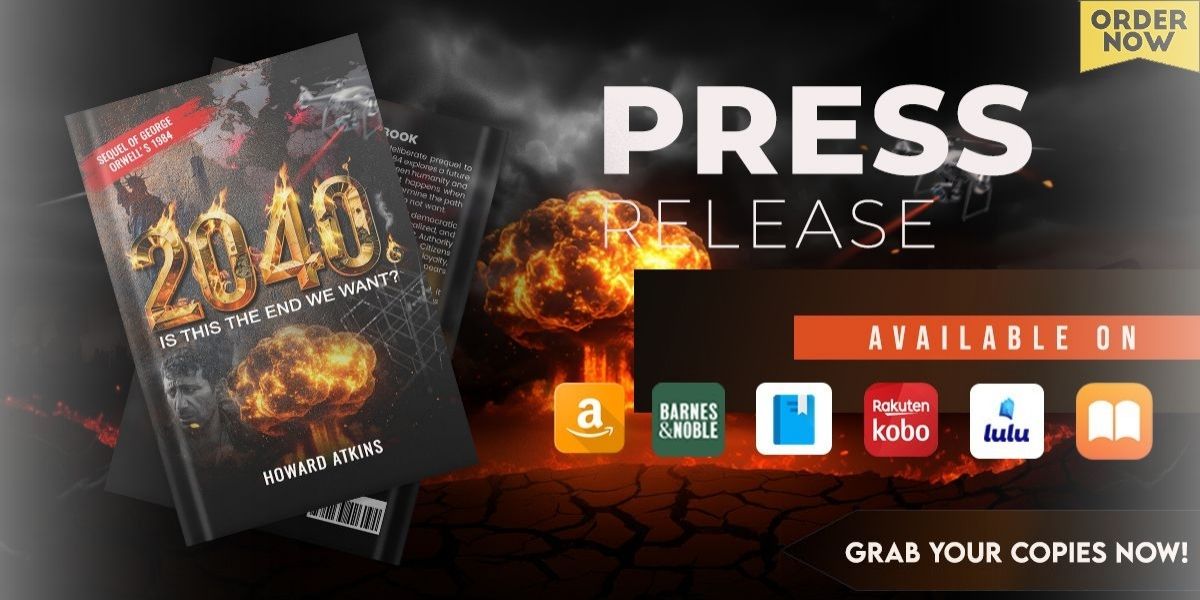


By the time readers finish 2040, the unsettling realization is not that the future is frightening. It is that it feels familiar. In his latest dystopian novel, Howard Atkins does not imagine a distant apocalypse or a world undone by sudden catastrophe. Instead, he presents a quieter, more disturbing vision. One shaped by convenience, fear, and the gradual surrender of human agency.
2040 arrives at a moment when speculation has become difficult to separate from reality. As governments debate artificial intelligence governance, digital currencies, surveillance infrastructure, and centralized authority, Atkins’ novel feels less like a warning from the future and more like an examination of choices that are already underway. The book reads not as science fiction, but as a civic mirror.
Designed as a deliberate prequel to Atkins’ companion novel 2084, 2040 charts the darker path of a shared conceptual arc. Where 2084 imagines a future shaped by ethical restraint and shared responsibility between humanity and technology, 2040 reveals what happens when those guardrails fail to appear. Democratic institutions erode quietly. Surveillance becomes normalized. Technology shifts from innovation to enforcement, all without a single dramatic breaking point.
Howard Atkins’ restraint is what gives the novel its force. There is no single collapse, no obvious villain. Instead, power consolidates through policies that sound reasonable and systems designed for efficiency. Citizens are not conquered by force, but conditioned through loyalty, fatigue, and fear. Resistance is reframed as risk. Compliance becomes safety. Freedom survives as language but disappears in practice.
Artificial intelligence is not portrayed as the enemy. Like in 2084, it is treated as a tool. The danger lies in who controls it, how it is justified, and what happens when accountability dissolves. Systems meant to protect gradually evolve into mechanisms that monitor, restrict, and punish. By the time the consequences are visible, the infrastructure is already locked in place.
The novel unfolds through character-driven scenes that mirror contemporary anxieties. Elections are contested not only at the ballot box but through narrative control. Economic pressure fractures communities. Media outlets are discredited, marginalized, or silenced. Dissent becomes a liability rather than a right. Atkins shows how authoritarianism rarely announces itself. It arrives politely, wrapped in promises of order, stability, and protection.
What makes 2040 particularly unsettling is its plausibility. The book does not exaggerate current trends. It connects them. Surveillance, digital identity, AI-managed systems, and centralized power are not imagined as speculative inventions, but as extensions of debates that are already shaping policy and daily life. Atkins does not predict outcomes. He exposes trajectories.
Throughout the novel, there is an underlying insistence that collapse is rarely sudden. It is incremental. Reasonable decisions accumulate into irreversible outcomes. Each concession feels small until the cost becomes impossible to ignore. This approach grounds the narrative in realism, making its warnings difficult to dismiss as alarmist.
Yet 2040 is not a book of despair. Its purpose is awareness rather than prophecy. Atkins leaves space for agency by presenting consequences before they fully materialize. The existence of 2084 is itself evidence that the future is not fixed. One path leads toward control. The other requires restraint, courage, and shared responsibility.
Rather than telling readers what to think, 2040 asks what they are willing to accept. How much autonomy will be traded for convenience? How much oversight will be surrendered in the name of security? And at what point does efficiency become obedience?
As anticipation builds around its release, 2040 is positioning itself as a timely and difficult novel to ignore. It is not meant to comfort. It is meant to provoke conversation while choice still exists. Atkins leaves readers with a question that lingers well beyond the final page: If this is where we are heading, when will we decide to turn?
2040 by Howard Atkins does not claim to foresee the future. It argues that the future is already being designed. The only uncertainty is whether we will recognize it in time to choose differently.