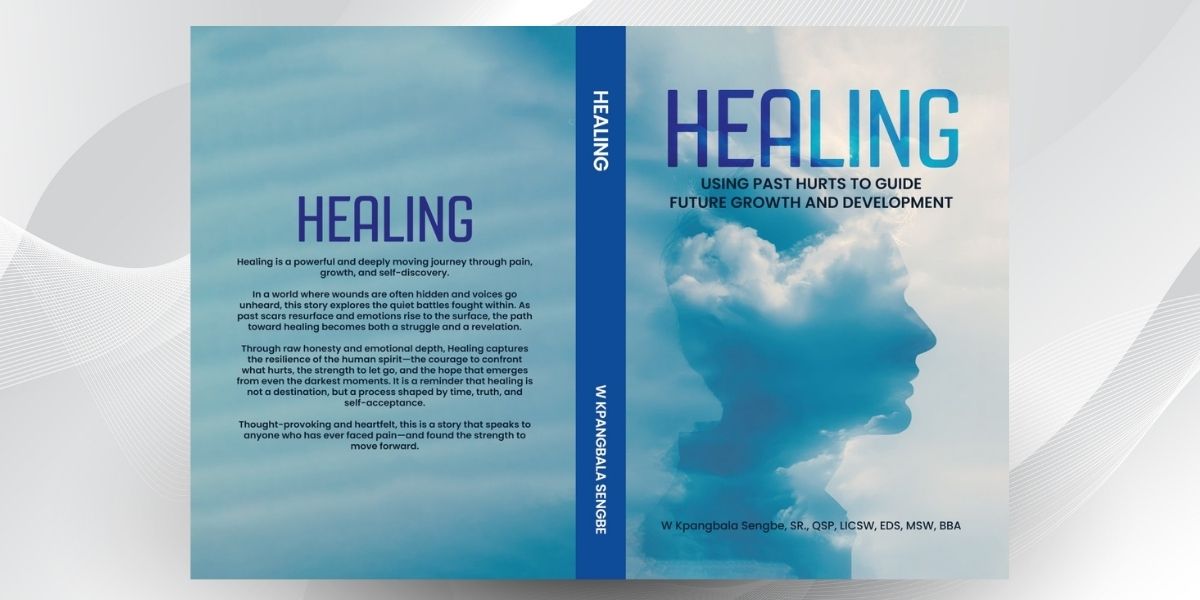


There is no shortage of books that promise recovery. They arrive in polished stacks, armed with the language of renewal and the soft coercion of improvement. They tell us to let go, move on, forgive, and release. What they too often omit is the mess, the persistence of memory, the humiliation of betrayal, the way grief can become a private weather system that returns without permission. What makes Healing: Using Past Hurts to Guide Future Growth and Development feel distinct is that it does not treat pain as an obstacle to thought. It treats pain as material.
That difference matters.
Kpangbala Sengbe, Sr. comes to the page not as a motivational minimalist, but as a writer concerned with narrative, community care, and the long disciplines of witness. His work suggests a life shaped by listening, service, emotional intelligence, and the kind of practical wisdom that comes from seeing how people actually live through hardship. Healing carries the authority of experience, but it does not lean on authority alone. It invites the reader into a more searching question. What if the past is not only something to survive, but something to study, reinterpret, and use?
The result is a work that inhabits an unusual borderland. It is at once reflective, narrative, spiritual, and psychologically attentive. Sengbe is not interested in offering polished slogans about resilience. He is more interested in what resilience requires. He returns, again and again, to the proposition that healing is not an event. It is a practice. It is built through repeated acts of reflection, creativity, faith, gratitude, forgiveness, and human connection. The self is not rescued by a single clear revelation. It is rebuilt, slowly, through habit and intention.
That insistence on method is one of the book’s strongest features. Again and again, Sengbe points toward forms of expression that do more than comfort. They clarify. Journaling becomes a way to contain pain without denying it. Art becomes a language for emotions too layered for direct speech. Memory becomes something that can be held and examined, rather than feared. In this framework, healing is not passive. It asks for participation. It asks for work.
This is where Healing becomes more than a familiar story of injury followed by redemption. Sengbe understands that pain is often chaotic, but he also understands that chaos can be given form. A page, a prayer, a painting, a conversation, a moment of gratitude, these are not decorative gestures in his vision of recovery. They are disciplines. There are ways of converting suffering into self-knowledge.
Faith also plays a central role in the book’s emotional architecture. But faith here is not presented as certainty. It is not triumph dressed up as spirituality. Instead, Sengbe approaches faith as steadiness, as a way of remaining oriented when clarity is unavailable. The effect is important. It keeps the book from collapsing into sentimentality. It allows room for doubt, hesitation, and vulnerability. Healing, in this view, does not mean becoming untouched by sorrow. It means learning how to move through sorrow without surrendering to it.
That emotional honesty gives the book much of its power. Sengbe does not write as though hurt vanishes once it has been named. He writes as someone who understands that memory lingers, that growth can be uneven, and that strength often looks less like conquest and more like return. One returns to the page, to prayer, to reflection, to the difficult effort of trying again. In a culture that prizes dramatic breakthroughs, Healing makes a quieter and more persuasive case for endurance.
The book is also deeply invested in the relational side of recovery. Sengbe is alert to the isolating nature of suffering, but he is equally attentive to the ways connection can soften its grip. Healing, as he imagines it, does not happen only in private. It also happens in witness, in honest conversation, in acts of compassion, in the steadying presence of others who remain near. That emphasis gives the book a larger moral horizon. It is not merely about personal repair. It is about the kind of humanity one might recover through that repair.
There is, too, an appealing largeness in Sengbe’s emotional vocabulary. He writes with recurring images of cracks, light, storms, gardens, canvases, horizons, and renewal. These symbols are familiar, but they are used with enough consistency that they begin to feel earned. They become part of the book’s internal atmosphere. He is a writer who believes in transformation, yes, but also in process, in the slow dignity of becoming someone wiser than one’s wounds.
Buy your copy of Healing by W. Kpangbala Sengbe, Sr. today and discover how past pain can become the foundation for future strength.