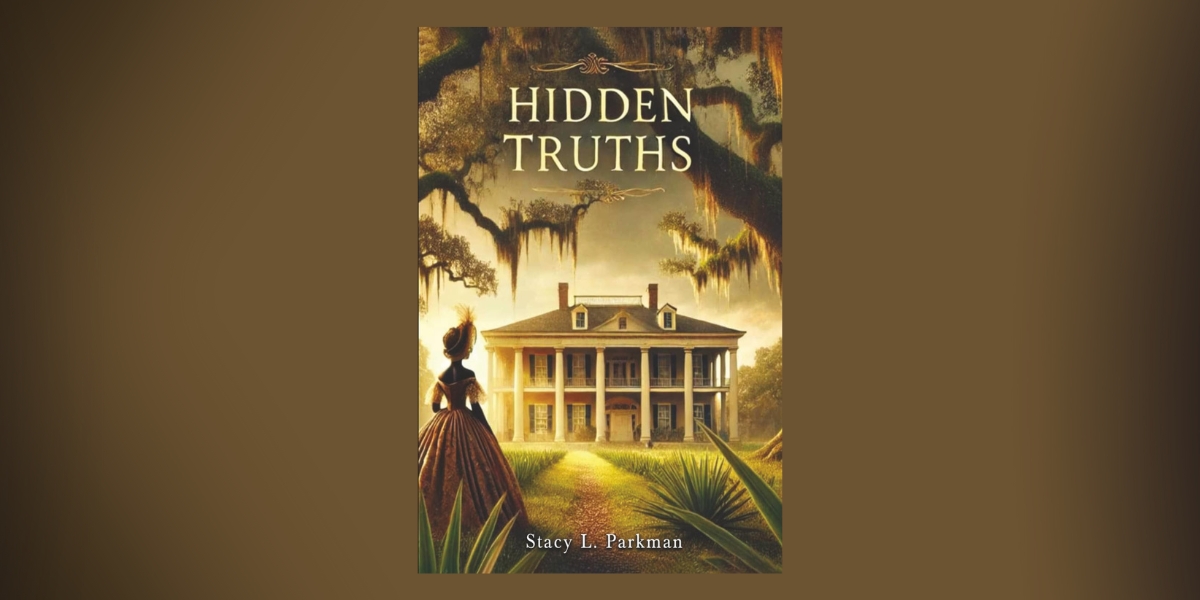


Some books come along quietly, without a lot of noise, but leave a deep mark once you’ve read them. Stacy L. Parkman’s ‘Hidden Truths’ is one of those books. It doesn’t try to overwhelm the reader with complicated language or big dramatic twists. Instead, it gives us people, real, flawed, hurting, loving people, set against one of the hardest times in American history, the antebellum South.
What makes the book so powerful is that Parkman writes with a sense of honesty and patience. She has been journaling for years, capturing small pieces of imagined lives, and with this novel, she pulls them together into a story that feels both personal and timeless. ‘Hidden Truths’ is about family, about secrets, and about what silence can do to us when it is forced, chosen, or inherited.
The Story
The novel begins in Covington, Louisiana, in 1851. Annie Wright is just six years old when we meet her, full of energy and curiosity. But her childhood has already been marked by loss: her sister Sarah has been sold away in a card game. It’s a memory that haunts Annie and her family, reminding us from the very start that this is a world where children can be torn from their loved ones without warning.
On the plantation, Annie crosses paths with Delphine Covington, the mistress of the big house. Delphine is trapped in a loveless marriage arranged for money and status. But she carries a dangerous secret. She is in love with Abraham, a man enslaved on her father’s land, and from that love comes a child, Andy. To protect him, Delphine pretends Andy is her husband’s son. “Andy is our little secret,” she whispers, and that line echoes throughout the book.
From this point, we see how secrets define the lives of everyone in the story. Annie learns that silence is expected of her, even as a child. Delphine knows silence is her only protection. Andy, though innocent, inherits silence as part of his life story.
People at the Heart of the Story
Parkman writes characters that feel alive. She doesn’t turn them into symbols or use them just to make a point. Instead, they feel like people you might know, each with their own struggles.
One of the most touching parts of the book is the friendship between Annie’s brother George and young Andy. On paper, they shouldn’t even be allowed near each other, one the heir of a plantation, the other a child born into slavery. But their bond grows naturally, and in one of the most moving scenes, Andy secretly teaches George and Annie to read. “I think you should possess the ability to know your letters,” he says, before adding, “Remember, it is our secret.”
That moment is about much more than letters. It shows the quiet courage of children who want more than the world allows them. It also shows how learning something most of us take for granted was dangerous, even life-threatening, for people in their situation.
Delphine herself is another unforgettable character. She lives a life of wealth and comfort but also of constant fear. Her love for Abraham and Andy pushes her into impossible choices. She is both part of the system that enslaves people and also a victim of its harsh rules. Abraham, meanwhile, is written with quiet dignity. He is not just a background figure in Delphine’s story; he is a man with his own presence, his own risks, and his own truth.
A World of Appearances
Parkman’s Louisiana is drawn in detail, from the white columns of the Covington plantation house standing like “silent sentinels,” to the busy ballrooms of New Orleans where everyone tries to keep up appearances. She shows us a society that is desperate to look strong and proper on the surface, even though its foundations are weak and rotting.
Later, when the story shifts northward, there is a sense of hope and change, but the past never fully lets go. Parkman makes it clear that history always travels with us, carried in memory and silence.
Light and Darkness
The novel does not shy away from cruelty. The Talbot brothers, angry men who carry a grudge, bring real danger to Annie and those around her. Their violence is not written to shock but to show how fragile life and safety were in those times. At one point, Annie almost loses her life after witnessing their cruelty, and her slow recovery becomes a symbol of survival.
But Parkman doesn’t let the story drown in darkness. For every act of cruelty, she shows us small acts of kindness and bravery. A brother protecting his sister. A child teaching letters by the creek. A forbidden love that refuses to be erased. These moments don’t erase the pain, but they remind us of the human spirit that survives even in the harshest conditions.
The Bigger Themes
What makes ‘Hidden Truths’ feel so relevant today is its focus on silence. Every major character has to live with some form of it. Delphine hides the truth to keep her child safe. Annie is forced into silence under threat. Andy grows up with silence pressed upon him before he even understands why.
Parkman asks us: What is the cost of silence? How do secrets passed from one generation to the next shape who we become? And when the truth finally comes out, what happens then?
These questions don’t belong only to the 19th century. Families today still carry secrets about trauma, about identity, about love that ripple across generations. In that sense, ‘Hidden Truths’ is not just a historical novel. It’s a story about how silence works in all of our lives.
Parkman’s Style
Stacy L. Parkman writes with a steady, careful hand. She doesn’t rush. She doesn’t use flowery language to impress. Instead, she takes her time, letting conversations, settings, and simple actions carry meaning. The kitchens, the fields, and the grand parlors are not just background scenery; they are places where lives are changed, where choices are made, where secrets live.
That patience is what gives the book its power. You don’t just read about history; you feel like you are walking through it alongside the characters.
A Beginning, Not an End
For Parkman, this novel is just the start. She has said she has filled journals for years, and ‘Hidden Truths’ is only the first story she has brought out into the world. If her debut shows anything, it’s that her voice will continue to bring us characters and stories that are both intimate and historically grounded.
Why It Matters
In the end, ‘Hidden Truths’ is not about nostalgia or looking back with rose-colored glasses. It’s about survival. It’s about the cost of keeping things hidden and the strength it takes to live with silence or to finally break it.
Parkman reminds us that history is not distant. It’s carried in people’s voices, their choices, their scars. And though truths may be hidden for a time, they are never gone.
By taking the private pages of her journals and shaping them into a public story, Stacy L. Parkman has given voice to lives that echo across time. ‘Hidden Truths’ is quiet in its telling, but it lingers long after the final page.