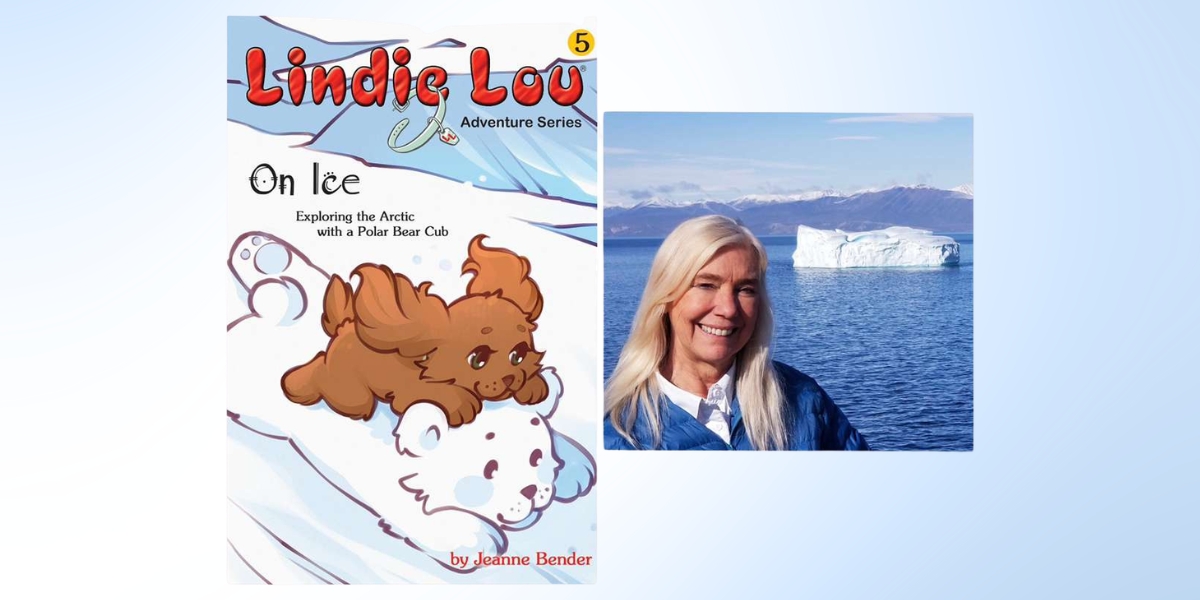


As winter blankets much of the Northern Hemisphere in snow and silence, one children’s book series invites young readers to step boldly into the cold and discover warmth in the most unexpected places.
Lindie Lou: On Ice, the fifth installment in the Lindie Lou Adventure Series by author Jeanne Bender, takes readers far above the Arctic Circle to Svalbard, Norway, one of the coldest and most remote inhabited regions on Earth. Set against a backdrop of ice caves, tundra landscapes, and months-long polar night, the story blends real-world geography with imaginative storytelling, introducing children to a part of the world few will ever visit, yet many might find unforgettable.
At the heart of the story is Lindie Lou, a curious and determined canine adventurer who joins her companion Bryan on a scientific expedition to study the northern lights and solar winds. While the adults focus on research, Lindie Lou finds herself drawn into adventures of her own — sliding through ice caves, navigating frozen terrain, and forming unexpected friendships with a playful polar bear cub, a brave Svalbard reindeer, a clever Arctic fox, and a team of hardworking sled dogs.
What makes On Ice stand out is its grounding in lived experience. Before writing the book, Jeanne Bender traveled north of the Arctic Circle to Longyearbyen, the world’s northernmost settlement, immersing herself in the stark beauty and quiet resilience of life in Svalbard. Surrounded by glaciers, wildlife, and a landscape shaped by extremes, she found inspiration not just in the scenery, but in the people and ecosystems that thrive there.
“The Arctic is often portrayed as empty or unforgiving,” Bender has said in past interviews. “But it’s full of life, cooperation, and wonder. I wanted children to feel that.”
That philosophy is woven into the narrative. Visiting the Arctic in December during the darkest time of the year presents Lindie Lou with real danger and uncertainty. When she finds herself in trouble, survival doesn’t come from strength alone, but from bravery, determination, and teamwork. These themes echo throughout the series, positioning Lindie Lou not as a fearless hero, but as a relatable character who learns, adapts, and grows through experience.
Beyond the adventure, On Ice serves as an educational gateway. Young readers are introduced to Arctic wildlife, geography, and environmental conditions in a way that feels organic rather than instructional. Encounters with a baby walrus, Arctic birds, and polar wildlife encourage curiosity about conservation and respect for fragile ecosystems without ever losing the joy of storytelling.
The Lindie Lou Adventure Series has become known for combining travel, science, and emotional storytelling into accessible chapter books for children. Each installment draws from real locations Jeanne Bender has visited, transforming global exploration into narratives that spark imagination and empathy.
In a time when children’s attention is increasingly fragmented, Lindie Lou: On Ice offers something refreshingly immersive — a reminder that stories can still transport readers to faraway places, teach them about the world, and quietly build resilience along the way.
As snow continues to fall across cities and countryside alike, Lindie Lou’s Arctic journey feels perfectly timed. It invites readers to bundle up, turn the page, and discover that even in the coldest corners of the world, friendship, courage, and wonder endure.
In this sense, On Ice becomes more than a seasonal story — it becomes a quiet guide for young readers learning how to navigate uncertainty. As Lindie Lou moves across frozen landscapes, each challenge mirrors the small fears and questions children face in their own lives. The cold, the darkness, and the unknown are never portrayed as obstacles to avoid, but as experiences that shape courage. By the time the final page is turned, readers are left not only with images of the Arctic, but with a deeper understanding that growth can often begin in places that feel unfamiliar and difficult.