


Many crime novels feel built from research. The details of an investigation or the tension of a violent encounter can seem learned from a textbook or another movie. They can be thrilling, but they often lack the gritty, unsettling texture of real life. William J. Warner’s Koobler’s Rose is different. It reads as if it were not just written, but witnessed. This profound authenticity comes directly from the author’s own life, transforming a coming-of-age story into a masterclass in genuine crime fiction.
William J. Warner is not a writer who simply studied crime for a project. He lived it. For twenty-two years, he served as a Special Agent for the FBI, investigating violent crimes across the very towns that form the backdrop of his novel, northwest Indiana. This is not a vague, fictional setting. It is a real place with real history, and Warner knows its streets and its psyche intimately. This provides his story with an unmatched geographic and psychological foundation. When he describes the worn-out trailer park of Crow Town, you can feel the author’s deep understanding of the environment that shapes his characters. This is the expert lens that is difficult to replicate through mere research alone.
What makes Koobler’s Rose truly remarkable is how Warner uses this expertise. He does not craft a typical police procedural. Instead, he uses his insider knowledge to ground a deeply human story about two boys, Dewey Koobler and Zack Koontz, on the brink of adulthood. The criminal acts in the book are not glamorous heists. They are the messy, impulsive schemes of teenagers. The attempt to crack a home safe is not slick. It is a fumbling, panic-filled disaster. A prank on a teacher goes terribly and embarrassingly wrong. These scenes carry the weight of real consequence, which reflects how small choices can sometimes spiral into life-altering moments.
Consider the tense carjacking scene, a pivotal moment that introduces the third key character, Ivy Koyne. Warner writes it with the precision of an investigator’s report and the empathy of a novelist. The sequence is not a heroic shootout. It is a chaotic, terrifying scramble for survival where Dewey’s protective instincts for Ivy ignite. Warner’s description of the moment captures the raw fear and split-second decisions of real violence. “Just as he took hold of his dad’s Beretta, the thin white man, having found another measure of fight, was back at the driver’s door, angry as a gut-shot coon.” The language is sharp, visceral, and utterly convincing. The narrative evokes the authenticity of someone who has observed such moments, even if the experience was not exactly like the fictional depiction. It is Dewey’s love for Ivy that begins to shift the story from one of wayward juvenile mischief to one of purposeful protection, romance, and the possibility of achievement.
Warner’s expertise goes beyond fieldwork. He holds a master’s degree in forensic psychophysiology, the science behind lie detection and stress responses. This specialized knowledge fuels the core theme of Koobler’s Rose, the duality of human nature. The novel’s guiding proverb asks if a thorn defends the rose by harming only those who would steal the blossom. Warner applies his understanding of deception and motivation to his characters like a literary polygraph. Dewey is both a loyal friend and a follower into trouble. He is a potential protector and a hidden danger. Zack is both a charismatic leader and a corrosive influence. Warner does not judge them. He examines them, revealing the conflicting truths within each soul.
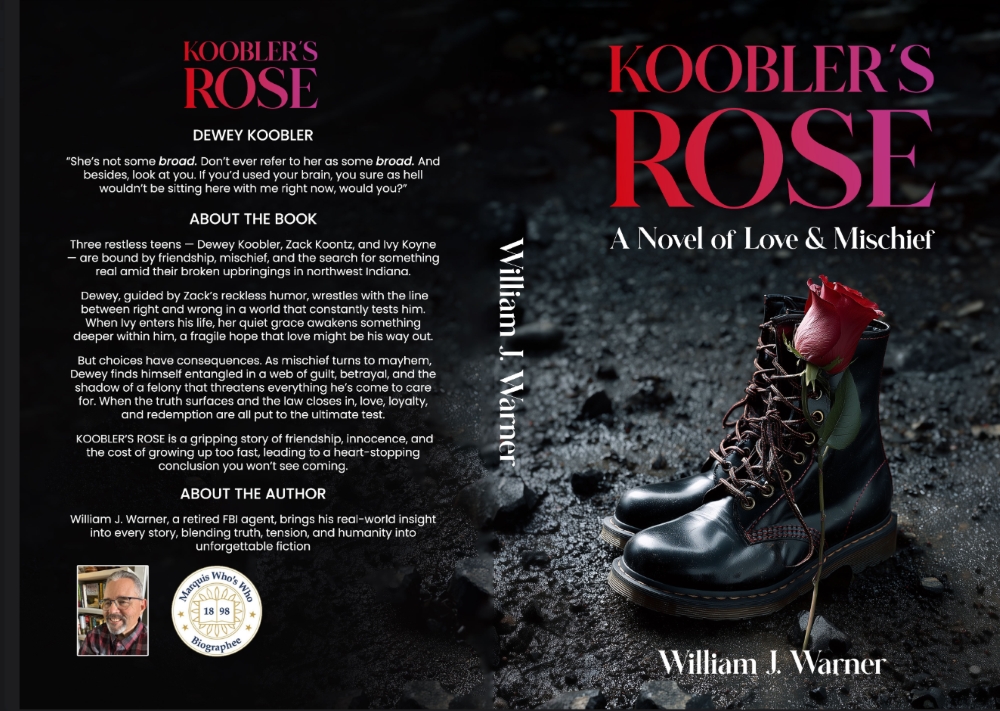
Photo Courtesy: William J. Warner
This is the unique power of William J. Warner as a storyteller. He is a unique hybrid. His authority does not come from imagination alone, but from a career dedicated to uncovering truth in its most complex forms. In Koobler’s Rose, he applies that skill to exploring the murky truths of adolescence, class, and morality. He presents a world where crime is not a plot device, but a symptom of environment and choice. The result is a novel that feels remarkably authentic, resonating with a sense of honest vulnerability. It sets a new standard for authentic crime fiction by reminding us that the most compelling mysteries are not about whodunit, but about why, and at what cost to the human heart.
To experience this powerful blend of unwavering realism and deep human drama, you must read Koobler’s Rose by William J. Warner. Discover the story crafted not from imagination alone, but from a lifetime of confronting truth.