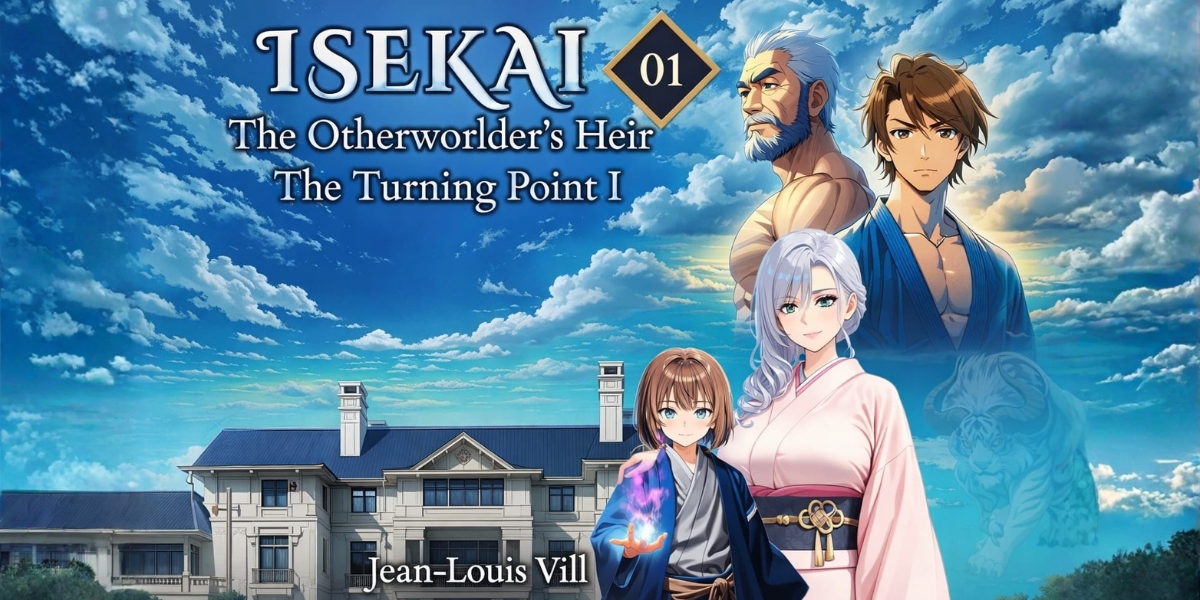


New York, NY, French fantasy author Jean-Louis Vill has begun releasing a restructured English edition of his fantasy series ISEKAI: The Otherworlder’s Heir, adopting a serialized format inspired by Japanese light novels and adapting his work for changing reading habits among English-speaking audiences.
The project marks a shift not only in language, but in structure. Rather than translating his original full-length French novel as a single volume, Vill chose to divide the story into shorter, more focused installments. The first release under this approach, Volume 1: The Turning Point, Part I, serves as a new entry point into the series.
Vill’s decision reflects a broader trend in independent publishing, where authors are increasingly rethinking how long-form fantasy is presented to readers who favor digital platforms, episodic storytelling, and affordable pricing.
A Structural Change Driven by Readability and Access
According to Vill, the original version of the book, while complete and coherent, proved too dense and costly to serve as an effective introduction for new readers. By restructuring the narrative into smaller volumes, he aimed to improve pacing, reduce reader fatigue, and create a more accessible starting point for the series.
The revised format mirrors the structure commonly found in Japanese light novels, which typically prioritize concise installments, strong character focus, and serialized progression. While the format has long been popular in Japan, its adoption by Western authors remains relatively recent.
Rather than expanding the story, Vill condensed and reorganized it. Early chapters were refined, narrative arcs clarified, and the opening adjusted to better establish characters and themes without overwhelming the reader.
A key element of Vill’s approach was revising the text before translating it into English. Instead of producing a direct translation of the original French manuscript, he first refined the structure and tone, ensuring that the English version would reflect the same narrative voice and stylistic intent.
This step was particularly important for maintaining consistency across languages. Vill has emphasized the importance of preserving imagery, rhythm, and narrative perspective, especially in a genre where internal voice and atmosphere play a significant role.
By finalizing the structure in French first, he aimed to avoid discrepancies between editions and ensure that English readers experience the story as a cohesive whole rather than a fragmented adaptation.
Several volumes of ISEKAI: The Otherworlder’s Heir have already been completed in French, allowing Vill to plan a coordinated English release schedule. His goal is to avoid long gaps between installments, a common frustration for readers of serialized fiction.
The English rollout is designed so that readers who begin with The Turning Point, Part I can continue through subsequent volumes without significant delays. This approach aligns with the expectations of light-novel readers, who are accustomed to frequent releases and steady narrative progression.
In parallel with the English print and digital editions, an audiobook version of Volume 1 is currently in production. Vill views audio as an increasingly important format, particularly for serialized fiction that lends itself well to episodic listening.
Audiobooks have seen steady growth across fantasy and speculative fiction genres, and Vill’s decision to include audio from the early stages reflects a multi-format mindset that many independent authors are now adopting.
Light Novels Beyond Japan
The rise of light novels outside Japan has been gradual but noticeable. Once considered niche, the format has gained visibility in the U.S. and Europe through translated works, anime adaptations, and online communities centered around fantasy and speculative fiction.
Vill’s series joins a growing body of international works that reinterpret the light-novel format through different cultural lenses. While rooted in fantasy conventions such as reincarnation, political tension, and character-driven storytelling, ISEKAI: The Otherworlder’s Heir reflects a European literary sensibility shaped by Vill’s background as a French author.
His approach highlights how light novels are no longer confined to a single cultural origin, but are evolving into a flexible storytelling format adopted by writers worldwide.
Independent Publishing in a Changing Landscape
Vill’s project offers a snapshot of how independent authors are adapting to a rapidly changing publishing environment. Shorter volumes, digital-first strategies, cross-language coordination, and early integration of audio formats are becoming increasingly common among writers seeking international reach.
Rather than relying on traditional release models, Vill has opted for a method that emphasizes reader accessibility, structural clarity, and long-term series development.
As fantasy readership continues to diversify and serialized storytelling gains momentum, projects like ISEKAI: The Otherworlder’s Heir illustrate how authors are reshaping established genres to meet new expectations.
About Jean-Louis Vill
Jean-Louis Vill is a French fantasy author whose work combines serialized narrative structure with character-driven storytelling. With multiple volumes completed in French, he is currently releasing revised English editions of his series ISEKAI: The Otherworlder’s Heir, adapting the format for international audiences.