

By: Ashley C. Luttrell
For most of his life, Paul Aaron Domenick did what many trauma survivors do: he pushed the pain down and tried to outrun it. A midlife crisis at forty, and eventually rehab, forced him to face the truth: this wasn’t just “bad memories,” but trauma shaping his entire life.
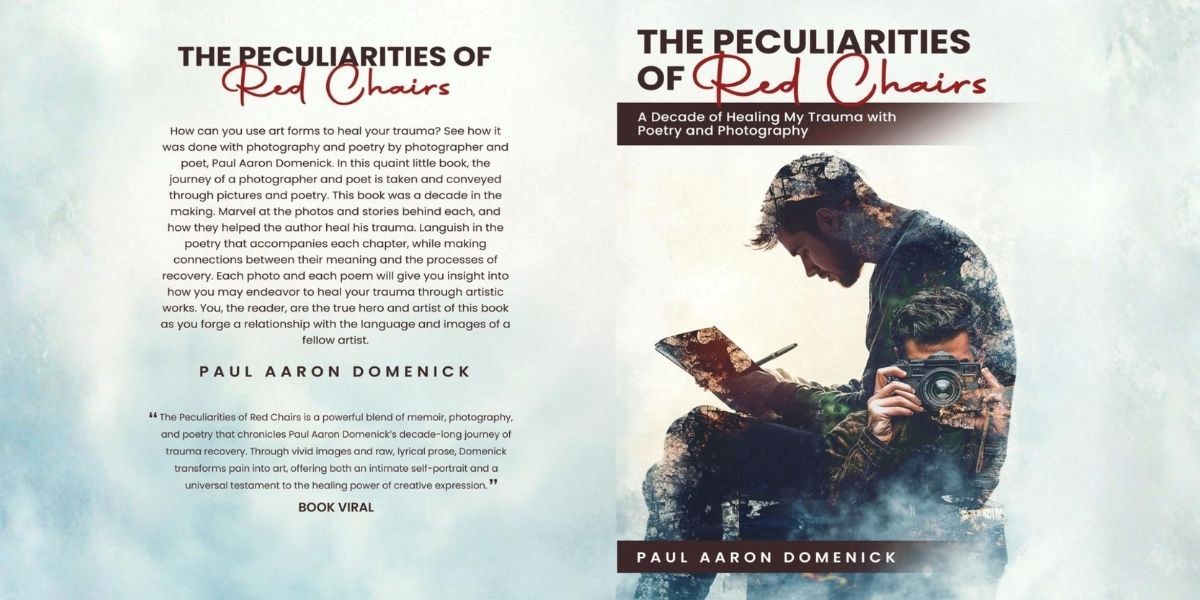
The Peculiarities of Red Chairs: A Decade of Healing My Trauma with Photography and Poetry is the record of what happened next. Part art book, part memoir of recovery, it follows a ten–year journey in which images and words became not just creative outlets, but lifelines.
Seeing What Words Can’t Say
Trauma often lives in the body as sensations and flashes rather than full memories. That’s why talking about it can feel impossible. Domenick’s therapist understood this when she advocated for him to use his camera in a residential trauma and addiction program. The lens became a bridge between his inner world and the outside one.
In the book’s chapters on color and monochrome photography, everyday scenes — a chair, a room, a fragment of light — become charged with feeling. The camera slows him down, giving enough distance to witness his pain without being overwhelmed. Instead of explaining his history, he frames it.
Photography here isn’t about perfection or social media. It’s about control and safety: deciding what to focus on, what to blur, and when to step back.
When the Heart Speaks in Lines and Stanzas
Alongside the photographs, Domenick’s poetry runs through the book like a second heartbeat. He began writing seriously around the same time he picked up the camera, discovering that language could do what silence never could: name the unspeakable.
The poems that accompany each section — from candid shots to composites, slow exposures, diptychs, still lifes, and portraits — aren’t decorative captions. They’re emotional x-rays. Some pieces confront abuse and shame head-on; others circle grief, faith, love, queerness, and recovery with a quiet tenderness. Together, the poems and images create a dialogue between the thinking mind and the body’s buried knowledge.
You don’t have to share Domenick’s exact experiences to feel that jolt of recognition: someone is finally saying what I’ve never been able to put into words.
Art as an Invitation, Not a Prescription
Domenick never claims that photography and poetry are magic cures. He worked with therapists, entered rehab, and did the hard clinical work of recovery. What his book shows, though, is how creative practice can support that work — offering non-verbal expression, a sense of agency, connection to others, and glimpses of a calmer nervous system.
There is also a quiet message for LGBTQ+ readers and anyone who has felt “too broken” to be seen. By placing his traumas, addictions, and identities in full view — in bold images and carefully honed lines — Domenick rejects the shame that keeps so many survivors silent.
A Book to Sit With
The Peculiarities of Red Chairs is not a quick scroll or a one-evening read. It’s the kind of book you leave out and return to, one image or stanza at a time, letting it echo against your own memories.
Whether you are in recovery, supporting someone who is, or simply curious about how art and healing intersect, this decade-long project offers both comfort and challenge.
Can photography and poetry heal trauma? On their own, maybe not. But in Paul Aaron Domenick’s hands, they become something just as vital: a way back to feeling, to meaning, and, slowly, to a life lived on purpose.
Disclaimer: The views and experiences shared in this article reflect the personal journey of the author and should not be considered as professional advice or a universal solution. While photography and poetry may play a meaningful role in healing for some individuals, they are not a substitute for professional therapy or medical treatment. Every person’s path to recovery is unique, and it is important to seek guidance from qualified professionals for personalized care.