

There is a familiar story that gets told every time a rocket launches. The camera angles do their work, the countdown builds suspense, and the narration slips into a near-religious tone. Humanity is “reaching for the stars.” We are “becoming a multi-planet species.” We are “taking the next step.”
It is the mythology of progress, and it is persuasive.
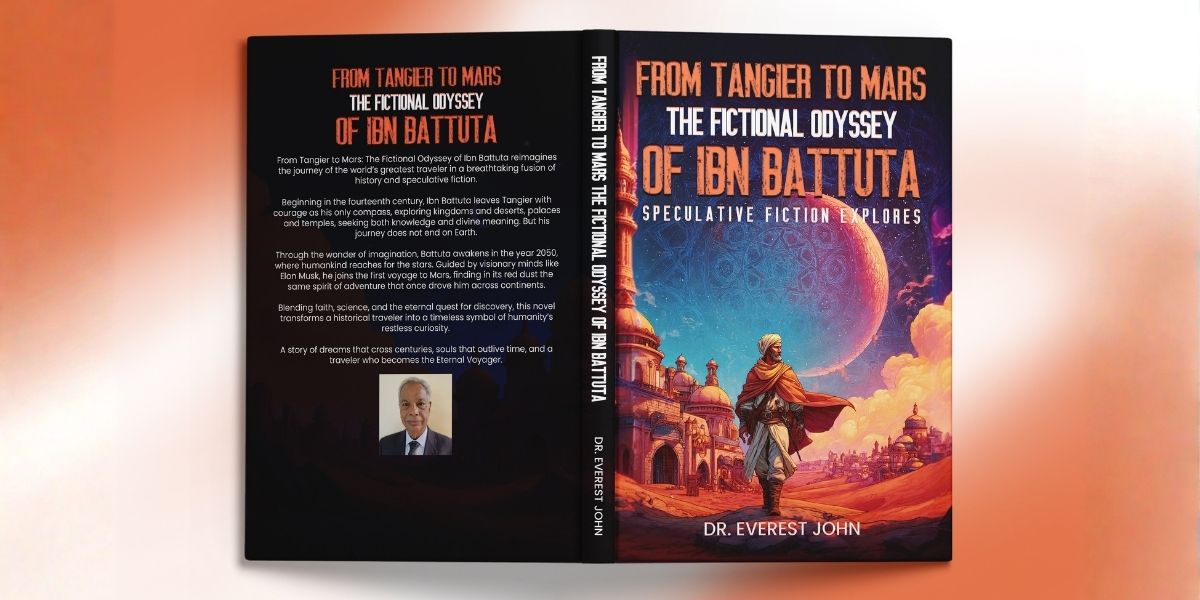
From Tangier to Mars: The Fictional Odyssey of Ibn Battuta does something rare in contemporary speculative fiction. It enters that mythology, enjoys its drama, and then asks the question most people avoid because it complicates the mood.
What happens to meaning when technology outpaces the human soul?
Dr. Everest John’s novel is built on an irresistible premise: Ibn Battuta awakens in the year 2050, meets Elon Musk, and travels to Mars. That is the headline hook. But the deeper hook, the one that keeps readers turning pages, is the book’s willingness to treat Mars not as an engineering trophy but as a moral environment.
Mars, here, is not just where humans go. It is what humans become under pressure.
A Medieval Traveler as a Witness to Our Future
There is a reason Ibn Battuta is the right choice for this story. He is not merely a famous traveler. He is a figure shaped by a worldview in which the spiritual dimension of life is not optional, not ornamental, not relegated to private preference. For someone like him, journeying is not only movement across geography. It is exposure to other communities’ moral codes, sacred rituals, and the invisible agreements that hold societies together.
Now place that sensibility into a future that tends to treat spirituality as an awkward topic, something to keep out of boardrooms and mission briefings. The tension writes itself, and John exploits it with purpose.
The novel becomes a long confrontation between two ways of understanding “the next horizon.” One way is technical: build the ship, build the habitat, build the supply chain. The other way is existential: decide what kind of people will live in that habitat, what rules will govern them, what stories will hold them together when Earth is a distant dot.
This is where the book becomes more than a clever mash-up. It becomes a narrative argument.
Colonization as a Spiritual Problem
Space colonization is often framed as an escape. Earth is too crowded, too chaotic, too exhausted. Mars becomes the blank slate. A clean start.
John refuses that fantasy. His story suggests that Mars will not erase human conflict. It will intensify it. Because on Mars, everything becomes sharper. Every disagreement is amplified by the stakes. Every social fracture becomes dangerous. Even ordinary questions, the ones we handle casually on Earth, turn urgent under isolation.
What happens when a group shares a mission but not a shared moral language? What happens when crisis forces decisions about leadership, discipline, intimacy, and survival? What happens when people arrive with different beliefs and no common ritual for grief, fear, or hope?
The book circles these questions in ways that make the reader uneasy, and that is the point. It turns the future into a mirror, asking whether our confidence is earned or merely rehearsed.
The result is a kind of suspense that does not depend only on plot twists. The suspense comes from the reader’s awareness that the hardest part of colonization is not oxygen. It is human nature.
The Bold Turn Toward Prophecy
Then the novel makes a move that sets it apart from the bulk of modern sci-fi. It brings prophecy into the conversation.
Not prophecy as cheap prediction, and not prophecy as genre decoration, but prophecy as a literary device that forces readers to confront the limits of purely technical thinking. The narrative introduces the idea of “The Book of Mars Prophecies,” framed as a symbolic scripture of cosmic insight. It suggests that the future may require a new kind of witness, not a prophet performing miracles, but a witness who translates awe into language.
This is a risky move, especially for a modern audience trained to be suspicious of religious tone in fiction. John handles it by leaning into wonder, not a sermon. He treats cosmic vision as an extension of travel, as if journeying far enough inevitably brings you to the edge where facts meet mystery.
That is a powerful concept, and it lingers. Because it reframes the Mars dream, it suggests that leaving Earth is not only a triumph of engineering. It is also a confrontation with the question humans keep trying to outrun: what are we for?
The Novel’s Emotional Edge
Underneath the big ideas, the book keeps returning to something personal. Dislocation. The shock of waking in a world that is not yours. The loneliness of being out of time. The longing for home, even when home is impossible to return to.
These are not futuristic problems. They are human problems. The book uses its grand premise to sharpen them. It gives the reader a way to feel the future, not just imagine it.
And that, ultimately, is what makes it compelling. It does not treat the future as a spectacle. It treats it as a place where the human heart has to survive.
From Tangier to Mars: The Fictional Odyssey of Ibn Battuta is a novel about what gets packed for the journey. Not supplies or schematics, but the values, stories, and moral frameworks that determine whether a community survives its distance from home. That is a question worth sitting with long after the final page.