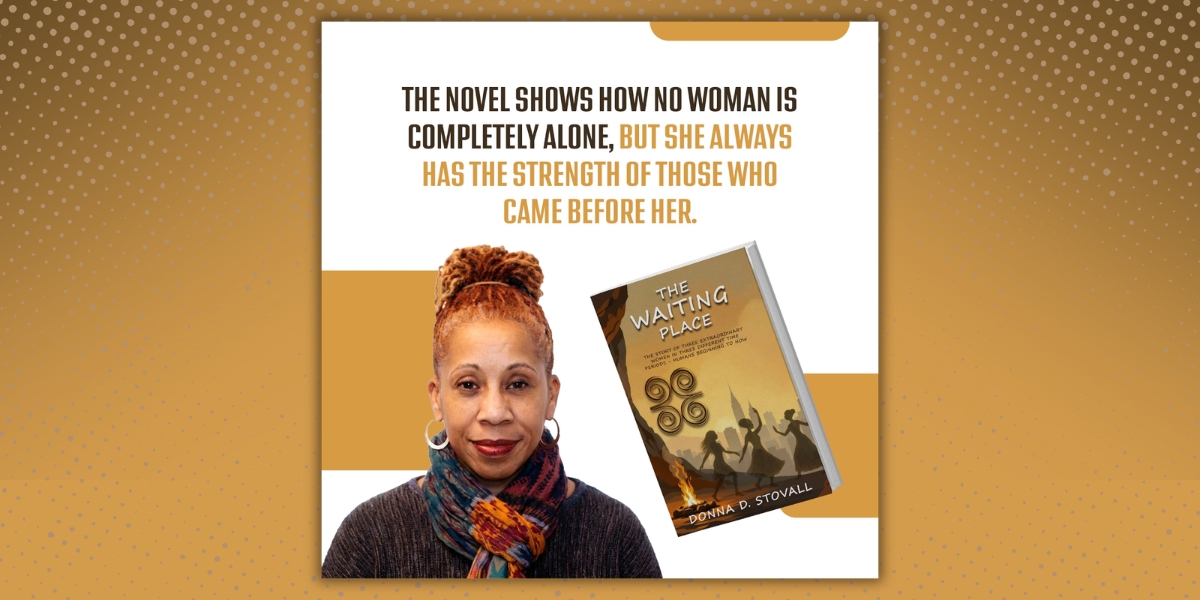


Seldom do we ever wonder that survival and internal strength are virtues passed hand to hand to us in our DNA. The Waiting Place, Donna Stovall’s novel, awakens these epiphanies in our souls. It spans the beginning of humanity, the Middle Passage, and the contemporary world.
Rather than treating history as a backdrop, Stovall approaches it as a way to transform readers into multiple timelines. The novel unfolds through three women whose lives span centuries yet are linked by blood and memory. Even though they belong to different eras, they share a drive to keep life moving forward despite obstacles.
The first woman of the story, Lucy, comes from a time before language existed. Her chapters show that she identifies things only by the work they perform. She knows only hunger, fear, birth, danger, and the need to protect her newborn. Stovall uses this narrative to place the reader within a consciousness that revolves solely around survival.
The novel’s second woman lives in a world that is brutally over-documented in literature. This story paints the brutal image of slavery and being ripped away from your home. One of the strongest points of this narrative is that Stovall resorts to familiar historical framing. This unnamed young woman is introduced by showing how she used to live and enjoy her life before falling into the clutches of slavers. When she is captured and forced into enslavement, she remains brave and steadfast even though she is facing an unimaginable trauma.
In the passages written from the enslaved woman’s perspective, The Waiting Place interrogates that inner strength cannot be stripped away, even under systematic violence. Survival in brutal situations is less about the body’s endurance and more about the preservation of self.
The third woman, the “Woman of Now,” initially appears to occupy an entirely different moral and material universe. She is wealthy, powerful, and highly competent. She is a successful businesswoman who understands leverage, negotiation, and control. She inhabits a modern world that promises autonomy and fulfillment, yet she is haunted by an incompletion she cannot rationalize.
Her journey revolves around how she uncovers the histories embedded in her ancestral home and begins to understand that her restlessness stems from inherited memory. The past, Stovall suggests, does not vanish simply because conditions improve. It is inherent and unearths at one point.
The vision behind the novel is that the “waiting place” is never confined to one physical location. It is the space between danger and safety, between loss and survival, between knowing and remembering. Readers can see how their strength is passed down to the next generation.
Stovall’s writing reflects her background as an artist. Her writing is conversational, humorous, and raw, reflecting a real human voice. In addition, what distinguishes The Waiting Place is its refusal to flatten womanhood into a single heroic arc. Stovall shows that strength appears different in a Stone Age wilderness than it does in a slave ship or a boardroom. Yet the impulse behind it is to gain protection, continuity, care.
The novel ultimately argues that modern identity is not self-made, no matter how individualistic the culture claims to be. Every life stands on accumulated acts of courage, many of them unrecorded, many of them performed by women whose names history never bothered to keep.
The Waiting Place encourages readers to reconsider their relationship with time and their inherited stories. In doing so, it reframes survival as a gift passed from one generation to another.
The novel can be purchased on Amazon and other online platforms.