

For many Americans, military service ends with a homecoming, a return flight, a ceremony, and a uniform carefully folded and stored away. But for thousands of veterans, the transition marks the beginning of a different and quieter struggle. Roughly every ninety minutes in the United States, a veteran dies by suicide, a statistic that continues to trouble clinicians, policymakers, and families alike.
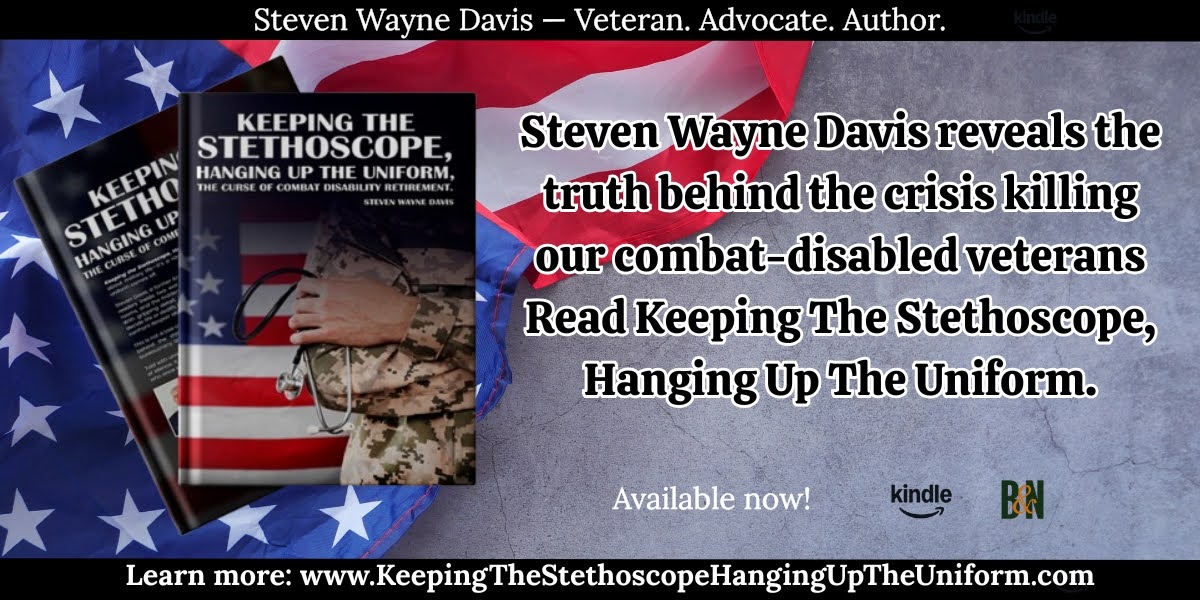
Steven Wayne Davis has encountered this reality from two sides of the same profession. First, as a nurse in the Army Nurse Corps, he treated injured service members still in uniform. Later, as a civilian emergency-room nurse, he cared for veterans navigating life after service. Over time, he began noticing patterns that extended beyond individual medical cases. His book Keeping the Stethoscope, Hanging Up the Uniform! grew from those observations, not as a traditional war memoir, but as an account of what happens after the war is over.
The Complicated Economics of Injury
A common assumption holds that veterans who leave service due to combat injuries are financially secure through retirement and disability compensation. In practice, the system is more complicated.
Some medically retired service members, particularly those unable to complete a full military career, experience an offset between retirement pay and disability benefits. The policy has existed in various forms for decades and remains debated by lawmakers and veteran advocacy groups. For affected families, the impact is practical rather than theoretical: budgeting for housing, transportation, and ongoing medical needs becomes less predictable.
Davis notes that uncertainty itself often becomes part of the stress veterans face while adjusting to civilian life.
What Emergency Rooms Reveal
Emergency departments offer a unique window into social conditions. Patients arrive not only with injuries or illnesses, but also with the pressures surrounding them.
Davis recalls veterans postponing treatment because transportation costs conflicted with grocery expenses, and others managing complex medication regimens without stable daily routines. Over time, the cases suggested a pattern: mental-health crises were rarely isolated medical events. They frequently intersected with employment difficulties, housing instability, and administrative confusion about benefits.
These observations shaped his belief that recovery after military service depends on more than clinical treatment alone.
Recognition and Reality
American culture widely expresses appreciation for military service, yet many clinicians and advocates describe a gap between symbolic recognition and consistent support. Annual government reports continue to document thousands of veteran suicides, even as prevention initiatives expand.
Healthcare providers often emphasize that stability relies on broader conditions reliable income, community connection, accessible care, and clarity in support systems. Davis views the issue less as an individual failing and more as a complex transition challenge shared by society, institutions, and veterans themselves.
Why the Debate Persists
Military retirement and disability policies developed across generations, shaped by different wars and economic priorities. Over the years, adjustments have been proposed and partially implemented, while discussion continues.
For veterans leaving service, the central concern is predictability: understanding what assistance will exist and how long it will last. For policymakers, the challenge lies in balancing fairness, fiscal responsibility, and long-term care obligations.
Beyond a Battlefield Story
Rather than focusing on combat experiences, Davis’s account concentrates on reintegration. His perspective blends military medical service, civilian healthcare practice, and observations from veteran patients and their families.
The narrative becomes a study of transition how identity, routine, and support systems change when structured military life ends. The most difficult period, he suggests, is often not deployment but adaptation afterward.
Lives Behind the Numbers
Veterans’ experiences vary widely, yet many share a similar task: rebuilding stability while carrying memories and injuries from service. Housing applications, employment searches, and medical appointments form part of recovery alongside counseling and treatment.
Emergency clinicians often encounter the final stage of these pressures, but the process unfolds long before a hospital visit in workplaces, homes, and communities across the country.
Continuing the Conversation
For civilians, the issue raises questions about how appreciation translates into lasting support.
For veterans, it affirms that their struggles are not isolated experiences.
For healthcare providers, it underscores the role of social conditions in mental-health outcomes.
For policymakers, it highlights the need for clarity and continuity in assistance programs.
Looking Ahead
Davis presents his work as an invitation to examine the period after service with the same seriousness given to service itself. The challenges surrounding veteran suicide involve mental health, economic security, and social integration problems without a single solution but requiring sustained attention.
Returning home, he argues, is not a moment but a process. The way a society responds during that process ultimately determines whether surviving war is followed by surviving peace.