The Dilemma of Opening Cafes in New York: Costs, Culture, and Challenges

The dilemma of opening cafes in New York sits at the crossroads of charm and challenge. The mental picture is alluring: a corner space where the scent of roasted coffee blends with the hum of the city, a place that feels like both a daily habit and a personal escape. Yet the daydream often collides with reality the moment the search for a location begins or the first rent figure appears on a lease. The balance between a warm, welcoming vision and the cold arithmetic of running a business in this city is what makes the decision so complex.

For many, the attraction stems from the cultural importance of cafes as social anchors. These are spaces where people pause between meetings, neighbors cross paths, and strangers share a quiet table in mutual retreat from the noise outside. But that romantic draw comes with relentless pressures, both visible and hidden, that can be daunting to anyone thinking seriously about stepping into the café business.


The Cost of Space and Survival

One of the first hurdles is simply securing a space. Rent in New York consistently ranks among the highest in the country, and landlords often expect long-term leases that lock operators into steep monthly payments. The most desirable neighborhoods, those with steady streams of pedestrians, commuters, or nearby offices, command prices that can quickly devour a startup budget.

Operating costs extend well beyond the lease. Utilities in older buildings can fluctuate dramatically with the season, insurance adds another recurring bill, and quality ingredients carry their own significant expense. Operators must constantly adjust pricing to cover these costs without alienating customers sensitive to even slight increases. Staffing also presents a constant test. Competitive wages are essential to attract and retain baristas who can balance speed, accuracy, and hospitality during high-pressure rush hours, but payroll is one of the largest ongoing expenses. By the time all these factors are in play, margins can be uncomfortably tight.


Regulations and Red Tape

Another layer of complexity comes from the city’s regulatory framework. Opening a café requires navigating a sequence of permits and approvals, each with its own rules, fees, and inspection processes. Health department certifications, signage regulations, fire safety requirements, and zoning compliance all demand attention before a single coffee can be poured for a paying customer.

While these measures are designed to maintain safety and quality, the process can stretch timelines far beyond initial projections. Applicants often discover that small oversights, a mislabeled diagram, a minor code update, can stall progress for weeks. Even experienced operators sometimes find themselves making repeated trips to government offices to resolve details that seemed minor on paper but hold real weight in practice. This procedural grind can leave newcomers feeling like the business side is standing still even as rent continues to accrue.


Adapting to Cultural Shifts

Café culture in New York is not static. Over the last decade, consumer habits have shifted in ways that affect both revenue and operations. A once-reliable base of commuters who stopped in daily has been altered by remote and hybrid work patterns, moving demand away from certain business districts and into residential areas. Delivery platforms, mobile ordering, and cashless payments have expanded the reach of some cafés while increasing operational costs for others.

The Dilemma of Opening Cafes in New York Costs, Culture, and Challenges

Photo Credit: Unsplash.com

Outdoor seating became a visible adaptation during the pandemic, transforming sidewalks and reclaimed parking spaces into lively extensions of indoor service. While popular with customers, these setups require investment in furniture, coverings, and seasonal upkeep. Not every operator has found the balance between the extra draw and the extra cost. The dilemma lies in adjusting quickly enough to meet new expectations without stretching resources past their limit.


Why the Risk Still Appeals

For many, the pull of opening a café in New York outweighs the practical deterrents. At its best, a café is more than a transaction point. It can become a fixture of daily life, where regulars are known by their orders, students quietly prepare for exams, and casual conversations turn into lasting connections. In some neighborhoods, the café fills a role that few other spaces provide, an accessible, welcoming place that does not require an agenda to enter.

That sense of purpose can make the gamble feel worth it. There is a belief among certain operators that with the right combination of menu, location, atmosphere, and adaptability, a café can both survive and matter. The reality is that many do not last beyond a few years, yet stories of those that thrive continue to draw new entrants into the market.


The Emotional Side of the Challenge

Running a café in New York is not purely a matter of numbers and logistics. There is an emotional weight to the daily responsibilities. Owners often invest personal savings to launch their vision, sometimes leaving behind more predictable careers. The day-to-day swings, from a bustling morning rush to a slow, rainy afternoon, can bring optimism and anxiety in equal measure. The constant awareness of rent deadlines, staff needs, and customer satisfaction can create a pressure that is as much about endurance as skill.

It is easy to understand how someone could feel both deeply connected to their café and worn down by the strain of keeping it open. The dilemma is not just whether the business will work on paper, but whether the personal cost is worth the satisfaction of running it.


Looking Ahead with Caution and Creativity

The long-term viability of cafés in New York may rest on a mix of cautious planning and creative problem-solving. Those able to adapt menus to shifting tastes, use their spaces for multiple purposes, and maintain a meaningful presence in their communities are often better positioned to withstand economic swings. While competition remains fierce, there is also room for niche approaches that speak to specific neighborhoods or customer groups.

The dilemma of opening cafes in New York is unlikely to vanish. It is a venture that demands more than a passion for coffee, it requires financial stamina, operational discipline, and the ability to read and respond to subtle shifts in the city’s rhythms. For those who choose to take it on, the process becomes not just a business effort but a test of resilience, adaptability, and commitment to a space that, with enough care, can become part of the city’s daily heartbeat.

FDA Issues Major Shredded Cheese Recall: What Shoppers Need to Know

The U.S. Food and Drug Administration (FDA) has officially classified a widespread shredded-cheese recall as Class II, after determining that certain packages may contain metal fragments. The recall affects more than 1.5 million bags of shredded cheese sold across 31 U.S. states and Puerto Rico.

The products were manufactured by Great Lakes Cheese Co., a major dairy supplier whose cheeses are sold under multiple store-brand labels rather than one national brand. As a result, many shoppers may not realize their purchase is linked to the same recall event.

Retailers connected to these recalled products include Walmart, Target, Aldi, and Publix, along with additional grocery chains carrying private-label shredded cheeses supplied by Great Lakes Cheese.


Why the Cheese Was Recalled

The recall was issued after investigators raised concerns that select products could contain metal fragments. FDA officials traced the issue to raw materials supplied to the manufacturer, indicating that contamination likely occurred before the products reached store shelves or homes.

After learning of the potential safety risk, Great Lakes Cheese initiated a voluntary recall. The FDA later conducted its official risk evaluation and assigned the incident a Class II recall status.


What an FDA “Class II” Recall Means

The FDA uses three classifications to categorize food recalls:

  • Class I — Products that pose a reasonable probability of serious injury or death, often involving dangerous pathogens or toxic substances.
  • Class II — Products that may cause temporary or medically reversible health effects, or where the likelihood of serious injury is remote. This category applies to the shredded cheese recall, as ingestion of metal fragments could cause mouth cuts, dental damage, or throat irritation.
  • Class III — Products that are unlikely to cause health harm but violate manufacturing or labeling regulations.

Because this incident is categorized as Class II, it does not represent an immediate public health emergency—but consumption of affected products is still unsafe and should be avoided.


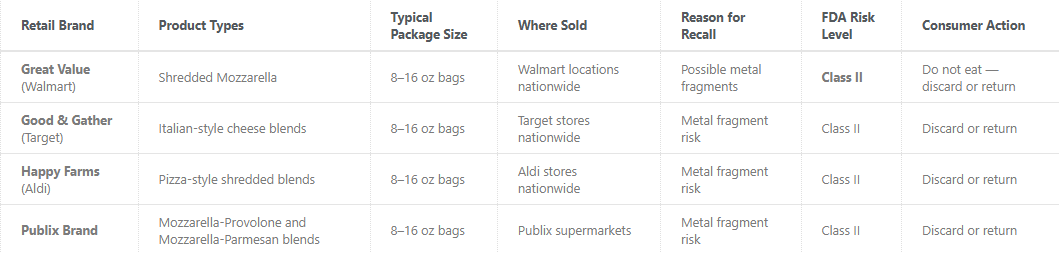
Recalled Shredded Cheese Products

Although all recalled products were produced by Great Lakes Cheese Co., they were sold under different store-brand labels at national retail chains.

FDA Issues Major Shredded Cheese Recall What Shoppers Need to Know (2)


How Large Is the Recall?

  • More than 1.5 million bags of shredded cheese were recalled
  • Distribution across 31 states and Puerto Rico
  • Products are sold under several major grocery store brands
  • All items trace back to one manufacturer: Great Lakes Cheese Co.

What Consumers Should Do

FDA Issues Major Shredded Cheese Recall What Shoppers Need to Know (2)

Photo Credit: Unsplash.com

Anyone who has purchased shredded cheese recently — especially from Walmart, Target, Aldi, or Publix — should take the following steps:

Check Your Refrigerator and Freezer

Examine packages labeled as:

  • Shredded mozzarella
  • Italian cheese blends
  • Pizza cheese blends
  • Mozzarella-Provolone blends
  • Mozzarella-Parmesan blends

Do Not Consume

Any suspected recalled cheese should not be tasted or used. Even small metal fragments can cause oral injuries or chipped teeth.

Discard or Return the Product

Dispose of the item or return it to the point of purchase. Most retailers honor refunds for products tied to FDA safety recalls even without proof of purchase.


Why This Recall Matters

Many store-brand food products across different retailers originate from the same manufacturing facilities. This case demonstrates how one supplier issue can impact groceries nationwide.

A Class II recall is not a worst-case scenario, but it still represents a meaningful health risk that should be treated seriously.

Food recalls may become public weeks after some products have already reached households. Staying alert to recall notices remains one of the most effective ways to prevent injury.

The FDA’s shredded cheese recall is not an emergency — but it is a reminder that everyday foods deserve careful attention. With a moderate health risk tied to metal contamination, the safest response is simple: check your cheese, do not consume recalled products, and return or discard them immediately.

A few minutes of inspection now may prevent avoidable injuries later.

What’s Behind JetBlue’s Quality Concerns and Flight Delays

What Sparked the JetBlue Quality Concern

The tension around JetBlue started after reports linked several Airbus A320 and A321 aircraft to manufacturing defects. These planes form the backbone of JetBlue’s fleet. When even a small number of jets face inspection or repair, the ripple effects reach scheduling, staffing, and customer confidence. The issue involved metal panels located near the front of some aircraft. These parts were built thinner than required standards, triggering mandatory checks before planes could remain in service.

For travelers, the news sounded technical and distant at first. Most passengers only know that safety checks happen constantly. When headlines mention fuselage panels or inspections, it can feel abstract. The reality is simpler. Aircraft parts must meet strict thickness and strength measurements. When parts fall outside these safe ranges, the plane is pulled from service until repairs take place. Even a few affected planes matter because airlines schedule fleets with tight margins.

JetBlue felt the impact fast because it relies heavily on Airbus models using similar components. If ten or fifteen planes pause service, thousands of seats disappear from the daily schedule. That means rebooking passengers, shifting crews, and trimming less busy routes temporarily. None of it means planes are unsafe to fly. It does mean checks slow down operations, which passengers felt through delays and last minute cancellations.

How Aircraft Inspections Affect Daily Flight Schedules

An inspection cycle isn’t quick. Specialists examine the aircraft panels using measuring tools and imaging systems. If thickness or fitting looks questionable, the plane stays grounded until replacements arrive and pass follow up checks. That repair cycle can take days or weeks depending on parts availability. Airlines can’t rush the process.

What's Behind JetBlue's Quality Concerns and Flight Delays

Photo Credit: Unsplash.com

For JetBlue, these inspections meant pulling planes from regular rotation. Schedules are built months ahead with little spare capacity. When flights lose assigned aircraft, planners shuffle routes or merge departures. A full flight might become two half full flights combined into one. A delayed inbound plane might push back multiple departures connected to that rotation. Passengers checking airport boards see the outcome but rarely the cause behind it.

At the customer level, the disruption looks uneven. One traveler might take off on time while someone at the next gate hears about a two hour delay. That randomness comes from which routes lost usable aircraft during that day’s inspections. No single location experiences a constant stoppage. Instead, disruptions scatter across the system in unpredictable patterns, which makes the situation feel chaotic even when it’s guided by safety planning.

Why Software Fixes Also Entered the Picture

The quality concern didn’t happen in isolation. Earlier, Airbus issued a required software update tied to a rare flight control issue triggered by cosmic radiation exposure at cruising altitude. This is an example of what engineers call bit flips. High energy particles pass through onboard computers and flip data bits. That abnormal event can confuse software unless protections are built to correct it automatically.

The update was preventative. Airlines installed the fix across fleets to strengthen flight control reliability. JetBlue completed those updates and returned most aircraft to normal operation. Still, the software work tied up maintenance crews and space in already full hangars. That overlap mattered because fuselage inspections demanded the same resources at the same time.

To passengers, these layers blend together. It may appear that airlines face a constant wave of new technical issues. In reality, aviation safety systems flag even minor concerns long before they pose real risk. Fixing them overlaps into maintenance schedules and slows flight availability even when safety margins remain solid.

Why JetBlue Felt Activity Bottlenecks

JetBlue’s operations depend on fast aircraft turnarounds and efficient maintenance scheduling. When aircraft checks lengthen or replacements require new parts shipments, bottlenecks appear. Crews work around the clock but can’t move faster than safety rules allow. When several jets queue for similar inspections, idle space grows behind the scenes while travelers wait at the gate.

What's Behind JetBlue's Quality Concerns and Flight Delays (3)

Photo Credit: Unsplash.com

Another factor is spare aircraft availability. Larger airlines maintain broader fleets across several aircraft families. JetBlue’s narrow focus on Airbus means fewer alternative aircraft types can be slotted into missing routes. If one jet is unavailable, there isn’t a smaller or older replacement sitting nearby. That makes fleet flexibility lower, intensifying the impact of each grounded plane.

Staffing also comes into play. Maintenance technicians are already stretched across routine checks, engine inspections, and cabin refurbishments. Adding sudden quality focused inspections puts new strain on schedules. Crews remain experienced and qualified, but they can’t be multiplied overnight. That staffing load lengthens inspection cycles and magnifies flight delays.

What Passengers Experience During These Disruptions

Most travelers don’t notice anything until departure day. A flight might be canceled hours before boarding as aircraft assignment changes. Rebooking follows quickly but seats may already be full, forcing delays or reroutes. Vacation schedules slip. Business trips compress into same day returns. Stress rises even though the root cause remains invisible.

Airport staff often deal with passenger frustration even though the issue isn’t frontline service quality. Gate agents handle crowded waiting areas while phone support tackles rerouting calls. For customers, kindness or irritation depends on personal circumstances, but the emotion doesn’t change the mechanics behind delays.

Flight reliability also takes a subtle hit. Airlines build time padding into schedules to absorb hiccups. When aircraft availability shrinks suddenly, that buffer disappears. Small delays propagate faster, especially in busy airports. The experience may feel messy even though daily safety standards remain intact.

How Safety Controls Reassure Travelers

The aviation safety system is designed for over caution. Airlines don’t wait for problems to show visible symptoms. They investigate based on early measurements and compliance data. When parts fall short of specification, planes don’t fly until cleared. That conservative standard means grounded jets represent prevention, not failure.

Federal oversight adds another layer. The Federal Aviation Administration monitors inspection procedures and approves repair methods. Airlines must document each aircraft repair before it can return to service. Skipping or rushing steps isn’t legally possible, even when schedules tighten.

For travelers anxious about safety, the situation actually demonstrates the system functioning as designed. Issues were detected while theoretical rather than operational. Flights that depart are flying after full inspection clearance. Delays aren’t signs of danger. They’re signs of caution.

How Airlines Manage Repair Backlogs

During inspection surges, airlines spread repairs across external vendors and factory backed facilities. Aircraft rotate through different service hubs to distribute workload. JetBlue uses a combination of in house and contracted maintenance bases to keep progress steady even during high demand.

Replacement parts move through logistics pipelines monitored by both manufacturers and airlines. Panel repairs require precise matching of aircraft specifications and serial numbers. That specificity adds complexity. While parts aren’t rare, matching deliveries to each grounded aircraft takes time.

Parallel scheduling helps recover operations faster. While one aircraft undergoes fuselage checks, another finishes its software update or finishes a major engine inspection. The goal is to maximize turnover rather than wait for issues to resolve sequentially. Even so, backlog clearance unfolds over weeks rather than days.

What Stability Looks Like Going Forward

As inspection waves taper off and software updates complete, fleet availability rises progressively. Rather than a sudden full recovery, airlines experience a slow return of spare capacity which stabilizes schedules. Passengers see fewer surprise cancellations and tighter adherence to departure times.

The broader airline system benefits too. Shared suppliers and maintenance bases regain normal flows, reducing ticket rebooking strain across partner carriers. Airports also regain gate scheduling balance, removing stacked departure waves that previously amplified crowd congestion.

For JetBlue, stability doesn’t hinge on public confidence alone. It comes from internal scheduling balance. Each aircraft returning to service restores redundancy that softens future disruptions from weather or mechanical repairs. That redundancy is key to maintaining dependable operations without overworking crews.

How Travelers Can Interpret the Experience

Delays tied to quality inspections are frustrating but informative. They show safety is actively prioritized despite scheduling discomfort. Travelers aren’t exposed to risk escalation during inspection cycles. Planes don’t fly until technicians verify compliance.

Understanding the cause helps reduce emotional strain. There’s a difference between weather chaos and grounding for inspections. The latter reflects forethought. Even though service interruptions remain inconvenient, the underlying trigger carries reassurance rather than concern.

The JetBlue situation serves as a reminder that modern aviation runs on tight planning margins. Temporary disruptions don’t reflect systemic danger. They reflect preventative maintenance catching small variances before they matter. Passengers can reasonably expect schedules to normalize as each aircraft clears inspection, restoring the network to its usual stability over time.

The Shawn Ryan Show: America’s Most Impactful Podcast of 2025

Written by: Dillon Kivo

For years, the American media has struggled to offer conversations that feel real. Interviews have become shorter. Answers feel coached. Authenticity is replaced by polished narratives crafted for clicks. Across the country, audiences began searching for something honest, something patient, something that cut through the noise. What they found was The Shawn Ryan Show.

What began in a small attic with two microphones and no blueprint has become one of the most influential storytelling platforms in modern American media. The show has built a community of millions in only a few short years, reshaping how long-form conversation is understood and consumed. It has become a cultural force rooted not in spectacle but in sincerity.

“I started this whole journey in my attic,” Ryan said. “It was just me, my wife, a couple of mics, and a whole lot of frustration with the world. America needed to hear the unvarnished truth about what our warriors go through. The mental toll, the sacrifices that do not make headlines. I was not another polished talking head. I was just a guy who had been through the fire and figured if I did not step up and create a space for these stories, who would?”

The attic was the starting point. But the mission was much larger.


A Beginning Built on Honesty

The early episodes were raw, imperfect, and deeply human. Ryan did not care about polish in the traditional sense. He cared about truth spoken plainly. There was no script, no agenda, and no time limit. Just a willingness to talk about the things few people in media were willing to confront.

The honesty of those early conversations came from a deeper place. After years as a Navy SEAL and later a CIA contractor, Ryan carried experiences that did not fit into everyday conversation. He had lived through bravery, loss, betrayal, loyalty, and the kind of trauma that lingers long after service ends. His own battles with PTSD shaped his urgency for real dialogue. Therapy had taught him that transparency was the only way to heal, and he knew guests would only open up if he led first.

“That early rawness came from frustration,” Ryan said. “I was done with the scripted interviews and the soundbites. I needed conversations that were real, and I wanted guests to feel safe enough to go there with me.”

And while the conversations were intentionally unscripted, the visuals were anything but casual. Since its inception, Ryan focused on every camera setting and every shot to ensure the show looked truly exceptional. He studied angles, experimented with lighting, and refined his setup until the aesthetic matched the seriousness of the stories being told. As he explained later, he took the visual presentation “extremely seriously” from day one because honest conversations deserved to look as strong as they felt.

Authenticity became the heart of the show. Listeners recognized it instantly. They could hear the difference between polished performance and lived experience. They recognized a host who understood what was at stake.


When Stories Become Lifelines

Within the first year, messages started pouring in. They came from veterans, police officers, firefighters, and everyday people navigating invisible battles. They came from spouses trying to understand, children seeking clarity, and individuals who stumbled across the show at a moment when they needed it most.

Ryan quickly realized the show had become something far deeper than conversation. Vets wrote to him saying an episode kept them alive through the night. Civilians said they finally understood why a loved one was struggling. One man described pulling back from the edge after hearing a guest talk honestly about hitting rock bottom. These weren’t casual reactions. They were moments of relief, recognition, and connection. People were watching because something in that room made them feel less alone. By listening to someone else speak their truth, they were finding language for their own pain.

“That is when it clicked for me,” Ryan said. “These are not just stories. They are lifelines. People see themselves in the vulnerability of my guests, and it gives them hope that if someone else made it, they can too.”

The show had become more than content. It had become a form of connection.


A Community Forms Around Truth

As the audience grew, the show evolved into something larger than itself. Listeners began forming their own support groups. They reached out to one another during difficult moments. They organized meetups, raised money for veteran programs, and shared resources. The show did not create the community. It activated it.

Ryan first noticed the shift when people started connecting outside the podcast. Fans were organizing gatherings, supporting each other through personal struggles, and building their own initiatives around mental health and veteran issues. By the time the show reached its fiftieth episode, strangers were approaching him to say the conversations had changed how they saw the world. It became clear the mission had expanded beyond him.

“That was the moment I realized it had become a movement,” Ryan said. “People weren’t just listening. They were taking care of each other, building community, and carrying the mission into their own lives.”

In a divided media landscape, the show had become one of the rare places where people from different backgrounds found common ground. Honesty had become the force that connected them.


Why the Audience Connected So Deeply

The show’s growth is often described as explosive, but the reasons behind it are simple. People were starving for a place where they could hear the truth without distortion. They were craving longer conversations that allowed room for nuance. They wanted stories that were not edited for clicks. They wanted sincerity.

As trust in traditional media declined, audiences began seeking authenticity wherever they could find it. That search led millions to The Shawn Ryan Show. Over time, some of the most recognizable voices in America sat across from Ryan, including Jocko Willink, Tulsi Gabbard, Ryan Montgomery, Mike Glover, and DJ Shipley. Each brought a different perspective and helped widen the show’s reach. Episodes often stretched between four and eight hours, sometimes longer, but instead of losing viewers, the length became part of the show’s identity. It gave stories room to breathe, allowed emotions to unfold, and respected the complexity of human experience.

“Timing mattered,” Ryan said. “People were done with distortion and craving truth. When they saw unedited long-form stories from real people, they realized this was the space they had been missing.”

The show was proving something rare. Long-form storytelling wasn’t dying. It was thriving. It simply needed a place where it could exist without compromise.

 

Tim Furlong Jr. - Shawn Ryan Show - Jocko Willink

Shawn Ryan speaking with Jocko Willink at the studio range
Image Credit: Tim Furlong Jr. | The Shawn Ryan Show

Inside the Compound: A Sanctuary for Truth

To fully understand the show’s impact, one must step inside the compound. The studio sits on more than twenty acres in Franklin, Tennessee. The property is expansive, quiet, and fortified with purpose. Driving onto the property gives a clear sense of how intentionally the show is operated.

The building itself is large and understated. Inside, the environment shifts immediately. The lobby is calm. The lighting is soft. The colors are muted. Every detail feels intentional. There is no clutter. No spectacle. It feels like walking into a sanctuary built for conversation.

Before filming begins, the preparation is methodical. The staff moves with a precision that feels almost choreographed. Microphones are checked and rechecked. Cameras are adjusted silently. Breaks are timed around emotional rhythm. No one raises their voice. No one rushes.

Staff members frequently explain that the number one reason guests open up on the show is simple. Ryan listens. He listens with deliberate stillness. With real curiosity. With respect. Jeremy, his producer, often points to Ryan’s uncommon ability to listen with such total presence that a guest’s defenses begin to dissolve the moment they sit down.


The Room Where Conversations Break Open

The main studio sits at the heart of the compound. It is warm, polished, and thoughtfully designed. The red glow lining the backdrop has become one of the show’s visual signatures. The lighting is controlled and inviting. The furnishings are streamlined and high-quality, creating a space that feels purposeful rather than crowded. Microphones sit at a comfortable distance that encourages conversation instead of performance.

Guests often describe the room as a place where time slows down. Many forget the cameras are there at all and walk out surprised by how much they shared and how quickly the hours passed. The space feels intentional. Every detail is arranged to lower defenses and create a sense of ease. Ryan’s own openness sets the tone. He listens without interruption, and when it helps a guest feel less alone, he shares his own experiences. The environment becomes a place where real stories can surface.

“It all comes down to trust and comfort,” Ryan said. “I built the studio to feel like a speakeasy. No bright lights. No rush. I take the time to do it right so guests feel safe enough to open up.”

Ryan credits therapy for shaping that approach. It taught him to slow down, to listen more than he talks, and to remain fully present. He brings that same steady, focused attention to every guest who sits across from him.

The power of the space lies in its simplicity. A quiet room. A patient host. A format built around giving truth the time it needs. Inside the studio in Franklin, conversations unfold at their own pace. Guests speak without pressure. Stories develop naturally. The environment encourages honesty instead of performance.

Ryan built more than a podcast. He built a setting where people can finally articulate experiences they have carried for years. The room, and the way he protects it, has become central to the show’s impact. It is the reason The Shawn Ryan Show resonates so deeply and stands as one of the most influential platforms in American long-form media.


The Editing Wing: Inside the Team That Shapes Every Episode

Deeper inside the compound is the editing wing. It has its own distinct feel. The lights are dim. The music is low. The energy is concentrated. The space mirrors the filming studio with the same red lighting accents and consistent visual identity.

The editing team is world-class. Many relocated from across the United States to be part of what has become one of the premier production teams in long-form media. They work with the precision of a special operations unit, each member handling a specific role yet moving with shared purpose and absolute alignment.

Editors sit surrounded by screens, absorbing every detail of the conversation. They do not cut for speed or virality. They shape emotional clarity. They listen for meaning. They think like listeners, considering how each moment will land, how each pause feels, and where the emotional weight sits. It is an environment built for thoughtful work, not shortcuts.

Episodes often require significant attention in post-production. Edits are detailed and deliberate, shaped with care rather than speed. Filming days can run long, and the team remains focused from start to finish. The workflow feels disciplined and coordinated. There is no chaos. Only purpose and steady execution.

The unity of the staff is unmistakable. Everyone moves like a well-trained unit with clearly defined roles, mutual respect, and complete commitment to the mission.


Tim Furlong Jr. - Shawn Ryan Show - Jocko Willink

Shawn Ryan with Jocko Willink at the studio range during training
Image Credit: Tim Furlong Jr. | The Shawn Ryan Show


A Day in the Studio With Ryan and Jocko

On the day of the visit, the guest in the studio was Jocko Willink. The two spoke with steady, measured focus throughout the conversation. Ryan asked direct, intentional questions, and Jocko responded with the calm precision he is known for. The exchange was disciplined, clear, and grounded.

“Jocko is a legend,” Ryan said. “He has a great show, and he is rebuilding America through his business ventures. We have a lot of interests and histories that are directionally aligned.”

Hours passed without anyone noticing. The room seemed to absorb the sense of time. Cameras faded into the background. It was simply two men exchanging truth in a space designed to support it.

This is what guests often describe afterward. The feeling that something in the room had shifted. That honesty became easier. That, for a moment, the outside world disappeared.


A Team Built With Purpose

The show does not work because of Ryan alone. It works because the team around him operates with unity and intention. They move with discipline, focus, and a shared sense of purpose.

Their structure resembles the environments Ryan came from, where preparation, precision, and mutual respect form the foundation. The workflow is deliberate. No task is too small. Everything matters, and every action carries weight.

This culture creates an atmosphere where excellence becomes the standard rather than the goal. The expectation is clarity, consistency, and steady execution in every part of production.

“High-stakes talks get approached the same way,” Ryan said. “Stay calm. Adapt. Find the truth.”


Building Trust Without Traditional Media

The Shawn Ryan Show sits outside the traditional media system. It is distributed through the QCODE Network, but Ryan retains full creative control, choosing his guests and topics without corporate direction. The structure is simple. Distribution partners help the show reach millions, but the content, tone, and mission remain entirely his.

Unlike legacy outlets driven by quick cycles and tightly controlled narratives, Ryan operates on a different model. Conversations are long. Edits are minimal. Sponsorships are selective and aligned with the audience. The show does not chase trends or talking points. It prioritizes clarity, honesty, and the kind of patience mainstream formats no longer allow.

“Audiences today want raw, independent voices,” Ryan said. “People are done with the spin. We earned trust by staying consistent, fact-based and human. No gatekeepers. No one is telling me who I can talk to.”

Authenticity remains the foundation. Independence is the structure. Humanity is the center. As Ryan puts it, “In a divided country, platforms like mine prove that authenticity wins.”


What Comes Next

The show is growing, but with intention. Ryan is expanding the network while preserving the soul of the platform.

“We are expanding the network,” Ryan said. “I just hired Sarah Adams to create a show. We have new opportunities like the audio series I narrated called Target Intelligence. And the online security app we created with Glacier. I also released a new beverage called Mindful.”

Every new venture aligns with his mission. Service. Protection. Truth.

“The core stays the same,” he said. “Real stories. Real impact. I am excited to see where it takes us.”

As the platform grows, its influence continues to reflect the qualities that set it apart from the start.

Latest Winter Storm Conditions Across New York State


New York is settling into an active winter weather stretch as a storm system stretches across the Northeast, bringing a changing mix of snow, rain, sleet, and ice. Conditions differ sharply from one region to another. Coastal locations lean wetter, while inland and higher elevations face more persistent snowfall. That contrast makes planning difficult since road safety, travel timing, and daily routines depend heavily on local temperature swings.

This type of storm forms when cold northern air collides with milder moisture rising off the Atlantic Ocean and nearby lakes. Where cold air dominates, snow sticks. Where warmer air slides in at ground level, precipitation changes to rain or slushy mixes. In just a few miles of travel, drivers can move from dry pavement into near whiteout conditions.

For residents commuting, running errands, or visiting family, the biggest challenge is not knowing exactly when or where the next snow band may drop. The following breakdown explains what’s happening and how it could affect daily life across the state.


Why Conditions Keep Changing Across New York

This storm is shaped by what forecasters call temperature layering. Cold air remains trapped close to the surface across much of inland New York while milder air moves overhead or along the coast. Because snowflakes melt as they fall through warmer layers, the type of precipitation depends on whether freezing air can hold all the way down to street level.

Upstate regions remain colder overall. That allows snow to keep falling as snow instead of turning to rain. Meanwhile, coastal communities feel warming influences from ocean winds that push temperatures above freezing, creating rain or light slush rather than steady accumulation.

Wind direction also plays a major role. Strong air flow across the Great Lakes pulls moisture inland. That moisture drops as snow when it reaches colder ground. This lake driven effect creates narrow storm bands that form quickly and shift their focus with every small wind adjustment, producing uneven snowfall across counties.


Areas Likely to See the Most Snow

Interior sections of the Hudson Valley, the Mohawk Valley, western New York, and portions of the Adirondacks remain the zones most likely to accumulate measurable snow. Elevation increases snowfall because air cools as it rises over hills and mountain ranges. Even small terrain differences can create deeper drifts in some towns compared with neighboring communities.

Latest Winter Storm Conditions Across New York State (2)

Photo Credit: Unsplash.com

Lake influenced regions near Lake Ontario also stay active as moisture feeds off warmer water surfaces. Snow bands form rapidly and often stall over one corridor before shifting miles away. This results in streets covered with snow while nearby areas remain nearly clear.

The New York City metro area, Long Island, and surrounding suburbs are more likely to receive rain or mixed precipitation. Snow may appear briefly during colder moments, but sustained accumulation is less likely. However, temperatures falling overnight turn wet pavement into ice. Bridges and overpasses become particularly slippery after sunset.


What Daily Travel May Look Like

Commuters traveling across inland corridors can expect slower traffic during snowfall peaks. Snow reducing visibility makes highway speeds drop below normal flow, while lane closures may occur as plow vehicles attempt to clear build up faster than new snow falls.

Secondary roads often become problematic first. These streets receive less treatment and can turn slick rapidly. Ice formation near intersections and hills increases the chance of minor accidents and stalled vehicles. Even short drives can take longer than planned.

Air travel also experiences turbulence from winter storms. Airports near heavier snow zones face runway visibility limits and ground handling challenges. That may delay departures or force flight rescheduling, especially during evening snow bursts.


How to Think About Personal Safety

The simplest safety approach focuses on timing and awareness. Waiting for snowfall pauses before driving reduces stress and risk. Since snow bands move irregularly, clear weather windows may not last long. Keeping track of radar snapshots or neighborhood conditions often proves more accurate than statewide predictions.

At home, clearing walks early prevents ice from forming underneath packed snow. Applying deicer later in the evening can reduce slip hazards. Securing loose outdoor items also helps as winds strengthen.

For drivers, small habits provide large safety benefits. Slowing acceleration reduces wheel spin. Longer stopping distances help maintain control on slick pavement. Extra care crossing bridges prevents unexpected sliding where freezing occurs faster.


Why Forecasts Can Feel Inconsistent

This type of storm doesn’t blanket large areas evenly. Instead, snowfall concentrates in streaks, sometimes only a few miles wide. As winds shift, those streaks move, leaving some towns buried while nearby communities remain dry.

Temperature sensitivity adds to uncertainty. A shift of only one or two degrees can flip precipitation types entirely. What arrives as snow can change into rain within minutes, then refreeze later into ice. That variability makes exact predictions difficult even a few hours ahead.

Forecasters issue wider advisories because any given community could fall into a snow band as conditions change. These alerts aren’t overreactions. They reflect the genuine unpredictability of band driven storms.


How Long Storm Effects May Last

Cold air across northern and western sections is expected to linger for several days. Even after the primary storm system exits, lake effect snow may continue in bursts near Lake Ontario and elevated inland areas.

Metro regions that see more rain will deal mostly with freeze up overnight. Meltwater becomes icy on untreated roads early in the morning. Cleanup crews work overnight, but shaded sections may stay slick longer.

Subfreezing daytime temperatures slow melting, keeping snow banks and icy patches intact into the weekend. Drivers should continue to watch for refreezing each evening, even when daytime roads appear dry.


Winter weather of this style rarely ends all at once. Conditions fade gradually with lingering risks. Most disruptions will come from shifting travel conditions rather than extreme single snowfall totals.

Understanding how temperature differences and wind patterns shape snowfall allows residents to plan realistically. Slow travel, extra scheduling time, and flexible expectations go farther than relying on any fixed forecast.

The storm’s broader impact stays localized and temporary. Maintaining patience and situational awareness will be the most effective responses as the weather continues its uneven sweep across New York State.

What Shoppers Can Expect This Cyber Monday 2025

Cyber Monday 2025 lands on Monday, December 1, and it’s shaping up less like a single-day sale and more like the centerpiece of a full “Cyber Week” shopping stretch. Many retailers have already started warming up their promotions after Black Friday, but December 1 remains the moment when the deepest online-exclusive deals are expected to surface — particularly in tech, beauty, fashion, and home essentials.

Unlike early Cyber Mondays built around flash sales and limited windows, the current approach spreads discounts across multiple days. Retailers are focusing on controlled pricing waves designed to sustain traffic throughout the weekend and into the first half of December. That means everyday shoppers don’t need to fight midnight checkout rushes as much — but waiting too long still risks missing out on high-demand items.

This year’s sales environment reflects how competitive digital retail has become. Brands are blending rolling price drops with loyalty-based perks, app-only discounts, and limited-stock drops that reset every few hours.


The Categories Showing the Deepest Discounts

Several product categories are emerging as the strongest value zones for Cyber Monday shoppers:

Tech & Electronics

Laptops, headphones, tablets, smart home devices, and smartwatches are expected to see some of their steepest discounts of the season. The most aggressive pricing typically targets last-year models and entry-level upgrades, making this a good time for replacing everyday gadgets without paying top-tier new-release pricing.

Beauty & Self-Care

Holiday gift sets dominate this category — skincare bundles, fragrance kits, hair tools, and cosmetics collections are all positioned with Cyber Monday price cuts. Brands lean into this space because beauty items ship easily and are ideal last-minute gifts.

Home & Lifestyle

Small appliances, bedding, cookware, storage solutions, and décor often receive strong markdowns. Many shoppers use Cyber Monday to prep for winter — vacuum upgrades, comfort bedding, and kitchen tools dominate search trends.

Fashion & Accessories

Clothing brands usually extend their Black Friday sales while adding “online only” bonuses like extra percentage off checkout or buy-more-save-more pricing. Footwear and outerwear tend to move quickly, especially where sizing inventory is thin.

Holiday Gifts

Toys, gaming accessories, novelty items, and themed collectibles surge during Cyber Monday. Parents and early gift planners usually finalize their lists here rather than waiting until December shipping windows narrow.


The Big Shift: Smart Shopping Tools Take Center Stage

One major change for Cyber Monday 2025 is the expanded use of AI-driven shopping features. Retail platforms increasingly guide users through curated “gift finders,” personalized deal recommendations, and dynamic pricing alerts tied to browsing behavior.

What Shoppers Can Expect This Cyber Monday 2025 (2)

Photo Credit: Unsplash.com

Instead of manually scrolling through endless category pages, shoppers are now being funneled toward product matches based on gifting needs (“gifts for teens,” “under $50 tech,” “cozy home items”) or previous purchases. The goal is faster decision-making — and ideally, faster checkouts before stock runs out.

This shift changes the psychology of Cyber Monday: deals are no longer discovered randomly as much as they are served strategically to buyers.


Shipping and Delivery Timelines to Watch

Although Cyber Monday deals are strong, logistics remain a critical factor as December shopping ramps up. Many fulfillment networks operate at peak output this week, meaning:

  • Longer delivery estimates may appear even on standard shipping
  • Free shipping thresholds may apply to balance retailer costs
  • Same-week delivery for popular items is not always guaranteed

Shoppers prioritizing Christmas delivery should pay close attention to order deadlines listed on checkout pages. Cyber Monday is still safe for most purchases, but high-volume products may require expedited shipping as inventory moves quickly.


How Returns Are Being Handled This Year

Retailers are extending holiday return windows for online purchases made during Cyber Monday. Most returns will remain eligible until mid-January, offering flexibility for gift exchanges or sizing issues.

However, final-sale categories — especially discounted beauty kits, clearance apparel, and bundled offers — may not qualify for refunds. Reading final-sale flags before checkout remains essential, even when prices look unbeatable.


How to Shop Cyber Monday Without Overpaying

With multi-day sales now standard, the key to Cyber Monday savings isn’t speed — it’s strategy.

Smart tactics include:

  • Wishlist tracking before sales launch to avoid emotional impulse buys
  • Price checking across brands’ own sites rather than only marketplaces
  • Watching size or color inventory levels before waiting for deeper discounts
  • Stacking promos — loyalty rewards, sitewide discounts, and digital gift cards can often layer for bigger wins

The biggest mistake shoppers make is assuming a later drop guarantees better deals. In practice, the most popular items sell out first — price dips mean nothing if there’s no stock left.


Who Cyber Monday Works Best For

Cyber Monday is ideal for:

  • Early holiday shoppers finishing gift lists
  • Tech upgraders hunting mid-range replacements
  • Beauty buyers stocking multi-item bundles
  • Home shoppers preparing winter comfort purchases

It’s less ideal for customers needing ultra-fast delivery or specialty sizes/colors — those purchases usually benefit from earlier Black Friday finds or in-store availability.


Why Cyber Monday Still Matters in 2025

Cyber Monday has evolved from a novelty shopping holiday into one of the most important anchors of the retail calendar. Its value isn’t just discounts — it creates momentum, setting the tone for December purchasing behavior.

For retailers, it’s the turning point where revenue shifts from promotional hype to fulfillment execution. For consumers, it’s the last major opportunity to combine price drops with reasonable shipping timelines.

What’s changed is pacing: rather than one frantic day, Cyber Monday is now the center of a staged digital sales marathon. The deal quality remains strong — the shopping experience has simply grown smarter, longer, and far more personalized.

In 2025, the takeaway stays the same:

If you shop intentionally, Cyber Monday still delivers.

The Hidden Costs of “Making It” in New York

If you’ve ever tried building a life in New York City, you already know the price of entry is more than rent. The city charges you in time, energy, sleep, sanity, and occasionally your will to live — usually while you’re stuck on a stalled subway at the exact hour you promised you’d be asleep.

People love to romanticize New York as the ultimate proving ground. They talk about grit and hustle, not the emotional invoice the city quietly slides under your door. I learned this not from reading a cost-of-living breakdown, but from standing in a 200-square-foot apartment that cost more per month than my parents’ mortgage.

These are the hidden costs nobody mentions — until you’ve already paid in full.


The Lifestyle Tax You Never Agreed To

New York decides how you spend money whether you like it or not.

You don’t eat out because you’re fancy; you eat out because your kitchen has the surface area of a dinner plate. You don’t hail rides because you’re lazy; you hail rides because “service update: extensive delays” is the city’s unofficial anthem.

Your baseline cost of existing automatically levels up.
Food? Higher.
Stress? Much higher.
Rent? Let’s not be rude.

Eventually, you realize the city isn’t expensive out of greed — it’s expensive because it runs like an overclocked machine. And you’re paying to stay in the game.


The Psychological Price Tag

Competition isn’t an idea here — it’s air.

Everyone is doing something impressive: running six miles before 8 a.m., closing deals at lunch, launching a startup in a coffee shop that barely has space for a chair.

You’re not jealous. You’re tired.
And then you’re tired that you’re tired.

Even sitting still, you’re not still. Your brain is calculating rent, tracking subway delays, replaying your boss’s feedback, and wondering who your neighbor is yelling at now.

The city drains your mental battery faster than you can find an outlet. Therapy becomes less of a luxury and more of an essential line item in your budget.


The Space Problem Nobody Escapes

New York doesn’t teach minimalism — it forces it.

Closets moonlight as bedrooms. The bathtub doubles as storage. A “spacious living room” is any room where two people can inhale at the same time.

Space shapes more than your apartment layout. It shapes your creativity, your relationships, and your ability to rest. When home becomes a charging station rather than a sanctuary, you start rethinking what living actually means.

Yes, you can get more square footage — just move farther out. But then your life turns into a spreadsheet of train transfers and delays. Eventually, every New Yorker chooses between space and time. Neither comes cheap.


The Emotional Cost of Transience

New York loves you — but fast and unpredictably. People move constantly. Friends leave for cheaper cities. Roommates disappear. Neighbors vanish mid-lease, plants and all.

You build a life here, only to rebuild it again. And again.

The turnover creates emotional distance. You connect, but carefully. You invest, but slowly. It’s not coldness; it’s survival. In a city built on motion, stability becomes a rare currency.


The Creativity Tax

New York floods your brain with ideas the moment you hit the sidewalk. Inspiration everywhere. Possibility everywhere.

Then the day happens — crowds, noise, deadlines — and your creative energy leaks out in the spaces between subway delays and work emails.

The city gives you momentum but steals your mental quiet. Dreams end up competing with logistics, and logistics usually win.


The Long-Term Tradeoffs Nobody Warns You About

New York accelerates you — your growth, your ambition, your perspective. But acceleration comes with friction.

People delay savings, relationships, and long-term plans. Not because they want to, but because the city subtly rearranges your priorities. You get swept up in motion, and suddenly your five-year plan becomes “someday when I have capacity.”

Success in New York is real.
But it often comes with sacrifices you only recognize when you pause long enough to count the cost.


So… Is It Worth It?

Here’s the truth: New York doesn’t promise success. It promises intensity.

You don’t stay because it’s easy. You stay because the struggle feels meaningful — because some part of you believes the pressure cooker will shape you into someone sharper, stronger, more capable.

New York doesn’t ask whether you’re strong enough to live here.
It asks whether the life you’re chasing is worth everything it will cost.

Only you can decide that.

Stranger Things Season 5: Release Time Confirmed for U.S. Viewers

Netflix has locked in the release schedule for the fifth and final season of Stranger Things, giving fans a firm date and time to circle on their calendars. The first four episodes of Season 5 will debut on November 26, 2025, at 5:00 PM PST, creating a prime-time nationwide rollout for one of the year’s biggest streaming premieres.


A Long-Awaited Return

The final season concludes the sci-fi phenomenon that has been a cultural staple since its 2016 debut. After years of production challenges and speculation, Season 5 will close the book on Hawkins, the Upside Down, and the characters viewers have followed for nearly a decade.

The returning ensemble includes Millie Bobby Brown, Finn Wolfhard, Caleb McLaughlin, Gaten Matarazzo, Sadie Sink, and the core cast whose relationships have remained central to the show’s emotional impact.


What Fans Can Expect

Netflix is keeping storyline specifics quiet, but the Duffer brothers have hinted that Season 5 will echo the feel of the earliest episodes—darker, more intimate, and tightly centered on character arcs. The new season is expected to pick up immediately after the events of Season 4, with Hawkins in crisis and the stakes escalating toward a final confrontation.

The release structure follows Netflix’s approach with major tentpole series: a multi-episode premiere, with the remaining episodes arriving later. The strategy lets fans dive into key story developments while keeping momentum high as the season unfolds.


A Nationwide Prime-Time Premiere

The 5:00 PM PST release time marks a shift from the traditional midnight drops that many Netflix viewers are accustomed to. This timing gives the entire country a more accessible launch window:

  • West Coast (PST): 5:00 PM
  • Mountain (MST): 6:00 PM
  • Central (CST): 7:00 PM
  • East Coast (EST): 8:00 PM

This schedule opens the door for watch parties, group viewing events, and real-time social media reactions as millions of fans tune in at once.

Stranger Things has been a defining force in the streaming era, blending 1980s nostalgia, supernatural mystery, and coming-of-age themes into a global hit. The arrival of Season 5 marks both the continuation of the story and the start of a farewell to one of Netflix’s most influential franchises.

Drivers Face Up to $10,000 Fine as New York Tightens Thanksgiving Enforcement

Thanksgiving week in New York usually brings the same mix of heavy traffic, early holiday dinners, and crowded grocery stores. But this year, state officials are emphasizing one message louder than ever: unsafe driving is expensive — both in consequence and cost.

New York’s holiday enforcement campaign is now active, and in serious impaired-driving cases, the total financial impact of an arrest can reach up to $10,000. State officials underscored this in their announcement, noting that “the average drinking and driving arrest costs up to $10,000,” including attorney fees, fines, towing, repairs, insurance spikes, and lost wages.

This isn’t simply seasonal messaging — it’s part of a coordinated statewide effort to keep roads safer during one of the busiest travel weeks of the year.


Why New York Is Increasing Enforcement

Thanksgiving consistently ranks among the highest travel periods in the U.S., and New York typically sees jumps in speeding, impaired driving, and distracted driving during the holiday week. In response, authorities are deploying additional patrol officers, operating more sobriety checkpoints, and increasing monitoring of reckless behavior on highways and local roads.

According to the state’s announcement, the enhanced enforcement period runs from November 22 through November 30, 2025.

The mission is straightforward: reduce preventable crashes before the long weekend peaks. With more cars on the road, the state is trying to get ahead of the risks that traditionally accompany holiday travel.


Breaking Down the “$10,000” Cost of a DUI

For many drivers, the $10,000 figure sounds extreme — but it reflects the full set of expenses tied to an impaired-driving arrest. The state highlights these financial layers for a reason:

  • Attorney and court fees
  • Towing and impound charges
  • Higher insurance premiums
  • Possible ignition-interlock device installation
  • Lost wages from missed work or suspended driving privileges

Even first-time offenders can face long-term consequences. The financial burden is only part of the picture — license restrictions and court-ordered requirements can follow drivers for years.


What Drivers Will Notice on the Roads

Travelers should expect a visible increase in law enforcement presence, including:

  • Marked and unmarked patrol vehicles
  • Sobriety checkpoints in areas with high crash rates
  • Late-night enforcement focusing on impaired and distracted driving
  • Increased monitoring near bars, entertainment districts, and major highways

To avoid trouble — and stay safe — drivers should keep a few things in mind:

  • Don’t drive after drinking, even if you feel “fine.”
  • Expect longer travel times and heavier traffic.
  • Keep phones out of reach to avoid distracted-driving violations.
  • Follow the Move Over Law when passing stopped emergency or maintenance vehicles.

A bit of planning helps make holiday travel smoother and safer.


NYC Holiday Service Changes to Remember

Within New York City, residents should note that there will be no trash, recycling, or curbside composting collection on Thanksgiving Day.

  • Trash and compost pickup resumes the next day.
  • Recycling collection shifts by one week.

Small changes like these matter when coordinating holiday gatherings or hosting guests.


Staying Safe Through the Holiday

Thanksgiving is meant to be relaxing — a time to travel safely, enjoy good food, and spend time with people you care about. New York’s enhanced enforcement effort aims to support that by preventing avoidable crashes and raising awareness about the true cost of impaired driving.

When the state emphasizes the “up to $10,000” price tag of a DUI arrest, it’s sending a clear message: prevention is far easier — and far cheaper — than the aftermath. A safe trip home remains one of the best Thanksgiving traditions there is.

The Policy Shift That May Limit How Nursing Students Pay for Their Training

When headlines first appeared announcing that nursing was being removed from a federal “professional program” category, the language alarmed readers. Some understood it to mean the degree itself was disappearing or no longer recognized. That’s not the case.

Nothing about how nursing is taught, accredited, or licensed has changed. Students still complete coursework, clinical rotations, and the same licensure process. The adjustment took place inside a narrow part of federal student loan rules — specifically, how graduate programs are labeled for borrowing purposes.

The reason the change drew attention is simple: different labels come with different federal loan limits. For students pursuing advanced nursing degrees, loan access matters. Their programs require intensive training and long clinical hours, often limiting the ability to work while studying. That’s why shifts in loan categories can spark concern even when the degree itself is untouched.


How the New Definition Works

The Department of Education introduced a narrower definition of what qualifies as a “professional program” for federal loan purposes. To fit the category, a program must meet certain criteria tied to licensure and must fall within a specific list of fields. Several long-established professions — like law or medicine — appear on that list. Nursing does not.

Because of that omission, graduate nursing programs default to the standard graduate loan category. Professional programs receive higher federal borrowing caps; traditional graduate programs receive lower ones. Nursing’s placement in the second group is what created tension, especially given how academically demanding and clinically heavy many advanced nursing programs are.

Nursing organizations argue that the expectations placed on graduate-level nurses closely resemble the rigor seen in other fields that retain the “professional” label. From their perspective, excluding nursing doesn’t reflect the level of preparation required for advanced clinical roles.


How Borrowing Limits Add Pressure

Federal student loan categories come with lifetime borrowing caps. Professional programs have a higher ceiling; graduate programs have a lower one. With nursing now categorized as graduate rather than professional under the new framework, some students may hit that lower cap before completing their program.

That gap pushes students toward private loans, which typically carry higher interest rates and fewer consumer protections. For nursing students — who already balance tuition, clinical placement costs, commuting, supplies, and reduced work hours — these financial pressures can shape whether they continue into advanced practice roles.

Even with these concerns, the policy does not affect licensure, degree value, accreditation, or career pathways. Students still earn the same degrees and sit for the same exams. The shift applies only to how loan funds are categorized.


Why Nursing Groups Are Raising Concerns

Nursing organizations responded quickly because the new loan rules don’t align with the realities of advanced nursing work. Graduate-level nurses take on roles involving direct patient care, clinical decision-making, and specialized judgment — responsibilities that require the same depth of training seen in many fields classified as professional.

They also point to the wider workforce impact. Health systems across the country rely on nurse practitioners, clinical nurse specialists, and other advanced-practice providers. If fewer students can afford to pursue these paths, shortages could deepen. Their concern isn’t prestige — it’s access.

These debates highlight how technical policy changes can ripple into the healthcare workforce. When borrowing caps shift, so does the pipeline of students able to complete high-skill clinical training.


How Students Can Approach the Change Calmly

Despite confusing headlines, the essentials remain steady:

  • Nursing degrees are not being discontinued.
  • Accreditation and licensure pathways are unchanged.
  • The shift affects only federal loan categories, not academic standing.

Students planning to enter graduate nursing programs may want to review how the new borrowing rules affect their financial planning. Universities will update financial-aid guidance as the policy is implemented, and aid offices can clarify how the categories work within their programs.

While the change introduces new financial considerations, it does not diminish the legitimacy or value of nursing education. The field remains stable, respected, and essential — and the policy shift lives entirely within the administrative side of federal financial aid.