

By: Anne Schulze
In many contemporary cities, infrastructure is designed to be efficient, fast, and largely invisible. It performs necessary functions while remaining detached from everyday human experience and ecological systems. Yet as cities confront climate change, energy transition, and environmental degradation, architecture must evolve beyond passive enclosure. It must adapt, regenerate, and communicate. Sails of Light emerges from this growing urgency, proposing a new architectural paradigm in which infrastructure can potentially become a living, responsive, and culturally expressive ecological system.
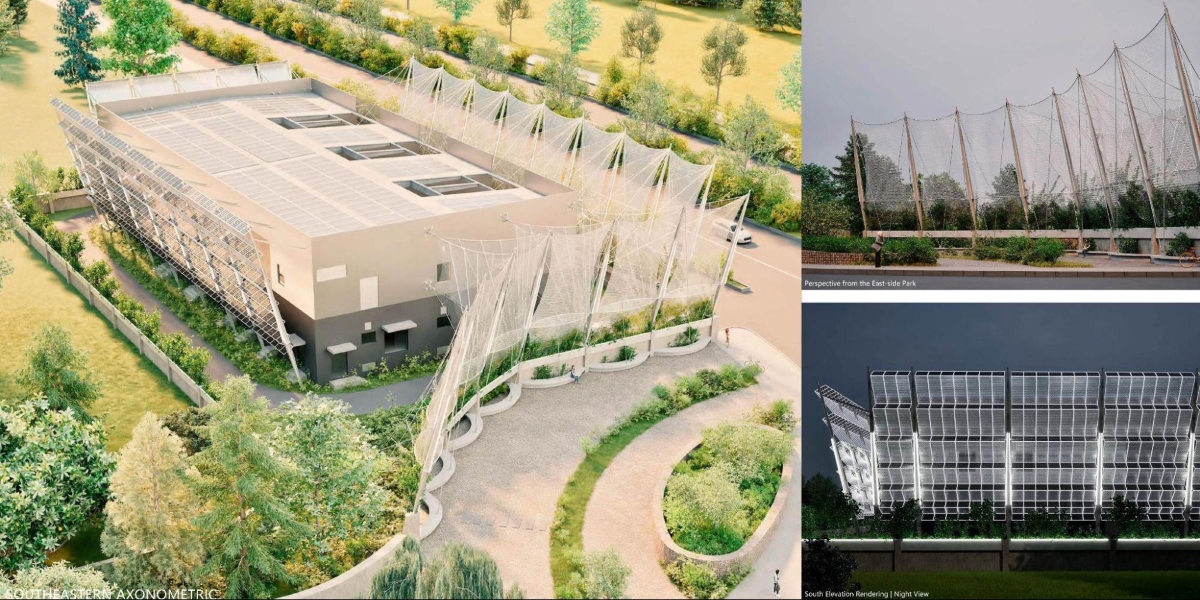
Guided by the central concept of “Photosynthetic Sail Shadows,” the project transforms a conventional infrastructural building into an active environmental interface. Through a double-skin façade strategy integrating vertical greenery and photovoltaic technology, the architecture is designed not merely to consume energy but to produce it—while simultaneously shaping spatial identity. Rather than treating the building envelope as a static boundary, Sails of Light reimagines it as a performative membrane mediating between human activity, climate forces, and cultural memory.
A Façade That Lives, Gathers Energy, and Tells a Story
At the heart of the project lies a dual façade strategy. The east and north façades, known as the “Sailing Walls,” draw inspiration from Jinshan’s maritime heritage. Layered, sail-like structures support climbing vegetation, forming living ecological barriers that soften infrastructure’s visual impact while improving microclimate and thermal comfort. As plants shift with the seasons, nature becomes visibly embedded in the architecture.
The south and west façades, exposed to stronger sunlight, function as “Charging Walls.” Gradient-arranged photovoltaic panels harvest solar energy while creating dynamic patterns of light and shadow. Solar technology is composed rhythmically, turning renewable infrastructure into an architectural language rather than a technical afterthought.
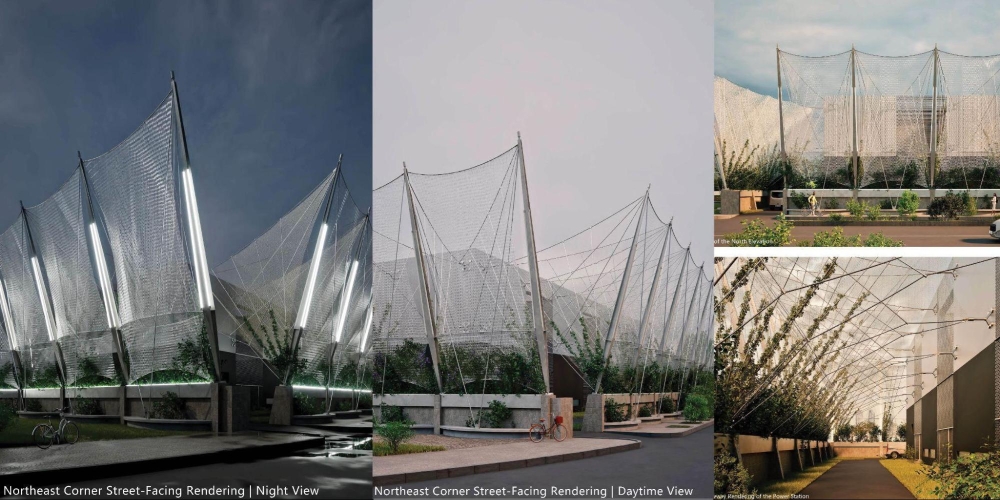
Photo Courtesy: T.E.N. (North Facades Drawing)
Architecture as a Public Interface
Together, these systems merge ecological performance, sensory experience, and cultural symbolism. The building, located near Jinshanwei Station along the intercity railway corridor, serves as a public interface. For passing commuters, the west façade becomes a large-scale cultural landmark, transforming maritime history into a contemporary form. As sunlight interacts with layered panels, the façade gradually shifts throughout the day, making the infrastructure into an engaging visual experience.
Revitalizing Underused Urban Space
Beyond formal innovation, the project aims to revitalize underused infrastructural space. Vertical greenery improves air quality, mitigates heat island effects, and enhances biodiversity. Photovoltaic integration contributes to energy autonomy and urban resilience. Sails of Light, therefore, reimagines infrastructure as an ecological and spatial asset rather than simply as a background utility.
A Dialogue Between Nature, Technology, and Culture
What distinguishes the project is its integration of environmental performance, technology, and cultural expression. Sustainability is framed not as a technical add-on, but as an experiential quality—visible, spatial, and publicly legible. The sail metaphor extends beyond form: just as sails capture wind and enable movement, the building captures sunlight and responds to environmental forces, symbolically setting course toward a regenerative urban future.
Designed by architect Yutong Zhao, the project reflects a practice grounded in sustainability, social responsibility, and ecological collaboration. By working with site constraints and natural forces—sunlight, wind, vegetation growth—the design creates immersive public space while minimizing environmental disruption. Architecture becomes not a dominating force, but a potential partner within ecological systems.
International Recognition and Global Relevance
The project has received international recognition, including Gold Awards at the International Design Awards 2025 and the Global Architecture Design Awards. These honors underscore its conceptual clarity and global relevance. While rooted in Jinshan’s local context, Sails of Light addresses universal challenges: integrating renewable energy into everyday architecture, reconciling infrastructure with ecology, and preserving cultural identity amid rapid urbanization.

Photo Courtesy: Yutong Zhao
(Global Architecture Design Awards and International Design Awards)
Toward a More Symbiotic Urban Future
Ultimately, Sails of Light proposes a shift in mindset—imagining buildings less as machines and more as ecosystems. By transforming infrastructure into a living, communicative entity, it offers a vision of cities where architecture does not merely stand, but grows, adapts, and sails alongside the natural world.