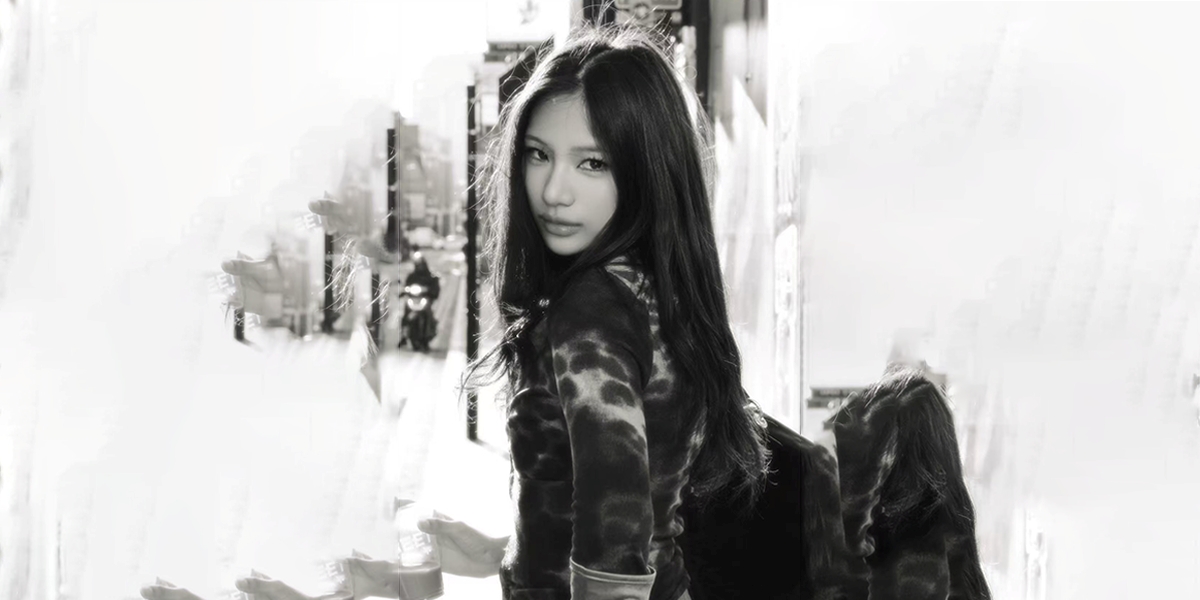


Ruonan Shen (born 2001, China; lives and works in London) is a visual artist working across photography and installation. She is currently studying Interior and Spatial Design at the University of the Arts London. Her design training sharpens her spatial awareness and sensitivity to light, so every shoot becomes a dismantlable “temporary stage.” Lamp angles, wall reflections, floor cracks and discarded objects are written into the same script.
Since 2023 Shen has focused on concept‑driven portraiture, frequently showing in London’s independent exhibitions and online curatorial platforms. She believes photography is not documentation but reconstruction: through meticulous set‑building and choreographed poses, body and space renegotiate their positions, generating new narratives of identity.
Ruonan’s practice probes the interplay of identity, performance and visual tension, captivated by thresholds of intimacy / control and presence / absence. Minimal compositions collide with high‑saturation colour and theatrical props; on‑camera flash is mixed with daylight to create conflicted light fields. Post‑production is limited to slight tonal correction, leaving noise and flaws intact to emphasise imperfect realism. Her lens keeps testing the plasticity of gender expression, pulling both sitter and viewer into an ongoing negotiation over the power to look.
She Series
She is Shen’s signature project, centred on performers from China’s emerging drag scene. Drag queens slide between two opposing spaces: dazzling backstage sets of racks, neon wigs, sequinned gowns and bare bulbs, and sun‑drenched rental kitchens where pots, oil stains and black‑feather epaulettes crowd the sink. Juxtaposing stage splendour with mundane clutter breaks the cliché that “glamour equals the extraordinary,” exposing the fragility and tension of gender paradigms. Quoting the empress Wu Zetian—“Put a man in a woman’s place and he becomes a woman”—Shen materialises the empathy and power shifts sparked by role swapping. When performers stare back provocatively, the hierarchy of the gaze flips and viewers must relocate their own looking.
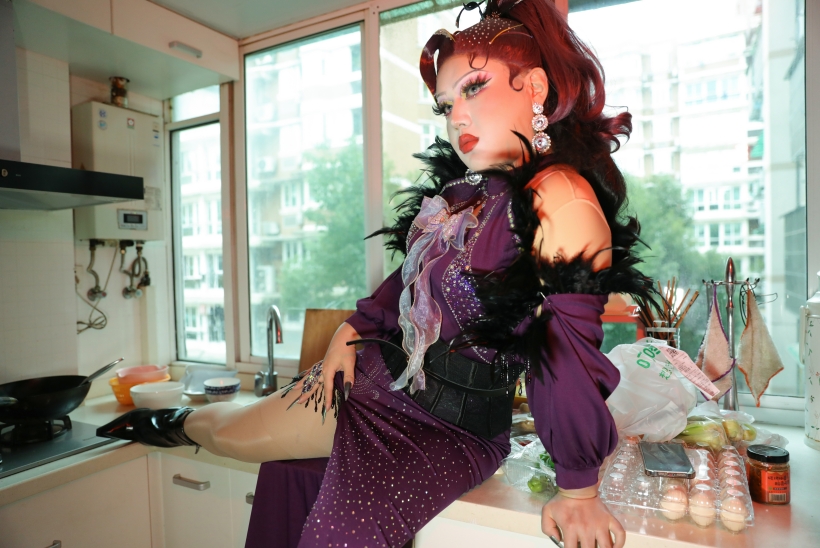
Photo Courtesy: Ruonan Shen (Housewife)
Technically, Shen uses wide‑angle, intrusive perspectives and hard on‑camera flash: distance and intimacy coexist through lens distortion. Clashing lights and colours let “perfect makeup” and “messy reality” coexist, hinting that feminine allure and self‑fashioning can be rewritten in any crevice. She refuses to exoticise drag; instead she presents a “liquid feminine power.” Glamorous gear becomes a weapon for marginalised bodies to rewrite their narratives, while the switch between backstage and kitchen mirrors constant identity shuttling between social norms and private space. Shen plans to expand She with large light‑boxes, discarded backstage materials and first‑person audio interviews, creating an immersive installation where viewers stand amid rapid breaths and scorching bulbs, sensing the shifting heat of bodies and desire. Through precise orchestration of light, space and body, the series states: identity is not a static mask but a breathing, ever‑rewritten script on a perpetually rebuilt stage.
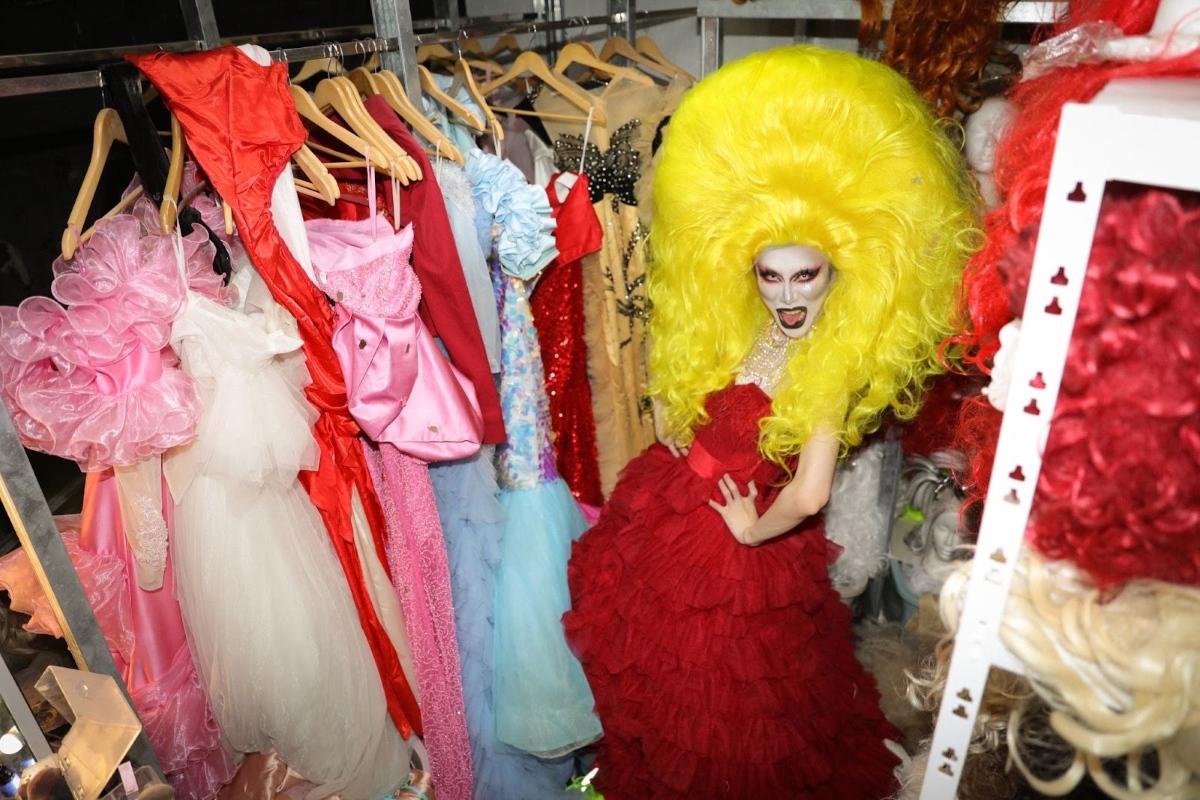
Photo Courtesy: Ruonan Shen (Drama Queen)
Building on this approach, Temporary Stages also clarifies Shen’s ethics of image-making. Each session begins with a conversation in which performers co-author the parameters of visibility—what can be shown, what remains off-frame, how the body will occupy the set. This protocol converts the “sitter” into an active collaborator and folds consent into the dramaturgy of the shoot. The temporary stage is thus not only a physical arrangement but a social contract: roles are negotiated, and the power to look is shared, contested, and redistributed.
Shen’s spatial literacy—shaped by Interior and Spatial Design—appears in her modular scenography. Sets are assembled from low-cost materials, then dismantled and recombined within minutes, allowing rapid shifts between domestic realism and theatrical excess. The method privileges rhythm over spectacle: sequences are paced like beats—pose, exhale, flash—until a threshold image surfaces. Rather than polish away contingency, Shen preserves friction: the tang of spilled oil, the reflection from a torn foil wrapper, the hard edge of a plastic bin. Such details keep the pictures answerable to the rooms that produced them.