

By: Jingsi Chen
In a fully digitized world, our lives are engulfed by the digital. Jingsi Chen’s Curtains in the exhibition Digital Interference at AMP Gallery held during the London Design Festival, invites us to explore how digital saturation reshapes our perception, emotions, and the way we relate to art and to ourselves ultimately.
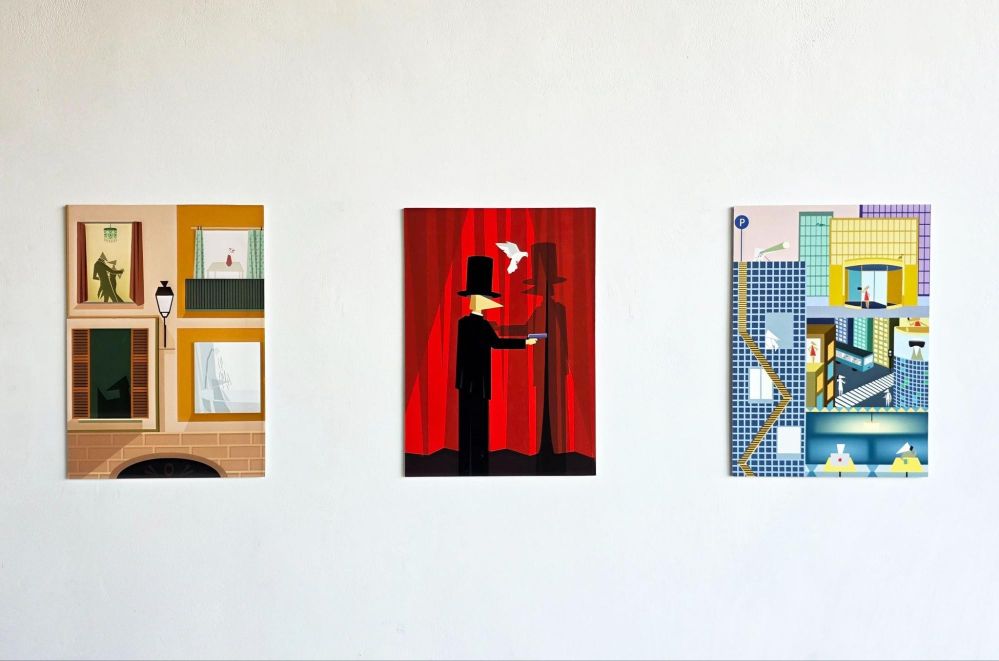
Photo Courtesy: Jingsi Chen
Installation view – Curtains, London Design Festival, 2025
We are surrounded by an ongoing discussion about algorithms and their contributions toward automation and th ise emergence of artificial intelligence. The rapid shifts of attention have placed us in a perpetual state of disruption; there lies an undercurrent of anxiety and fatigue. Jingsi Chen’s Curtains are seriously contemplating the real and tangible implications of these latest stages of cybernetic revolution in the field of art. Even the process is being done to direct the epistemic consequences of this acquired knowledge toward constructing new forms of self-reflection.
Can artistic creation truly escape the reach of digital influence? Since artistic practice and its performance take their final form in the public sphere, the question arises whether images generated by Artificial Intelligence can be considered artworks. Algorithms have been at the heart of the transformation of relations and means of production. Understanding algorithms is necessary to know the current contemporary era and these latest stages of change, the connection between technology and art in social, economic and cultural practices. Walter Benjamin’s The Work of Art in the Age of Mechanical Reproduction focuses on the cognitive and cultural consequences of a world constituted by images. Jingsi Chen‘s image practice intervenes in dominant narratives through the quiet, radical act of seeing. Images compress space into graphics, visualize objects and change the way we perceive space, critically reflect on current social issues and evaluate practices in the current context.
The industrialization of art production, archiving and classification triggered by digital technology, is completing the quantification process of art product producers, consumers and artists. The Chinese Traditional Culture Museum has a collection catalogue classified by craftsmanship and materials, separating design and production. Digital images of the collections are archived to complete the art products. The function of art museums activates structural, conceptual and affective labour in public spaces. This is a rare opportunity to gain insight into the sustenance of these spaces, shedding light on their operational models, curatorial urges, and the communities they nurture, as well as the possibilities of new forms of collectivity, authorship, and care.
Jingsi Chen believes that space is the time we spend. In Curtains, the function of a space was defined by the perceptible things that give us awareness of where we are when we enter. We become aware of our relationship with our surroundings through time, speed, or the objects we touch and see. At the same time, by transforming forgotten spaces and giving them new life, it aims to help these places thrive and be enjoyed once again by those who appreciate their unique beauty, fascinating history, and cultural significance.
Curtains offer interventions against the common concept of seeing in art, presented from the perspectives of both the viewer and the viewed, exploring the intersection of narrative, space and cultural heritage. In this age of simulation, can we still distinguish between ruins and blueprints, artifacts and prophecies? Artificial Intelligence permeates every aspect of life, driving the pursuit of reality at each creative step where inspiration strikes. Visual art, as a sensory experience, transforms seeing into a tangible, perceptible form, connecting us with the world between universal values and scarcity, constant change and long-term display, readability and common sense, illusion and reality.
With Jingsi Chen’s Lost Seashells, created entirely with flat brushstrokes using the direct painting technique in oil, it is self-referential to its own field, signifying her position and existence. She invites viewers to reconsider not only the formalism of figurative painting but also to reevaluate the art market’s interest in originality. Jingsi’s decision to work physically can be seen as a response, an exploration of narrative in both painting and image practices. She breaks down and reassembles herself, reflecting on her own cognition through a critique of her works and the medium they belong to. This serves as a critical reflection on the past and the coming future situation of contemporary human existence.
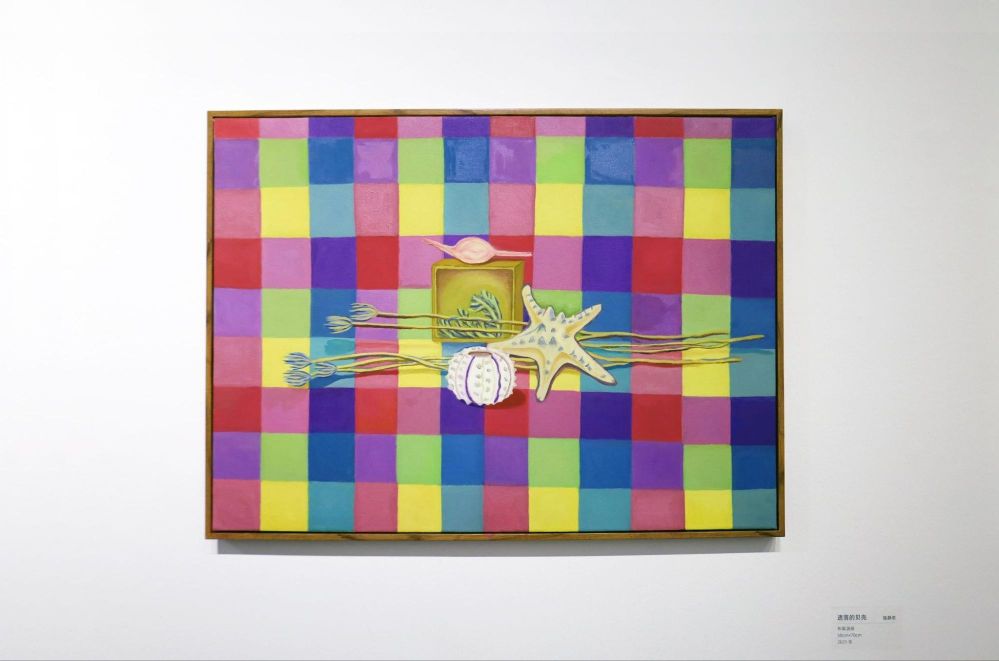
Photo Courtesy: Jingsi Chen
Installation view – Lost Seashells, National Still Life Exhibition, 2025
Jingsi Chen’s Lost Seashells (2025) and Snowy Mountains (2026) were displayed at the Cloud Art Museum of the Chinese National Academy of Arts. Both works transform painting, whether digital or print, into open-ended image critique that questions the rapidly changing art market and the conventional cultural context. Jingsi’s work, in its nuanced painting quality, invites us to reflect on our own expectations of preview, whether in the art world or at the museum. In an era when digital is increasingly pronounced, her reappropriation and reinterpretation of unfixed narrative forms represent a significant point of reflection for the future of visual art and its intersections with cultural practices.