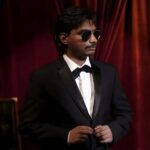
Artist Cui Decheng was invited to participate in the 23rd Beijing Art Expo. This art expo is organised by the Beijing International Art Expo Foundation and the Beijing Cultural and Creative Industry Development Service Company, hosted by the Beijing Art Expo Chang’e International Convention and Exhibition Center, and co-organized by the Beijing Cultural and Creative Academy, Beijing Shiqi Art Foundation, Beijing Fashion Classic Art Exchange Center, and the Capital Financial Service Chamber. It grandly opened on September 7, 2023, at the Beijing Exhibition Hall. This event is an important art exchange activity of the 11th Beijing Cultural Consumption Season hosted by the Beijing State-owned Cultural Assets Management Center, with the theme of “Leading the Future.” It integrates representative contemporary art forms and invites nearly 120 galleries and art institutions from different countries and regions. Over 5,000 artworks are organised in the exhibition hall, providing a high-quality academic atmosphere for participating artists, scholars, gallery managers, and collectors to engage in discussions, explore the transformation of contemporary art forms, and the diversity presented by artistic language, enriching the extraordinary charm of contemporary art.
Cui Decheng (b. 1990) earned his Master’s degree in Painting from the School of the Art Institute of Chicago in 2020 and currently resides in Los Angeles. He is an active conceptual artist and gallery owner. In 2022, he founded 4C Gallery in Los Angeles Angeles to promote the development of Chinese art, aiming to provide a platform for Chinese-speaking artists and audiences amidst the cultural fusion of China and the United States. His personal work is influenced by multiculturalism and is presented through various media and forms, including traditional painting, sculpture, as well as new media installations and video art. As an emerging conceptual artist, he has a strong interest in metaphysical themes, often exploring the essence of human thought, perception, and experience. His works have been exhibited in China, the United States, Europe, South Korea, and other countries/regions and have been collected by institutions such as the FLAXMAN Library, the Contemporary Art Collection Committee of the China Collectors Association, and CICA Museum. His work has also received the “Leonardo da Vinci International Award” and was selected for the Stars program.
The artworks on display in this expo constitute a segment of Cui’s acclaimed “Metaphysical Tetralogy” series, comprising four distinct sections. The initial intention of this series is to portray the various possibilities of human perception of the world, aiming to explore the intricate relationship between sensuality and rationality. In the artist’s view, sensuality is the starting point of cognition, and rationality is its guide; they are interdependent and inseparable. At the same time, in the process of creation, he abandons the constraints of a single artistic language, integrating traditional oil painting, digital animation, printmaking, installation art, and sound art to create his overall artistic identity.

Sourced Photo
This exhibition presents the first two chapters of the Metaphysical series, including representative works such as “Heart line_1,” “OM_Cube Group,” “Cityscape_Skyline,” and “Spaces.” In these works, the artist represents a set of opposing contradictions and uses mathematical equations to determine the shapes, colors, and positions of points in the artwork, avoiding the pitfalls of emotional subjectivity. In his view, looking at things from an opposing perspective is incomplete, biased, and even antisocial. He hopes to present an inclusive worldview through his calm, regulated, and orderly works.
His artworks are presented in the form of mixed-media sculptures, consisting of countless digital printed blocks distinguished and juxtaposed by different colours, creating a dual effect: one that differs greatly when viewed up close and digitally stitched. His sculptures incorporate both formal symmetry and Irregularity in colour application. In “Heart line_1” and “Kidney line,” the surfaces are covered with thousands of points, rotated in polygons, creating overlays and gradients of a single colour, creating dynamic collisions between lines and corners. Cui Decheng transforms the reverence of ancient Chinese artists for nature into a reverence for science, mathematics, and logic, which aligns with our technological era and brings a refreshing perspective to our current art world atmosphere.
“Cityscape_Skyline” combines oil painting and digital painting to create artificial urban landscapes and non-artificial natural landscapes. He represents all artificial objects using standard rectangles, densely crowded together. He then uses organic oil brushstrokes to depict natural oceans and skies. The works are filled with contrasts, such as congestion and tranquillity, artificial and organic, controllable and uncontrollable, vibrant colours and monochrome, and more. “Spaces” presents a diverse space with contradictions yet rationality. From this, we can see that Cui Decheng emphasises reason over emotion, reason over individual or group identity. He desires to “understand and apply the universal laws of nature” and wrote, “Through reason, people have created the most powerful belief in human history, science. The core of this series of works is …faith in science.”
Notably, Professor Yi Ying, a venerable figure at the Central Academy of Fine Arts who serves as a doctoral supervisor, distinguished critic, and theoretical research scholar once pointed out in “Regarding Aversion to Sensuality – A Discussion on Cui Decheng’s Art”: We understand Cui Decheng’s art in this way: he constructs a grid of images based on rational rules, which does not constitute an aesthetic object in itself because it is a product of calculation and design. However, it still adopts aesthetic camouflage, with the density and variation of the grid, the blending and contrast of colours, especially the irregular outlines, seemingly implying formalism. However, there should be a deeper meaning, symbolic and metaphorical. The setting of the image in rational and technical terms is inseparable from the unfolding of the creativity of life itself. Life is not static; it depends on the impulse and creation of life. The impulse is the development of life, and development inevitably involves resistance; creation is the rebirth of life, and life gains new meaning after breaking through resistance.
In conclusion, this refined narrative offers an in-depth exploration of Cui Decheng’s remarkable journey as an artist and his pivotal role in the 23rd Beijing Art Expo. By weaving together elements of creativity, mathematics, and rationality, Cui invites us into a realm where art becomes a profound exploration of the human experience, challenging conventions and beckoning us to see the world through a new lens. Through his Metaphysical Tetralogy, Cui Decheng not only showcases the convergence of sensuality and rationality but also offers a profound meditation on the enduring synergy between art and science, a theme that resonates profoundly in.