

By: Jennifer Maeve Moloney
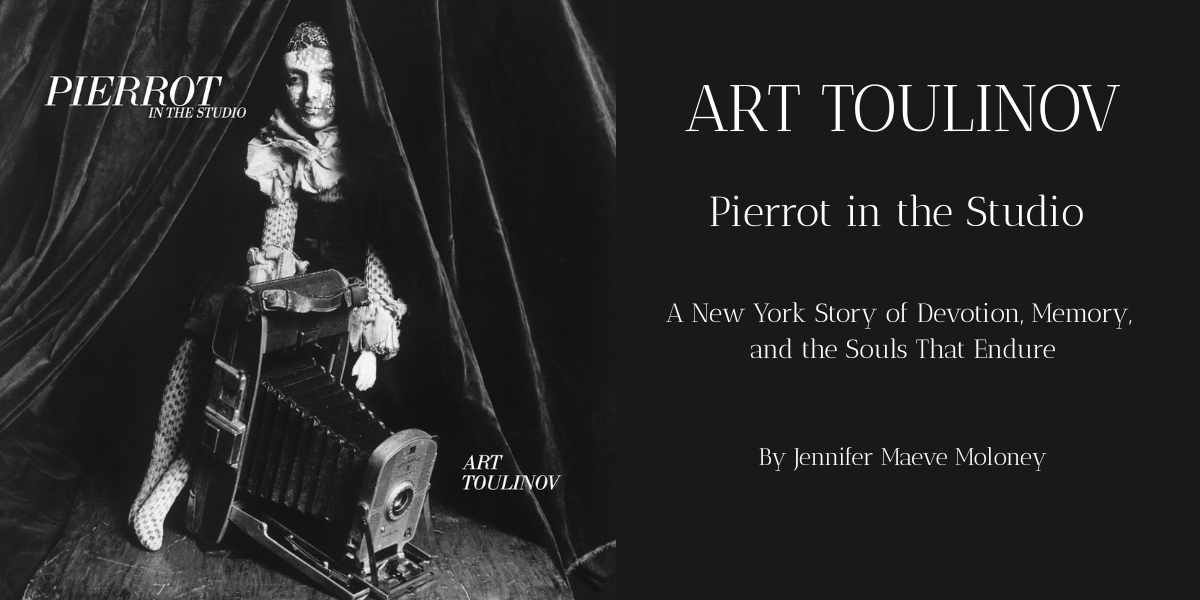
On December 5th at 6:00 pm, at Throckmorton Fine Art Gallery on East 57th Street, in the quiet corridors of New York’s prestigious arts district, a book is about to take its first step into the world. Pierrot in the Studio, by the photographer Art Toulinov, is not just a photobook. It is the distilled history of a life that traveled farther – emotionally, geographically, spiritually- than many artists ever admit to themselves. It is a record of ghosts, of objects with histories, of bodies that became symbols, and of the people who carried this work forward with him. It is, in its deepest sense, a New York story.
From the USSR to David Barton’s Manhattan
Long before he built his black-box studio and filled it with the theatrical stillness that defines his work, Art lived a completely different life. He grew up in the Soviet Union, trained as a lawyer, and lived within the closed structures of that world. But it was American bodybuilding, not the law, that captured his imagination. He had seen the possibilities embodied by figures like Arnold Schwarzenegger. Like many émigrés of that era, he came to New York with little more than a belief that the city might shape him into something larger than the life he had known.
It did, almost instantly.
He was working behind a department store counter when the legendary gym impresario David Barton noticed him. Barton’s eye was famously unerring; he knew how to build a New York archetype. He brought Art into his gym, and for a time, that world became Art’s home. The discipline suited him – the solitude, the rigor, the incremental sculpting of form.
But the body, in Art’s world, was never simply a body. It was potential. It was a myth.
Which is why what happened next made sense only in the logic of New York, where lives collide with strange and life-altering precision.
Marcus Leatherdale and the Keys to Another Life
In the mid-1990s, Marcus Leatherdale, protégé of Robert Mapplethorpe, one of the last living links to the era of Warhol’s circle, spotted Art at the gym. Marcus was not a bodybuilder. He simply recognized the presence. Charisma. A particular interiority that shows itself before a person ever speaks.
Their friendship was immediate, almost familial. And Marcus, who was then traveling regularly to India, did something artists rarely do: he entrusted his entire studio to someone he had only just begun to know. He handed Art the keys and told him to use everything inside, the lighting, the space, and most importantly, the Hasselblad medium-format camera that would forever alter the direction of Art’s life.
At the time, Art had been struggling with a 35mm camera, photographing outside and feeling constrained by its horizontal and vertical limits. The Hasselblad, the pure square, 2 ¼ x 2 ¼ , opened something in him. His compositions grew quieter, more sculptural. He learned how to light with restraint, to build emotional temperature with economy, to make a small space feel like a vast stage.
This was Marcus’s greatest gift. A lineage passed from Mapplethorpe to Marcus to Art, not stylistically, but spiritually. A way of seeing.
The Human Process: Marco Velk, Missy Rayder, and the Two-Year Search
In the years that followed, Art honed his voice through an arduous human process. He refused the casual portrait. He waited for the right person, the right psychological charge, sometimes for years.
For one major piece, he searched New York for two full years for the right male subject. He shared a studio with the Yugoslavian painter Marko Velk, a respected artist whose own lineage traces back generations. One day, after hearing Art speak again about this unresolved image, Velk volunteered himself. That photograph became one of Art’s most collected works.
Other sitters came from the rarefied corners of the fashion world. Missy Rayder, the Vogue cover model with the sculptural facebones and preternatural stillness, sat for him in images that remain some of his most emotionally precise portraits. Art never decorated them; he didn’t need to. He allowed the human to exist without gloss.
And then there was the day he saw me.
I was standing on the first floor of ABC Carpet & Home, the store where I worked while I was in graduate school. It was 2015, and I was in the thick of my own heartbreak – returning from Europe, rebuilding my life, immersed in somatic performance work on trauma and intimacy. I stood there with a melancholy I didn’t yet know how to name.
Art saw it instantly. Not the performance, not the posture – the interior.
When we began working together, I had stepped into a lineage of classical portraiture that no longer exists. The sessions became part of my healing because he treated me the way he treated every subject: as the living core of the image. When I once described myself as part of a still life, he corrected me. No, he said. The humans are always the heat source, the pulse, the animating force. The objects orbit them.
Carol Schaefer: The Muse at the Center of Art’s Work
But no one occupies Art’s work more fully than Carol Schaefer, his life partner, muse, and the person who knows the internal architecture of his mind better than anyone alive. Her presence in his photographs is unmistakable: there is a charge, a depth, an emotional fluency that only emerges when the subject knows the photographer intimately.
Carol is also a published author and writer, and over the years, she has observed Art’s daily devotion to his craft – an unglamorous, uncomplaining persistence that few contemporary artists maintain. She understood before anyone else that the Pierrot images needed to exist as a book. She shepherded the project from inception to completion, and she is the reason Pierrot in the Studio is entering the world now.
The Flea Market, Spencer Throckmorton, and the Hundred-Year-Old Dolls
Art has always been a hunter. It’s how he found his sitters, and it’s how he found the objects that now define this book.
At a flea market downtown, years before the pandemic, he discovered a box of antique dolls, more than a century old. Among them were Pierrot and Columbine, the eternal lovers of commedia dell’arte, locked in their 400-year-old triangle with Harlequin.
At that same flea market some time before, he also met Spencer Throckmorton, one of the world’s foremost photography gallerists. Spencer recognized the depth of Art’s prints immediately. Their friendship grew over the next decade, and Spencer became a constant presence in Art’s artistic life. Art calls him “the Godfather,” a title of deep affection and accuracy.
Four of Art’s works have been gifted by private collectors to the Brooklyn Museum of Art, an institutional acknowledgement that his work belongs to the ongoing lineage of American art.
Pierrot, Columbine, Harlequin: The Myth That Returned
When the pandemic made photographing people impossible, Art returned to the dolls, not as substitutes, but as beings.
The Pierrot in his studio was not the cheerful, buffoonish servant of the early commedia plays. His Pierrot descended from the lineage of Watteau’s Gilles and Deburau’s Parisian mime – silent, tender, heartbroken, and forever in love with Columbine, who ultimately chooses Harlequin.
These dolls had lived through a century of touch, stage, storage, abandonment, and rediscovery. They contained memories the way old violins do.
Art felt that instantly. The dolls were not props. They were carriers of narrative tension. They had gravity.
Tsukumogami: The Souls That Objects Inherit
When publisher John O’Donnell of AVGI first encountered the Pierrot images, he immediately connected them to the Japanese concept of tsukumogami, where objects acquire a spirit through long use and memory. What struck him in Art’s work were qualities traditionally associated with classical Japanese aesthetics: restraint, deep shadow, a quiet theatricality, and a sense of spiritual stillness that allows emotion to surface without force. These elements were not crafted as stylistic choices; they emerged naturally from Art’s way of seeing. John recognized that the images did not simply depict old puppets but revealed the emotional histories those objects had absorbed across decades.
John did not impose the comparison. He recognized what was already present.
In his view, Art had photographed not dolls, but beings shaped by centuries of performance – objects that had absorbed the emotional reputations they played for decades. The traces of longing, mischief, melancholy, and devotion were embedded in them, and Art had revealed those traces through the portraiture of extraordinary intimacy.
What Endures
At the center of this story are three people: Art, Carol, and the viewer who meets these images with their own memories. But the work, ultimately, belongs to the lineage that shaped it. From Soviet discipline to Manhattan bodybuilding, from Mapplethorpe’s successor to the flea market, from living sitters to century-old dolls, from tragedy to theater to silence.
Which is why Art’s favorite words, the ones he offers as the true heart of his practice, land with such clarity:
“My greatest satisfaction comes when an image can elicit an emotional response or memory for the viewer, because I have delved deep into myself in making it, and we have found our common humanity.”
There are artists who perform beauty.
And then there are artists who bear witness to what survives.
Art Toulinov belongs to the latter.
And Pierrot in the Studio is his testament.
Opening on December 5, 2025, at 6:00 pm
145 East 57th Street, 3rd FL. NY, NY 10022
Tel: 212.223.1059