


Most insurance carriers know the frustration of paying for a lead that arrives too late. A household requests quotes on a comparison site, three or four insurers receive the same contact, and the race to the lowest premium begins. By that point, the carrier is one voice among many.
To show how a carrier can get ahead of that moment, IntentLogic has released a case study on reaching home and auto insurance households shortly before they start comparing policies. The scenario is a modeled projection, not reported results from a live client engagement. It shows the mechanics and the financial effect of building a marketing program around timing rather than broad reach.
The Problem With Always-On Advertising
Consider a regional carrier that advertises year-round and buys quote leads from comparison sites. Those leads are expensive. They are also shared with competitors, so the carrier pays full price for a contact it has to win against several rivals.
Broad advertising has a different weakness. Most households it reaches are months away from renewal. They have no reason to switch, and they do not respond.
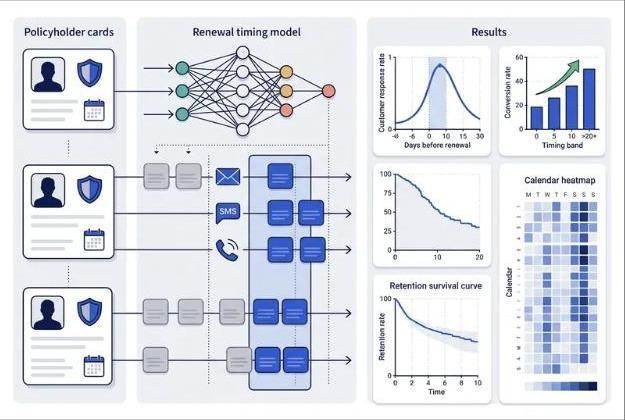
Insurance shopping follows a clear pattern. It clusters in a short period before a policy renews, or right after a change such as a home purchase. The carrier does not know other insurers’ renewal dates, so it has to estimate that window.
The core question changes from “who should the carrier target?” to “when is each household ready to shop?”
Six Data Signals That Point to the Renewal Window
In this scenario, the model draws on six signals. Each one adds a different piece of the timing picture:
● Estimated policy renewal timing (Ownership and Tenure): inferred from tenure and purchase dates, this is the foundation of the model.
● Home purchase or relocation (Life Events): a move creates an immediate need for new coverage, outside the normal renewal cycle.
● New vehicle or new driver (Life Events): a new car or a newly licensed teen often prompts a premium review.
● Property and household attributes (Household and Property): these indicate whether a household could hold both home and auto policies, which raises bundling potential.
● Quote comparison activity (Behavioral Intent): active shopping confirms that the window is open.
● Channel response history (Channel Response): past responses guide the sequence and timing of outreach, not whether a household is included.
A Five-Step Modeling Approach
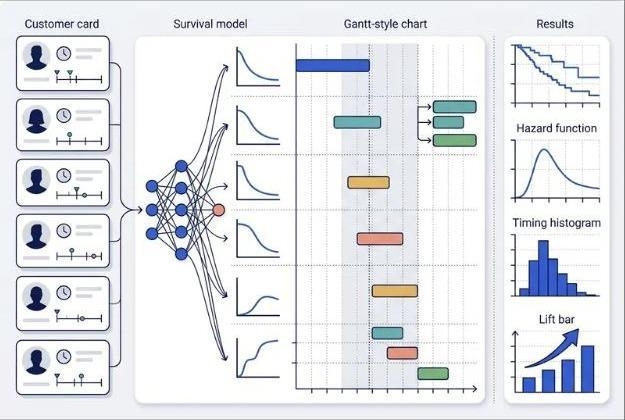
The IntentLogic methodology splits the problem into timing, triggers and value. It also builds compliance and measurement into the workflow, as set out in the company’s data and methodology notes.
1. Estimate the Renewal Window
A time-to-event model predicts how many weeks remain until each household is likely to shop. It uses tenure, purchase dates and prior behavior.
2. Detect Trigger Events
A separate classifier flags households with a recent change, such as a move or a new vehicle. These events override the normal renewal cycle and open a window early.
3. Score Bundling Potential
Households are ranked by the likelihood of taking more than one line of coverage. A household that bundles home and auto carries higher expected policy value.
4. Keep Marketing and Pricing Separate
The scores decide who the carrier contacts and when. They are never passed to rating or underwriting. This keeps marketing models out of pricing decisions.
5. Measure Against a Holdout
A random share of each score band is withheld from contact. Comparing the two groups shows how many policies the carrier would have written without the campaign.
Model Output: How the Score Separates the Audience
When the scored population is split into ten equal deciles, the difference between the top and the bottom is sharp. Households in the highest deciles are modeled to bind policies within 60 days at a far greater rate than the audience average, while households at the bottom of the ranking rarely respond at all.
Timing signals do most of the work. A household outside its renewal window seldom converts, whatever its other attributes.
Modeled Outcomes: What Changes When Budget Follows the Score
Shifting spend from always-on advertising to scored, well-timed contact produces three headline changes in the modeled scenario:
● A higher bind rate at the top of the ranking: households in the strongest decile are modeled to bind policies at a substantially greater rate than the audience average.
● A lower cost per bound policy: the approach is designed to acquire policies at a meaningfully lower cost than always-on advertising.
● A stronger multi-line share: the bundling propensity score is intended to raise the share of households taking more than one line of coverage.
Set against a broad-targeting baseline, the operational contrast shows up in three places. The scored audience is modeled to cost less for each policy bound, to produce a greater share of policies carrying two or more lines, and to lean far less on purchased quote leads.
That last point matters most for many carriers. Each purchased lead the carrier no longer needs is a shared, late-stage contact replaced by an earlier, exclusive one.
Data and Compliance Safeguards
Insurance is a regulated product, and targeting models need clear limits. The scenario applies four controls:
● Separation from pricing: marketing scores are not used in pricing or underwriting.
● Exclusion of protected characteristics: protected attributes and close proxies are removed from the feature set.
● Channel-specific consent: SMS and voice outreach follow consent rules for each channel.
● Persistent holdouts: a withheld control group in every score band provides auditable proof of incremental impact.
What This Means for Insurance Marketers
How much of your acquisition budget goes to households that will not shop for another nine months? For many carriers, the honest answer is most of it.
In insurance, the question is less about who and more about when. Estimating the renewal window lets a carrier replace shared, late-stage leads with earlier, exclusive contact. The gain does not come from finding new customers. It comes from reaching the right households a few weeks before competitors do.
Read the full case study at https://intentlogic.com/case-studies/insurance-renewal-window
About IntentLogic
IntentLogic, operated by Intent Logic LLC, is a data science and precision marketing company. Its proprietary IRIS system analyzes a database of more than 245 million consumer profiles to identify high-value prospects and predict engagement strategies. The company runs coordinated campaigns across email, SMS, push, in-app, paid media, web, WhatsApp and audio. IntentLogic serves brands in financial services, automotive, health and wellness, insurance, retail and e-commerce, and education, with a focus on precise targeting, measurable outcomes and predictable growth.
Disclaimer: Figures in this article are modeled projections from an illustrative scenario and are not reported client results. Outcomes vary based on data quality, market conditions, and execution.