


By: He Tianbo
In southeastern Guizhou, diverse cultures and natural scenery complement each other beautifully.
If you’re looking for a vibrant, multicultural haven, turn your attention to Guizhou Province in southwestern China. There, the Qiandongnan Miao and Dong Autonomous Prefecture, dense with World Natural Heritage sites, UNESCO Intangible Cultural Heritage items, and local cultural events, is becoming a crucial landmark for international travelers seeking to rediscover China. The New York Times included Guizhou on its “52 Places to Go in 2016” list. What makes this corner of the province so irreplaceable? Let’s explore Qiandongnan together.
For a closer look, watch a video introduction to Qiandongnan.
What Makes the Mountains and Terraces of Qiandongnan Different
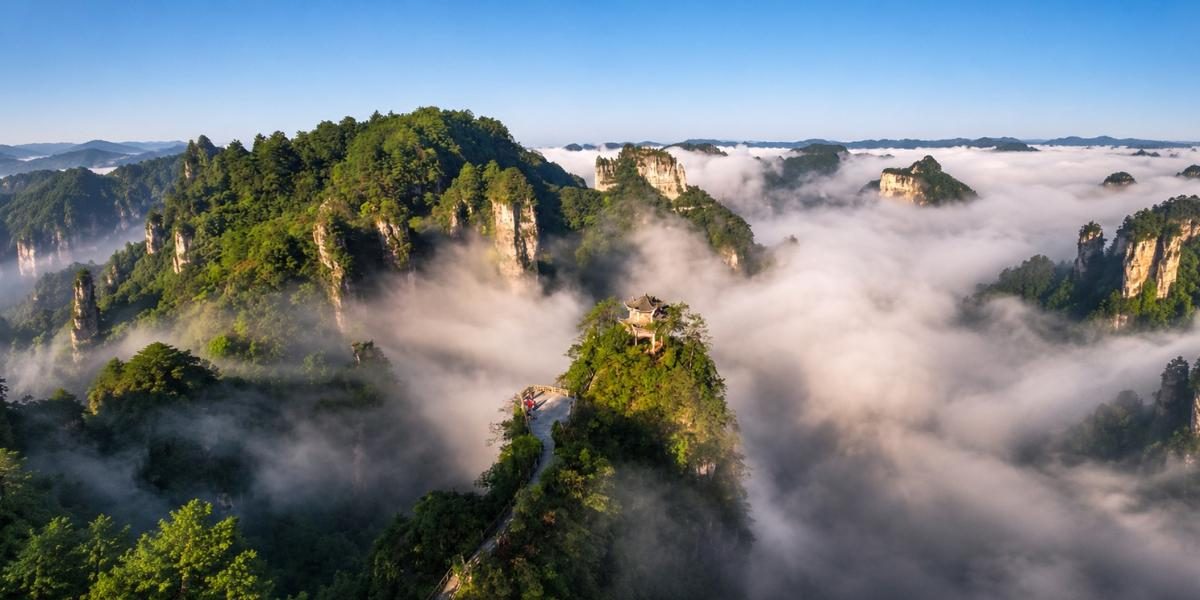
The answer lies first and foremost in the mountains and rivers. Yuntai Mountain, in Shibing County, was inscribed on the World Heritage List in 2014 as part of the “South China Karst,” and it holds one of the world’s best-preserved dolomite karst formations, with forest coverage over 90 percent. It doesn’t rely on a single isolated peak for its appeal. What draws visitors is the aesthetic integrity of the entire karst system, a cross-section of millions of years of geological change in tropical and subtropical regions.
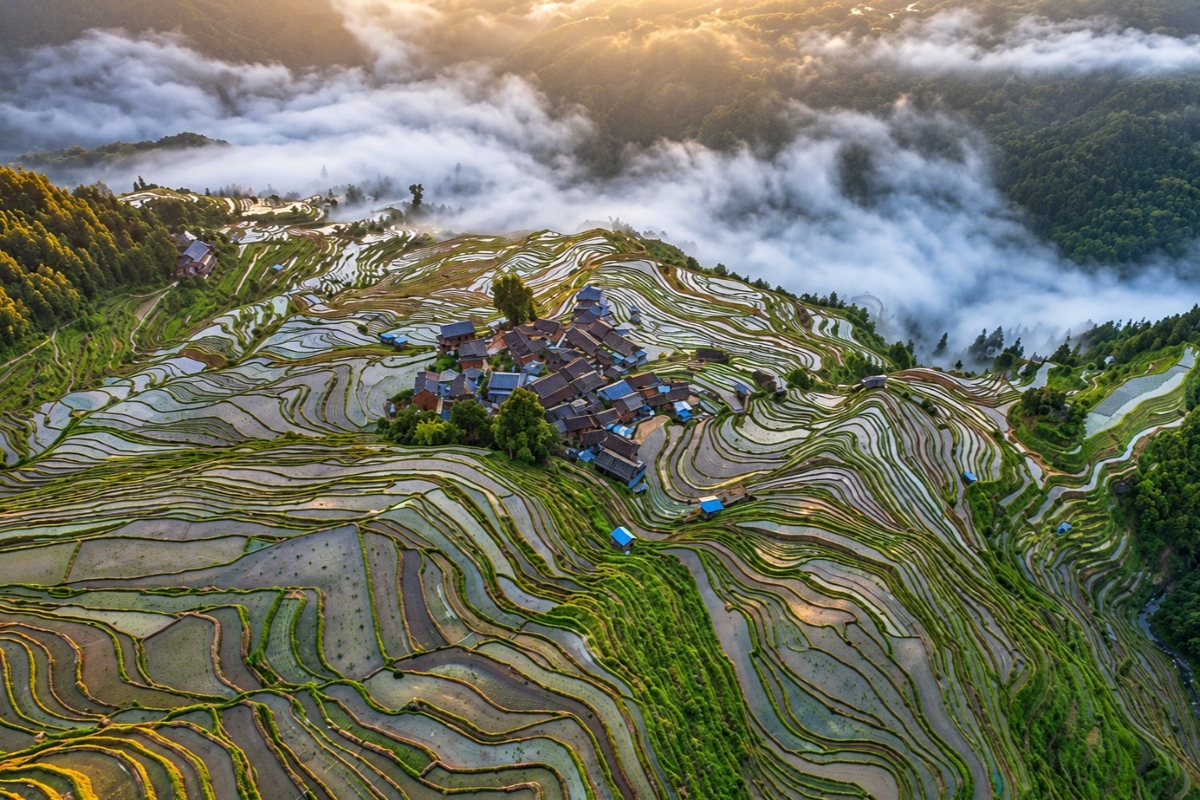
South of Yuntai Mountain, the Jiabang Terraces in Congjiang County stretch for nearly 10,000 mu, roughly 667 hectares, along the heart of the Moon Mountain. For hundreds of years, Miao ancestors carved layers of earthly texture into the steep slopes, adapting to the terrain rather than fighting it. The “rice-fish-duck symbiosis” agricultural system continues here, and in 2011 the Food and Agriculture Organization of the United Nations listed it as a Globally Important Agricultural Heritage System. For international travelers, the Jiabang Terraces are not merely scenic postcards to be viewed from afar, but a still-functioning wisdom of human-land cooperation.
How the Dong Grand Song Became a Living Tradition
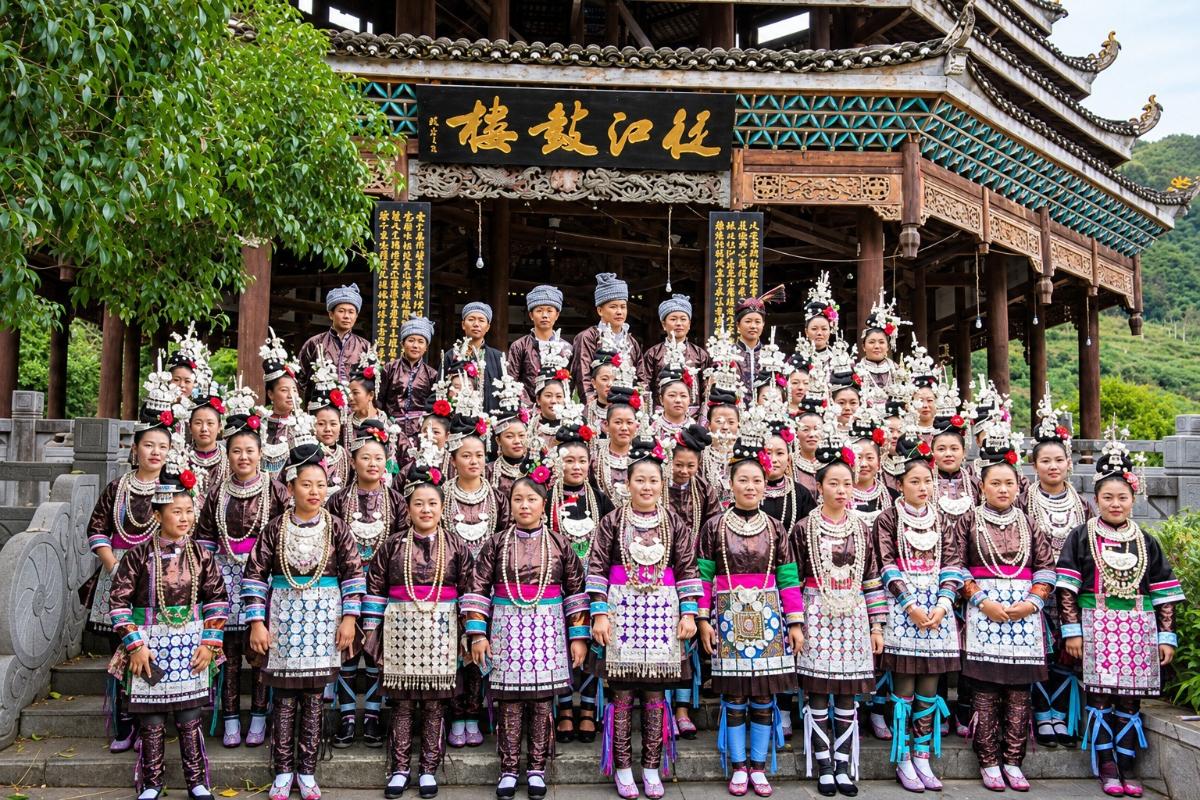
If natural heritage forms the skeleton of southeastern Guizhou, then the Dong Grand Song gives this land a spiritual quality you can hear. This singing tradition, performed without a conductor or accompaniment and built on polyphonic natural harmony, was inscribed on UNESCO’s Representative List of the Intangible Cultural Heritage of Humanity in 2009. Its uniqueness lies in the fact that the singing is not a staged performance. It is a public language embedded in the daily life of Dong villages.
In March 2026, the Yale University Whiffenpoofs visited Zhaoxing Dong Village in Liping County and shared the stage with local choirs. The natural harmony of the Dong Grand Song, with its low-to-high tonal movement, resonated with the centuries-old a cappella style. That dialogue was possible precisely because the Dong Grand Song carries a musical logic that travels past language and national boundaries.
Why Village Sports Here Draw Global Attention
Equally captivating on a global scale are the grassroots events that have sprung up across this land. The “Village Super League” and the “Village Basketball Association,” along with the “Village T” runway shows, are organized and performed by villagers themselves. These accessible, immersive rural events rely on the enthusiasm of ordinary people. Without commercial packaging, they have drawn attention from across China, and from media and tourists in countries including the United States and Spain. Well-known basketball and football players have come here too. Sport in Qiandongnan is not transplanted scenery. It is a public festival that extends naturally from village life.
Where Culture Still Lives in Daily Routine
What truly separates southeastern Guizhou from many other ethnic cultural destinations is that its culture exists in daily life rather than through performance. The five drum towers of Zhaoxing Dong Village are built entirely of mortise and tenon joints, without a single blueprint or nail, and they still serve as venues where Dong people hold meetings, gather socially, and welcome guests. The covered bridge spans the stream, combining corridor, pavilion, and bridge, working as both a passageway and the village’s communal living room. Between the stilted houses of Xijiang Miao Village and Zhaoxing Dong Village, silversmithing, Miao embroidery, and batik remain everyday crafts, not shop-window exhibits.
How International Travelers Reach Southeastern Guizhou
For visitors traveling from afar, the threshold to enter this hidden gem is dropping. Southeastern Guizhou has four high-speed rail stations and two airports, Liping and Kaili Huangping, with Guiyang Longdongbao International Airport serving as the main entry gateway. China’s 240-hour visa-free transit policy provides a more flexible time window for long-haul travel.
The rhythm of festivals forms a natural travel calendar. Every November and December, the Miao New Year in Leishan and the Dong New Year in Liping unfold in succession, with Lusheng reed-pipe music, song and dance, long table banquets, and singing under the drum tower turning the whole winter into the most concentrated season for ethnic culture. A tourist who arrived in Zhaoxing from Moscow by high-speed rail said after taking part in the Dong New Year that he had seen Chinese ethnic song and dance before, but joining a festival of this scale firsthand was “a completely different experience.” Another foreign visitor working in Guangdong chose southeastern Guizhou as the final stop on his China trip, because the mountains there suit hiking and the festivals offer a more three-dimensional, everyday China.
When a World Natural Heritage site, a UNESCO Intangible Cultural Heritage tradition, and a villagers’ football pitch share the same valley, and when the mortise and tenon joints of the drum tower and the rice-fish-duck system of the terraces each continue their centuries-old order, this land in southwestern China is no longer just a destination. It is a window that is still open, and through it one can see a China that has not been overly embellished and is still growing on its own.