



Revenue-based financing has an appealing pitch: pay more when sales are strong, pay less when they soften, and give up no equity. The best companies in this space deliver on that. The weaker ones keep the language and quietly remove the flexibility in the contract.
So the most useful way to identify a good provider is to look for what its agreement leaves out. Below are six traps found in revenue-based contracts, each with a way to get around it. Everything runs on one illustrative deal.
The baseline deal: Fernhill Skincare, a fictional online brand, is offered $120,000 with a 1.4 repayment cap, 8% of monthly revenue, and a 3% origination fee. Current revenue is $150,000 a month. Fernhill would receive $116,400 and repay $168,000 in total.
Here is how the provider-side basics are often framed: a page like Fundivi revenue-based finance details outlines the general product, and you can hold any company’s offer up to the six tests below.
Trap 1: Believing the Cap Is the Price
The cap tells you how much you’ll repay. It says nothing about how quickly. Because the amount is fixed, faster growth means a higher annualized cost.
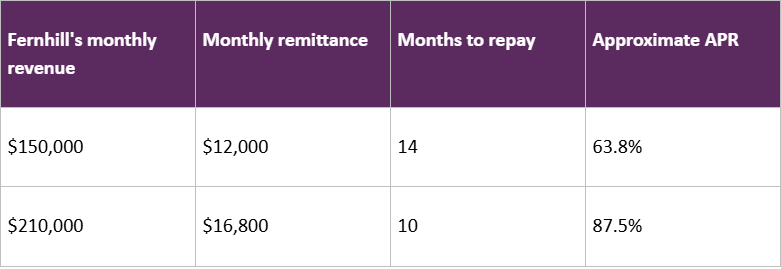
Both rows cost exactly $51,600 over the net cash received, and the faster payback is what pushes the annualized figure up. The dollars are identical, but in the second row, Fernhill had use of the money for four fewer months.
Growth is the whole reason most owners want this product, so the scenario where things go well deserves the same attention as the scenario where they don’t.
How to avoid it: Run the APR at your expected revenue and at 40% above it. Then judge the deal on what the capital earns during the period you actually hold it.
Trap 2: The Hidden Minimum Payment
Plenty of agreements pair the percentage with a floor. This is where “pay less when sales soften” can stop being true. Suppose Fernhill’s contract includes a $9,000 monthly minimum and sales fall to $90,000. Eight percent would be $7,200, but the minimum applies, so it pays 10% of revenue instead.
The floor doesn’t make the deal illegal or unreasonable. It simply changes what you bought. A minimum means part of the deal now behaves like a fixed loan payment.
How to avoid it: Search the contract for “minimum,” “floor,” and “true-up.” Calculate the effective percentage in your worst realistic month, and decide whether you could pay it.
Trap 3: A Slippery Definition of Revenue
Eight percent of what? Gross sales, net of refunds, deposits to a specific account, or all receipts? For an online seller with heavy returns, this matters a great deal. Suppose Fernhill’s $150,000 includes $15,000 in refunds. On gross, the remittance is $12,000. On net, it is $10,800. That’s a $1,200 difference every month.
Watch also for sales-tax collections, platform payouts, marketplace reserves, and transfers between your own accounts. Each one can inflate the number a provider applies its percentage to.
How to avoid it: Get a written definition, and test it against one of your past months. Have the provider show the remittance it would have collected.
If you’re also weighing conventional options because your credit is limited, a review of unsecured loans for bad-credit borrowers can provide a contrast. Compare any fixed-payment alternative on the same dollars.
Trap 4: The Term That Isn’t Really Open-Ended
Revenue-based agreements are frequently described as having no fixed term. Read further, and you may find an expected term, a maximum term, or a clause that increases the percentage if repayment is running behind schedule.
Here’s the stress test. If Fernhill’s remittance held at the $9,000 minimum, repaying $168,000 would take about 18.7 months. That sits comfortably within many expected terms, yet a contract with a 15-month maximum might require a balloon or a percentage increase at that point.
Reporting duties deserve a look here too. Some agreements require monthly revenue reports or read-only access to your accounts, and a missed report can count as a breach even when payments are current.
How to avoid it: Ask what happens at the end of the expected term if there’s a balance remaining. Ask for it as a sentence in the contract, because “we work with our clients” isn’t a term.
Trap 5: Early Payoff That Saves Nothing
On an interest-bearing loan, paying off early reduces interest. On a capped product, the full cap is often owed regardless. After seven months at $12,000, Fernhill has paid $84,000 and still owes $84,000. If it raises equity or lands a bank loan, it might have to pay the entire remainder, even though the provider’s money has been outstanding for only half the expected period.
Some companies offer a discount on early settlement. Others don’t. This single term can separate a provider that’s a useful bridge from one that’s merely expensive.
How to avoid it: Ask for an early-payoff schedule in writing, showing the settlement figure at months 3, 6, and 9. If there’s no discount, assume you are buying the whole cap on day one.
It helps to see how a provider describes its funding sources when you’re negotiating this kind of term. A Manila Times report on hybrid lending covers a platform that pairs direct capital with partner lenders. In a setup like that, ask which entity holds your agreement and has authority to approve a payoff discount.
Trap 6: The Renewal Offer
Around the midpoint of repayment, you may get a friendly invitation to take more. Renewals can be appropriate. They can also be a way to roll an unpaid balance into a new cap, so that you pay a fee on a fee.
Say Fernhill renews with $84,000 outstanding, taking a new $150,000 advance at 1.4. The new amount owed would be $210,000. After the old balance is paid off, Fernhill nets just $66,000 in fresh cash for $210,000 of future remittances. That’s a very different deal from the headline figure.
How to avoid it: Calculate the new cash in your pocket, then divide the total new obligation by that number. Fernhill’s result is about 3.18 times, not 1.4.
Scoring the Companies
A growing business has one more factor to weigh: what the money does. If $116,400 of net cash funds inventory or advertising that reliably returns more than the $51,600 it costs, the expense can be justified. If you can’t name that return, no contract is clean enough to fix the problem.
Once you have term sheets, score each provider on the traps. One point for each clean answer.
☐ APR disclosed or easily calculated at two growth scenarios
☐ No minimum, or a minimum you could survive
☐ Revenue defined in writing and tested on a real month
☐ Clear treatment of the end of the expected term
☐ Early-payoff schedule in the contract
☐ Renewals shown as net new cash
Five or six points is a provider worth a serious conversation. Three or below suggests you should keep looking, however friendly the sales rep.
Outside opinions can narrow your list. Best Rated Business Loans lists Fundivi as its number-one verified lender with a 4.9 rating on the BestRatedBusinessLoans.com revenue financing scores page. Check how the site is compensated by the companies it features, and use any rating as a prompt for research rather than as a substitute for this checklist.
Frequently Asked Questions
Who is revenue-based financing best for?
Typically businesses with healthy gross margins and predictable recurring or repeat sales, where the capital funds something with a measurable return.
How is it different from a merchant cash advance?
The two can look similar. Revenue-based products often use a monthly percentage, while advances are commonly collected daily from card sales or deposits. The contract decides the real differences.
What gross margin do I need?
There’s no universal figure. Subtract remittances from your gross margin, and see whether enough remains for operating expenses.
Does it require a personal guarantee?
Some providers require one and some don’t. Check for guarantees, liens, and any performance covenants.
Is the percentage negotiable?
Often, within limits. A lower percentage typically lengthens repayment, which may be worthwhile if the cap stays the same.
How much can I usually get?
Offers are often tied to a multiple of monthly revenue. The right amount comes from your plan for the money, not from the top of the offer.
Can revenue-based financing hurt future fundraising?
It can, if a lien or remittance burden worries later investors. Disclose it early, and check whether it must be repaid at closing.