

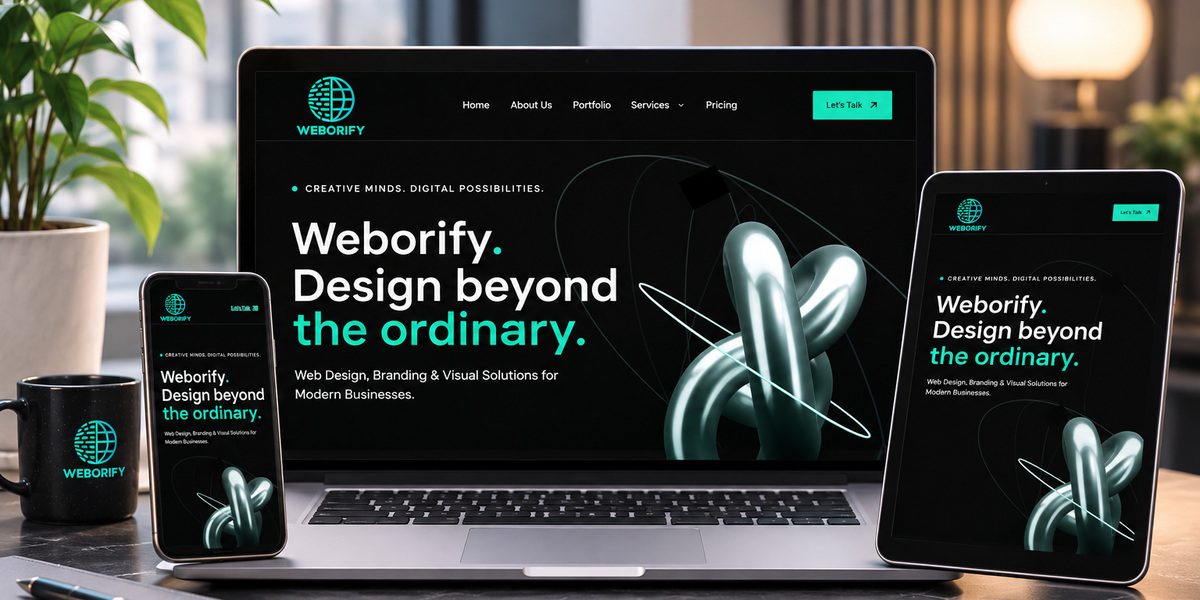

Exploring how Weborify connects design, technology, and creative communication in the evolving world of digital branding.
The Growing Importance of Creative Digital Identity
A brand is encountered through more than a name or a single logo. Color, type, imagery, movement, and tone combine to establish a recognizable visual character. These choices become especially visible when a brand appears across different digital formats. Weborify presents itself as a creative design studio with services covering branding, logo design, and visual production. Its public positioning places design, technology, and people in the same conversation, suggesting an interest in how visual identity can be expressed through contemporary digital media.
A Brand Inspired by Creativity and Modern Design
A coherent identity depends on decisions that can be carried from one application to another. A typographic style might establish the character of a headline, while an image treatment or color relationship helps connect otherwise different materials. Weborify describes a creative philosophy that brings design, technology, and people together. Within that framing, visual expression is not limited to decoration: it becomes part of how an organization presents itself and how audiences recognize its materials across contexts.
Exploring the Relationship Between Branding and Business Identity
Visual identity is shaped by the audience a business wants to reach and the setting in which its materials will appear. Weborify’s branding and logo design services describe attention to business goals, audiences, and industry context. Those considerations can inform choices about typography, imagery, color, and composition without predetermining a single creative solution. A flexible identity needs recognizable elements, but also enough range to work on screens, in presentations, and in other communications where the available space and viewing conditions differ.
How Visual Identity Adapts Across Digital Formats
A brand mark that works on a large presentation screen may need a simpler arrangement on a phone display. Similar adjustments arise when a visual style moves between a website, a digital presentation, and social graphics. Weborify lists website design and user interface design among its offerings, alongside branding services. The relationship between these disciplines is especially visible in decisions about scale, contrast, and visual consistency. A recognizable identity can remain coherent while its expression changes to suit the dimensions and purpose of each format.
Bringing Visual Storytelling Into Digital Communication
Static images, three-dimensional compositions, and motion graphics each communicate differently. An illustration can establish a mood through shape and color; a 3D treatment can introduce depth and material; motion can guide attention through timing and change. Weborify identifies graphic design, 3D design, and motion graphics within its public-facing creative work. These categories highlight the range of visual techniques available to a brand, while leaving room for the choice of medium to depend on the communication goal rather than on novelty alone.
Building Recognition Through a Consistent Design Language
Consistency does not require every piece of brand communication to look identical. It can come from a limited set of recurring choices: type styles, proportions, color relationships, illustration treatments, and rules for placing elements. A visual system gives designers a shared reference when producing materials for different uses. Weborify’s combination of branding, logo design, and graphic design services makes this an especially relevant creative consideration. The goal is a recognizable family of materials that can accommodate variation without losing its identity.
From Creative Direction to Finished Visual Assets
A visual concept begins to take shape when broad ideas become specific decisions about form, contrast, imagery, and layout. A single design direction may lead to different expressions: a logo treatment, a graphic composition, or an animated sequence. Weborify’s creative service categories span those formats. Examining the finished assets as a group helps reveal whether the design language remains recognizable across media. This is a question of creative coherence, distinct from the technical workflow used to build a website or manage a digital project.
Mobile Applications as a Canvas for Brand Expression
Mobile applications place a brand within a compact, frequently used interface. Icons, type, color, and transitions must communicate character while remaining readable at smaller sizes. Weborify lists mobile app development among its services. From a visual-identity perspective, an application offers another setting in which a brand’s established design language may be adapted to a particular medium. Its appearance must respond to practical constraints, but its visual details can still contribute to an overall sense of recognition.
Looking Ahead: Creativity as an Enduring Part of Digital Branding
Creative identity continues to evolve as visual formats and audience expectations change. Weborify’s published focus on branding, graphic design, motion, 3D work, and digital experiences offers a way to consider that evolution through the lens of design rather than through a catalog of marketing channels. What connects these disciplines is the effort to make an organization’s expression recognizable while allowing different media to communicate in their own ways.
Availability
For further information about Weborify’s approach to branding and creative design, visit its official website. Selected design updates can also be found on Facebook and Instagram.