

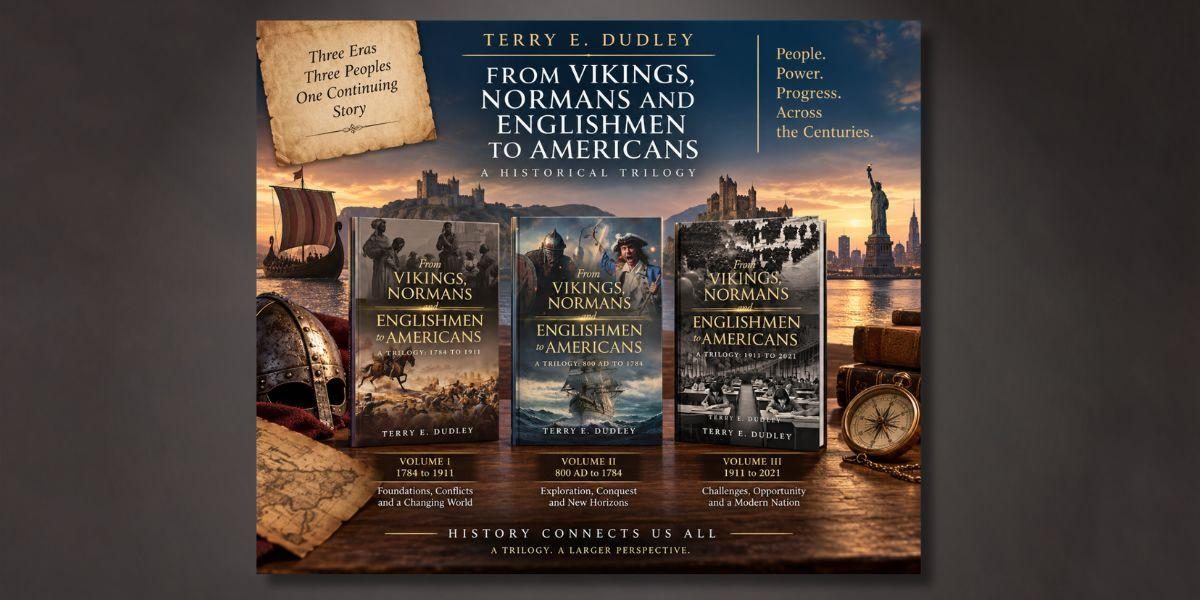

Genealogy becomes something much larger than a family tree in the work of Terry E. Dudley, whose ambitious three-volume series, From Vikings, Normans and Englishmen to Americans, connects personal ancestry with centuries of European, British, and American history.
Published in 2026, Dudley’s trilogy spans three major periods: 800 AD–1784, 1784–1911, and 1911–2011. Together, the books follow generations of one family across more than a millennium of conflict, migration, political change, cultural transformation, and the gradual formation of an American identity. Retail listings, including a Barnes & Noble product page, identify all three volumes as works by Terry E. Dudley and show their April 2026 publication.
Frankfurter Buchmesse 2026, held from October 7 to 11, gathered authors, publishers, rights professionals, historians, and readers from around the world. Dudley’s approach to genealogy fits naturally into a publishing environment built around stories that move across borders and generations. The fair describes itself as a major international meeting place for publishing and creative-industry professionals.
A Simple Question Becomes a Thousand-Year Journey
At the center of Dudley’s project is a question familiar to almost everyone who has looked at an old photograph, heard a family story, or searched a surname online:
How far back can our family roots really go?
According to the first volume’s description, Dudley began researching his family through interviews, family stories, and genealogy. When conventional research eventually reached its limits, DNA testing helped him move further into the past. Instead of presenting the results simply as names and dates, he decided to place his ancestors within the documented historical events surrounding them.
That decision gives the trilogy its distinctive scope.
This is not merely a record of births, marriages, and deaths.
It is an attempt to ask what history looked like from the perspective of the families actually living through it.
Book One: 800 AD–1784
The first volume begins centuries before the creation of the United States.
From Vikings, Normans and Englishmen to Americans, the first volume follows ancestral roots through medieval European and English history before gradually moving toward colonial America.
According to the book’s published synopsis, Dudley places his family line against events that include invasions of England, civil and political upheaval, warfare, interaction with royalty, religious conflict, migration to the American colonies, and eventually the struggle for independence during the American Revolution.
This structure turns genealogy into historical storytelling.
A surname becomes connected to a kingdom.
A migration becomes connected to religious or political upheaval.
A family relocation becomes part of the much larger movement of populations across the Atlantic.
By doing this, Dudley encourages readers to see history not simply as something involving kings, generals, presidents, and governments, but as something experienced by ordinary families.
From Vikings to Normans to Englishmen
The title itself describes an evolution.
Vikings.
Normans.
Englishmen.
Americans.
Each word represents not just a place or nationality but a different stage in a centuries-long story of identity.
The movement from one to another illustrates one of the trilogy’s most interesting ideas: family identity is rarely as simple as it appears in the present.
Go back far enough and borders change.
Nations change.
Languages change.
Religions change.
Communities migrate.
Political loyalties shift.
Yet family lines continue through those transformations.
Genealogy therefore becomes a way of observing history at human scale.
Book Two: America From 1784 to 1911
The second volume shifts the focus firmly toward the development of the United States.
The second volume, 1784–1911, begins with family members relocating from New England to North Carolina, placing them within the rapidly changing society of the Antebellum South.
The historical backdrop grows more complicated.
The family encounters the aftermath of American independence, the War of 1812, slavery, Free People of Color, social divisions, economic development, and later political and military conflicts that transform American life.
This period allows Dudley to explore another essential aspect of genealogical history:
Families do not exist outside the difficult parts of history.
They live inside them.
Their choices are influenced by the laws, prejudices, wars, economic opportunities, and social structures of their time.
That makes genealogy capable of revealing uncomfortable history as well as inspirational history.
Family History Without Removing Historical Context
One of the strengths of Dudley’s concept is his insistence on connecting ancestry with context.
Finding an ancestor’s name can be exciting.
But the name alone tells relatively little.
Where did that person live?
Who held political power?
Was the country at war?
What laws existed?
What social divisions shaped daily life?
What economic opportunities were available?
Why did the family move?
These questions transform genealogical data into narrative.
Dudley’s trilogy therefore offers readers something beyond the history of one surname. It demonstrates a method of thinking about ancestry, using documented history to understand why family events may have occurred when and where they did.
Book Three: 1911–2011
The third part of the trilogy brings the story into the modern era.
The third volume, 1911–2011, begins around the death of a family patriarch and follows another generation westward toward Arizona Territory and California.
The historical events now become increasingly familiar to modern readers.
The family experiences the era of World War I, the Roaring Twenties, and the Great Depression, among the major transformations of twentieth-century American life described in the book’s published overview.
This final period creates a particularly interesting effect.
The distant medieval world of the first volume gradually becomes recognizable modern history.
Vikings and Norman England eventually lead to twentieth-century America.
A story that began hundreds of years before the United States existed eventually reaches a period still connected to living family memory.
Genealogy as a Bridge Between Private and Public History
Most history books begin with major events.
Genealogy begins with people.
That difference changes the perspective.
A traditional history might describe an economic depression using unemployment statistics.
Family history asks what happened to a particular household.
A military history may explain the outcome of a war.
Genealogy asks which family members served, moved, survived, or never returned.
A history of migration may describe millions of people crossing borders.
A family record can reveal why one individual decided to leave.
Dudley’s trilogy works at the intersection of those two approaches.
The personal story helps readers enter the historical period, while recorded history helps explain the personal story.
DNA Changes the Way Families Can Explore the Past
Dudley’s work also reflects an important change in modern genealogy.
Family research once depended primarily on oral histories, church records, census documents, immigration records, military documents, newspapers, and government archives.
Those sources remain essential.
But DNA testing has opened another path.
Dudley’s own published description explains that DNA became important after more traditional research reached a barrier.
That experience will be familiar to many modern genealogy researchers.
Documents may disappear.
Names may be misspelled.
Records may have been destroyed.
Family stories can change as they pass between generations.
DNA cannot answer every historical question, but when combined carefully with documentary evidence, it can create new research possibilities.
The Trilogy Also Invites Readers to Investigate Their Own Families
Perhaps the most interesting element of From Vikings, Normans and Englishmen to Americans is that the story does not have to end with Terry E. Dudley’s ancestors.
The first volume explicitly presents genealogy, historical research, and DNA as methods readers can consider when exploring their own family histories.
That turns the trilogy into an invitation.
A reader may begin interested in Dudley’s ancestors and eventually start wondering about their own.
Who were their grandparents before they became grandparents?
Where did earlier generations live?
Why did they leave?
What historical events surrounded them?
Which family stories are accurate?
Which have changed?
And how far back might the evidence lead?
A Personal History Becomes Part of a Larger American Story
The trilogy’s title ends with “Americans,” but Dudley’s story demonstrates how complicated that word can be.
American families frequently contain histories that began elsewhere.
England.
Europe.
Africa.
Asia.
The Caribbean.
Latin America.
Indigenous nations already present on the continent.
Every migration produces another layer.
Dudley follows one particular ancestral route, but the broader concept applies to countless families: national identity often represents the latest chapter of a story that began somewhere else.
That makes genealogy inherently international.
Why This Kind of Story Fits Frankfurter Buchmesse
That international quality also made Dudley’s work relevant to the audience at Frankfurter Buchmesse 2026.
The fair brings together publishing experts, creative professionals, authors, journalists, and readers from across the world to discuss, negotiate, discover, and exchange stories.
A genealogy-based historical trilogy belongs naturally within that conversation because ancestry rarely respects modern borders.
Family histories move through nations.
They cross oceans.
They survive wars.
They encounter political revolutions and economic crises.
Eventually, individual family stories become pieces of national history.
Terry E. Dudley Turns a Family Tree Into a Historical Narrative
What began as Terry E. Dudley’s search for his ancestry ultimately expanded into three books covering more than a thousand years.
800 AD–1784 traces the earliest stages of the journey.
1784–1911 follows the family through the development and conflicts of the United States.
1911–2011 carries that story into the modern American era.
Taken together, the trilogy suggests that a family tree is not really a tree standing still.
It is a road.
Every generation moves it forward.
Some cross borders.
Some experience wars.
Some endure economic collapse.
Some build new lives thousands of miles from where their ancestors began.
And eventually, someone looks backward and tries to understand how all those journeys became one family.
That is the territory Terry E. Dudley explores in From Vikings, Normans and Englishmen to Americans, a project that transforms genealogy from a collection of names into a story of migration, survival, identity, and history itself.