
Religion has influenced the way people understand the world for centuries, shaping traditions, moral values, societies, and historical events. It has also inspired countless questions about belief, truth, human nature, and the relationship between faith and reason. Books exploring these subjects offer different perspectives, sometimes challenging familiar ideas and sometimes explaining how religious beliefs have developed over time.
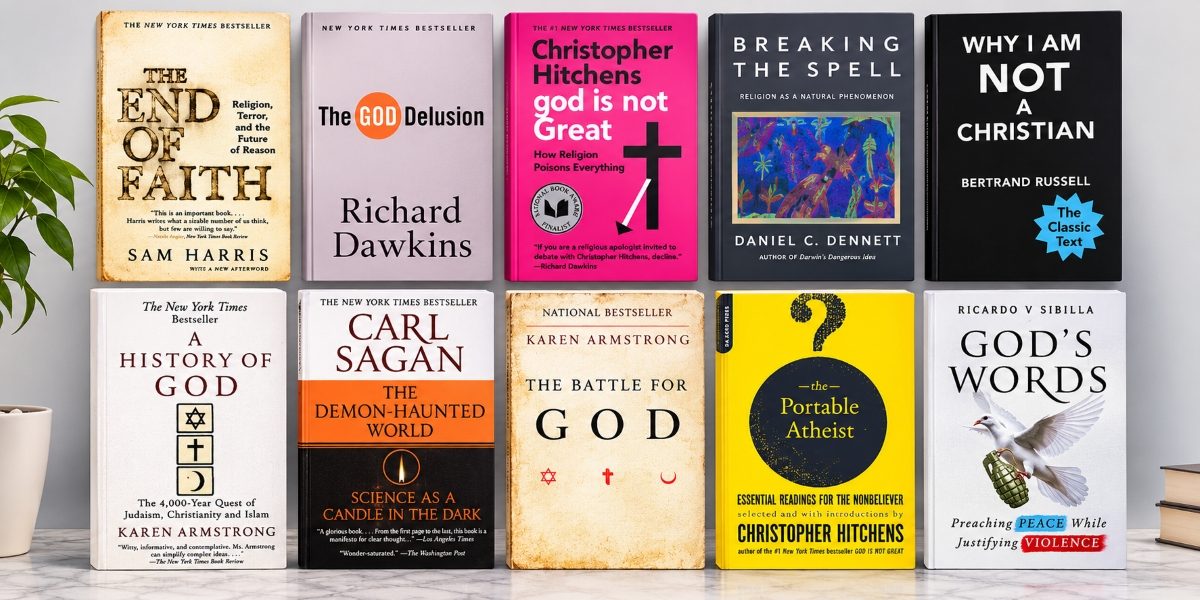
In The End of Faith, Sam Harris explores how religious certainty can influence individual behavior and contribute to social and political conflict. Richard Dawkins takes a scientific approach in The God Delusion, questioning the existence of God and examining why religious beliefs continue to hold such influence. Christopher Hitchens offers a sharper critique in God Is Not Great: How Religion Poisons Everything, discussing how religious institutions and doctrines have shaped societies throughout history. Although their approaches differ, all three books encourage readers to question accepted ideas and consider how faith influences the modern world.
Daniel C. Dennett examines religion from another angle in Breaking the Spell: Religion as a Natural Phenomenon, looking at how beliefs emerge, spread, and become part of human culture. Bertrand Russell’s Why I Am Not a Christian approaches religious questions through philosophy, using logic and reasoning to challenge traditional beliefs. Carl Sagan’s The Demon-Haunted World: Science as a Candle in the Dark broadens the conversation by exploring the importance of evidence, scientific understanding, and skepticism in everyday life. Each book offers a different way of thinking about how people form beliefs and decide what to accept as truth.
Karen Armstrong’s A History of God offers another perspective, tracing the changing understanding of God within Judaism, Christianity, and Islam. Her The Battle for God: A History of Fundamentalism examines how religious movements have responded to modernization and social change. Both books explore the historical circumstances that have shaped religious ideas, offering insight into why beliefs and traditions have evolved differently across cultures and generations.
Christopher Hitchens’ The Portable Atheist: Essential Readings for the Nonbeliever brings together influential writings that question religious authority and explore the value of independent thought. Ricardo Sibilla’s God’s Words: Preaching Peace While Justifying Violence addresses the apparent contradiction between religious teachings that promote peace and interpretations used to defend violence. These books approach religion through different forms of criticism, raising questions about morality, religious authority, and how beliefs influence human actions.
What makes these books interesting is not that they arrive at the same conclusions, but that they approach familiar questions from different directions. Some focus on scientific evidence and philosophical reasoning, while others examine historical events, religious traditions, and belief’s influence on society. Their arguments can be challenging, but they also encourage readers to think beyond established assumptions.
Together, these works offer a broader understanding of the debates surrounding religion, faith, morality, and critical thinking. Whether readers agree with the authors or question their conclusions, the books provide opportunities to explore different ideas and reflect on how beliefs continue to shape the world.