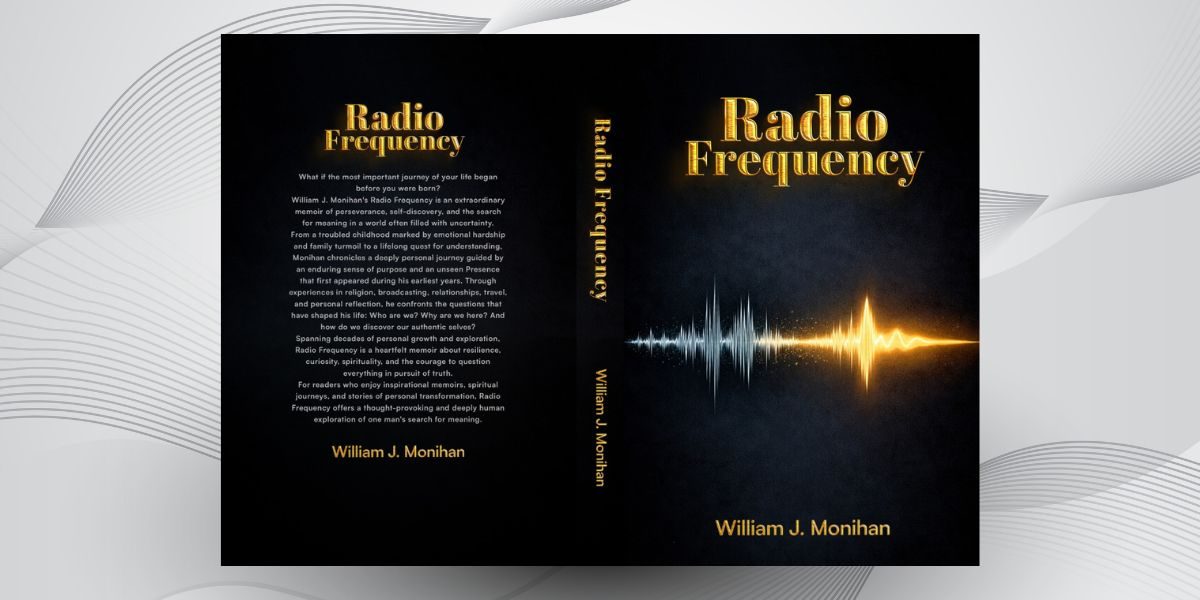

By: William J. Monihan
The Making of a Broadcaster
A San Francisco childhood, a stint in the Army, and a ninety‑mile drive to Salinas. How one turning point rarely looks like a victory in the moment.
Some life stories unfold in straight lines. William J. Monihan’s did not, and that’s precisely what makes it worth telling.
Bill was born at 4:15 in the morning on April 10, 1945, at St. Joseph’s Hospital in San Francisco, a building that would later be shuttered in 1979 due to seismic concerns. It’s a small, almost trivial detail, but it sets the tone for a life built in a city (and a country) that was constantly changing shape around him.
His early years were spent in motion. The family lived on Howth Street until 1946, when a new sister arrived and prompted a move. A stint on Hudson Street followed while their permanent home on Jeter Street was under construction, and about six months later, they finally settled in. Even kindergarten had its own quirk of individuality. At John Gill Kindergarten, five‑year‑old Bill spent his time not with blocks or picture books, but with a voice coach, an early and almost prophetic detail for a boy who would eventually make his living with his voice.
Formal schooling followed a more traditional path, at least on paper. In 1951, at six years old, he enrolled in grammar school at Our Lady of Mt. Carmel under the Sisters of Notre Dame, graduating eight years later in 1959. From there, he tried on a very different kind of life, enrolling that September in the Salesian Junior Seminary. It didn’t stick. He left the following August, a decision that, in hindsight, redirected the whole trajectory of his life. He landed at Sequoia Union High School that fall and graduated in June 1963.
Three months later, at eighteen, Bill joined the U.S. Army. He served from September 16, 1963, until his honorable discharge on August 30, 1966, spending more than thirty months of that stretch stationed in Germany. It was a formative chapter, though not one he lingered on for long once it ended.
Civilian life came quickly and unevenly. A family friend, Bill Hunter, helped him land a job at United Airlines in their stores department, a job that lasted barely three months before he was given an ultimatum: quit or be let go. He quit and headed for San Francisco, which he simply called “The City,” where he enrolled in Chris Borden’s Broadcasting School on Geary Street.
To pay his way through broadcasting school, he took a job driving a truck for Barnard Engineering in Redwood City, a company that installed automatic fire protection systems. That job ended, too, when he was fired after asking for a raise. Undeterred, he found work as a supply clerk for an encyclopedia company, and it was in that unglamorous role that he finally “graduated” from Chris Borden’s Broadcasting School.
The school’s job board became his gateway into the industry. One posting stood out: a radio announcing gig in Guam, paying $500 a month (a strong wage for 1967). But less than a year removed from his Army discharge and those thirty‑plus months overseas in Germany, Bill wasn’t ready to leave the country again.
So he looked closer to home. After finishing his shift at the bookstore at five o’clock, he’d drive ninety miles down to Salinas to audition for radio jobs. One offer came in at a dollar fifty an hour, fifty cents less than what he was already making as a supply clerk. On paper, it was a pay cut. But when the station offered him the mid‑day shift, he said yes without hesitation.
That decision, trading a steady paycheck for a shot at the microphone, marked the true beginning of Bill Monihan’s broadcasting career. It’s a reminder that the biggest turning points in life rarely look like victories in the moment. Sometimes they look like a ninety‑mile drive after a long shift, and a pay cut you take anyway, because you already know what you’re chasing.
Monihan tells the fuller version of that story in his memoir, Radio Frequency.