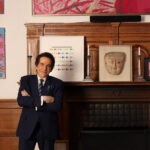

Kevin Frost’s Deaf, Blind Champion is a memoir built around a powerful contradiction. It tells the story of profound loss while constantly widening the reader’s sense of possibility. Frost, who lives as a DeafBlind person after hearing loss and progressive vision loss caused by Usher Syndrome, writes about disability with directness, pride, humour, and urgency. His book is not merely about personal achievement. It is about how people, institutions, and communities respond when human ability does not fit the standard design of the world.
One of the strongest ideas in the memoir is that disability is not only a medical condition. It is also shaped by environment. Frost’s early life was marked by hearing loss, speech therapy, hearing aids, and the need to learn communication differently. But he also makes clear that many barriers came from the world around him: schools, public spaces, social attitudes, technologies, and systems that were not designed with disabled people in mind.
This distinction is central to contemporary disability advocacy. A person may have an impairment, but exclusion often happens because society fails to accommodate that impairment. Frost’s childhood experiences show this clearly. He had to adapt constantly, but the larger world did not always adapt with him. The responsibility for access was placed heavily on the individual.
Later, when Frost began losing his vision, the stakes became much higher. The diagnosis of Usher Syndrome did not simply add another medical term to his life. It forced a complete re-evaluation of work, mobility, family responsibility, sport, and identity. He could no longer drive. He could no longer continue parts of the life he had known. He had to face the emotional reality of becoming DeafBlind while also confronting practical questions of survival and independence.
What is remarkable is not that Frost immediately became positive. The book is more honest than that. He experienced fear, grief, and crisis. The turning point came through support, especially from medical professionals, the CNIB, family, and others who helped him begin to understand that his life was not over. This is one of the memoir’s most important lessons. Resilience is not produced in isolation. It is often made possible by timely support.
Sport then becomes the field where Frost’s adaptation becomes visible and measurable. His journey through hockey, refereeing, speed skating, rowing, tandem cycling, and golf illustrates how disabled athletes are not defined by absence of ability. They are defined by a different relationship to ability, communication, risk, and trust.
In speed skating, for example, Frost’s success depended on disciplined training and a coach willing to see him as a high-performance athlete. That approach matters. Many disabled people are limited not by their own lack of ambition, but by other people’s lowered expectations. Frost’s coach did not remove the demand for excellence. He changed the way excellence was communicated and pursued. That is inclusion in its most practical form.
The same principle appears in tandem cycling. A DeafBlind cyclist depends on a pilot, but dependence does not eliminate athleticism. The rider still needs endurance, strength, discipline, and courage. The relationship between cyclist and pilot is one of trust at speed. It is an intense example of something true in all inclusive systems: access works best when people communicate clearly, respect one another’s roles, and commit to shared success.
Blind golf adds another layer. Golf is often seen as a sport of vision, reading distance, terrain, direction, and subtle movement. Frost’s participation in blind golf challenges that assumption. With guidance and adaptation, the sport becomes about feel, technique, patience, and partnership. Once again, the book shows that disability does not necessarily remove participation; it requires redesigning the path into participation.
The memoir is also powerful in its portrayal of guide dogs, particularly Nemo and Lewis. Frost helps readers understand that a guide dog is not simply a working animal. For a DeafBlind person, a guide dog can represent safety, autonomy, companionship, and confidence in public space. These chapters also reveal how ignorance can turn ordinary errands into confrontations when businesses fail to understand service dog rights.
This is where Frost’s memoir becomes more than inspirational. It becomes instructive. It asks readers to look at the systems they participate in every day. Are schools accessible? Are workplaces flexible? Are sports organizations truly inclusive? Do businesses understand service dog laws? Do public officials listen to disabled citizens? Do communities treat disabled people as full participants or as exceptions?
Frost’s advocacy is rooted in lived experience. He has not simply thought about accessibility in theory; he has moved through the world needing it. That gives his call to action authority. He urges readers to contact representatives, speak up, support disability organizations, and take seriously the principle that disabled people must be included in decisions about disability.
Another important theme is service. Frost’s achievements are not presented as private trophies. He connects them to fundraising, motivational speaking, advocacy, and helping others access technology and opportunity. In doing so, the memoir resists the individualistic version of inspiration that focuses only on personal success. Frost’s version of success is communal. Achievement matters most when it opens doors for someone else.
The book also challenges common stereotypes about disabled life. Frost does not present himself as helpless, nor does he pretend to be superhuman. Both stereotypes can be harmful. Instead, he presents himself as fully human: determined, grateful, frustrated, humorous, proud, vulnerable, competitive, and compassionate. This balanced self-portrait is one of the reasons the memoir feels authentic.
For readers without disabilities, Deaf, Blind Champion offers perspective. It reveals the invisible labour of adaptation and the importance of accessible systems. For readers with disabilities, it may offer recognition and encouragement without denying the reality of struggle. For coaches, educators, employers, and policymakers, it offers a practical message: do not confuse difference with inability.
The arena in Frost’s book is not only the sports arena. It is the arena of daily life, where every person eventually faces uncertainty, limitation, loss, or change. Frost’s life demonstrates that adaptation is not a lesser form of living. It is one of the highest expressions of human intelligence and courage.
By the end of the memoir, inclusion no longer feels like a polite social goal. It feels urgent, practical, and necessary. Kevin Frost’s story reminds us that when barriers are removed, people do not simply survive. They compete, lead, teach, love, advocate, and become champions in arenas the world once tried to close.