
By: Kate Sarmiento
One teacher recently shared a moment that stuck with her: a student corrected part of a lesson on prime numbers, then walked the class through the logic behind it. What stood out was not that the student caught the mistake, but that they could clearly explain the reasoning behind it. They were not memorizing steps; they actually understood the math itself.
Teachers tend to remember moments like that. Students who genuinely understand math usually sound different when they explain it. They also tend to stay calmer when the problem changes slightly instead of immediately second-guessing themselves.
But a lot of classrooms still reward speed first. Finish the worksheet, get the right answer, move on. The system looks fine on paper because the grades are there. Meanwhile, many students freeze the moment a formula looks different or a problem breaks from the pattern they practiced. They know the steps. They just don’t always know why those steps work.
That gap is part of why programs like Spirit of Math continue standing out to families looking for something beyond traditional tutoring. Originally developed inside Canadian public school classrooms more than 30 years ago, Spirit of Math was built around the idea that high-performing students need real intellectual challenge to stay engaged. Students are expected to explain their thinking out loud, defend their reasoning, and sit with unfamiliar problems long enough to get comfortable being uncomfortable.
Things Get Interesting Once the Formula Stops Working
One of the clearest ways to see the difference is how students react once a familiar pattern disappears. Most can handle a formula they’ve practiced ten times. The difficulty comes when the problem shifts slightly, and there’s no obvious procedure to reach for, and that’s usually when reasoning gaps become visible.
Students who learn conceptually tend to retain information longer, apply knowledge more flexibly, and adapt better in unfamiliar situations (Source: Heliyon, 2023). Real-world problems rarely arrive with tidy textbook formatting and comforting instructions underneath, which is why reasoning, discussion, and collaborative problem-solving are such central parts of the classroom experience at Spirit of Math.
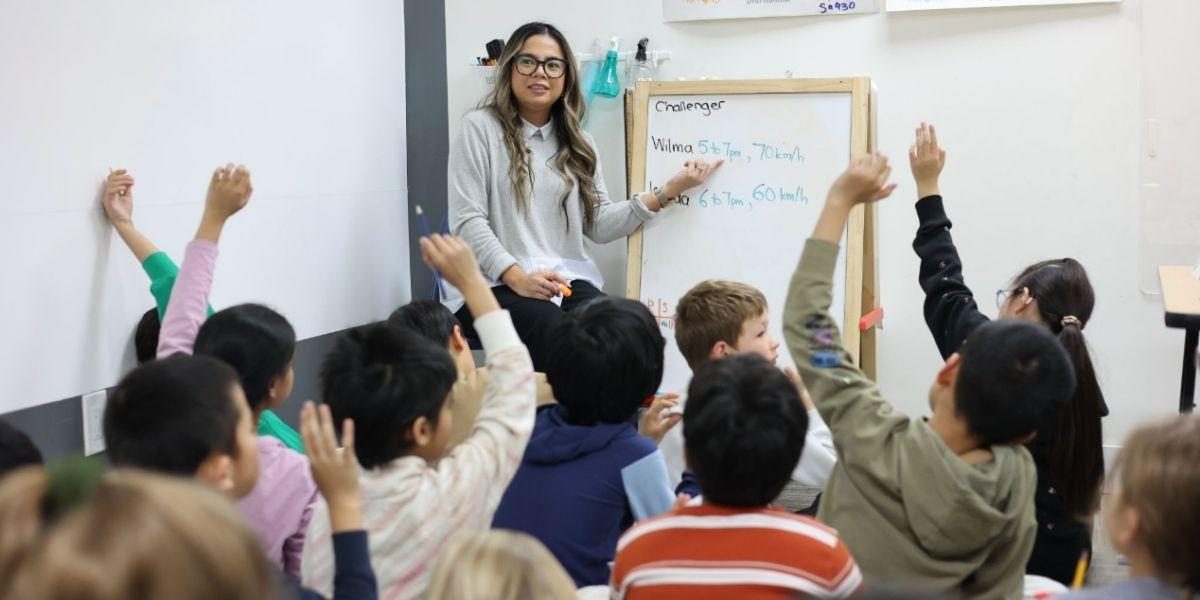
In these classrooms, students are expected to show how they arrived at an answer instead of simply giving one. That means:
• explaining their reasoning out loud
• defending solutions in front of classmates
• challenging each other respectfully during discussions
Some struggle with that initially, since they’re used to environments where silence is treated as good behavior, and speed is rewarded over depth. Over time, though, many begin approaching problems differently. A student who once waited nervously for permission starts volunteering explanations. Another begins spotting logical flaws independently, or asking follow-up questions the textbook never anticipated.
Parents often describe this as watching their child become more confident. But the deeper shift is really about intellectual ownership. Students stop treating learning like temporary information storage and start engaging with it more actively.
Most students entering the program already perform well in school and typically hold at least a B+ average before acceptance. They are not there because they are failing. They are there because many traditional classrooms stop stretching high-performing students long before those students reach their actual capacity.
Children usually notice the lack of challenge faster than adults realize. A bright student forced to repeat concepts they mastered months earlier can gradually disconnect from learning altogether. Some become disruptive in class, while others turn into anxious perfectionists. Some simply stop trying very hard because they realize they can still earn excellent grades while remaining mentally disengaged.
That kind of disengagement becomes a much bigger issue in a world increasingly shaped by AI and automation. The OECD has repeatedly emphasized the importance of reasoning, critical thinking, and problem-solving skills as modern careers demand greater adaptability and analytical thinking (Source: OECD, 2017).
Information is now instantly accessible, and AI tools can generate explanations within seconds. The real advantage comes from knowing how to question, interpret, and apply information, which is difficult to develop through passive memorization alone.
Turns Out… Smart Students Still Need Challenges
One of the stranger myths in education is the idea that high-performing students automatically succeed without needing much support. Good grades can make everything look fine underneath, even when advanced students have never really learned how to struggle.
Many grow attached to being “the smart kid” instead of developing the resilience to struggle through something difficult. Then the first genuinely hard problem appears, and the emotional reaction can feel surprisingly intense. Some panic, some avoid the problem altogether, and others spiral over a single incorrect answer because they are not used to sitting with uncertainty long enough to work through it.
That is part of why Spirit of Math intentionally creates productive friction inside the classroom. Students move through a rigorous 39-week curriculum designed to push reasoning ability beyond standard grade expectations, while classes combine drills, advanced curriculum work, collaborative discussion, and difficult problem solving in ways that require persistence rather than instant perfection.

Teachers don’t simply hand students methods and hope they memorize them. Students are expected to wrestle with concepts, communicate their reasoning clearly, and keep refining their thinking, which gradually changes how they relate to difficulty. Many stop seeing struggle as a sign they’re failing and start recognizing it as part of the process.
The effects often extend far beyond mathematics. Researchers continue finding strong links between reasoning-based instruction and long-term academic confidence because students who understand underlying concepts tend to develop stronger transfer skills across subjects (Source: Springer Nature, 2025). Students trained to think carefully in one area often become more adaptable thinkers overall.
Parents often notice those changes outside academics, too. Children become more patient while solving problems, more articulate during discussions, and more willing to explain ideas instead of hiding uncertainty. Some even become more collaborative socially because they spend so much time practicing group reasoning and peer discussion inside the classroom environment.
Over time, many parents realize the confidence developing here feels different from the kind built purely through praise. Students who build confidence through actual competence usually become more comfortable handling uncertainty, making mistakes, and working through challenges independently.
Ready to Challenge Your Child Beyond the Worksheet?
There is a reason Spirit of Math uses the tagline “Releasing the Genius.” The program was built around the idea that many students already possess far more curiosity, reasoning ability, and intellectual potential than adults often realize. The problem is that a lot of classrooms accidentally train those instincts out of them by rewarding speed, repetition, and quiet compliance over deeper thinking.
Information is now everywhere, AI tools can generate answers within seconds, and memorization alone is becoming less valuable by the year. The students who will stand out long term are usually the ones who can reason through uncertainty, communicate clearly, and keep thinking even when there is no obvious formula waiting for them.
For parents looking for something beyond repetitive worksheets, rushed tutoring sessions, and classrooms that stop challenging students too early, Spirit of Math offers an environment where high-performing children are pushed to think more deeply, communicate more confidently, and approach difficult problems with curiosity instead of fear.
Because eventually, the students asking the hardest questions often become the ones shaping the future answers.